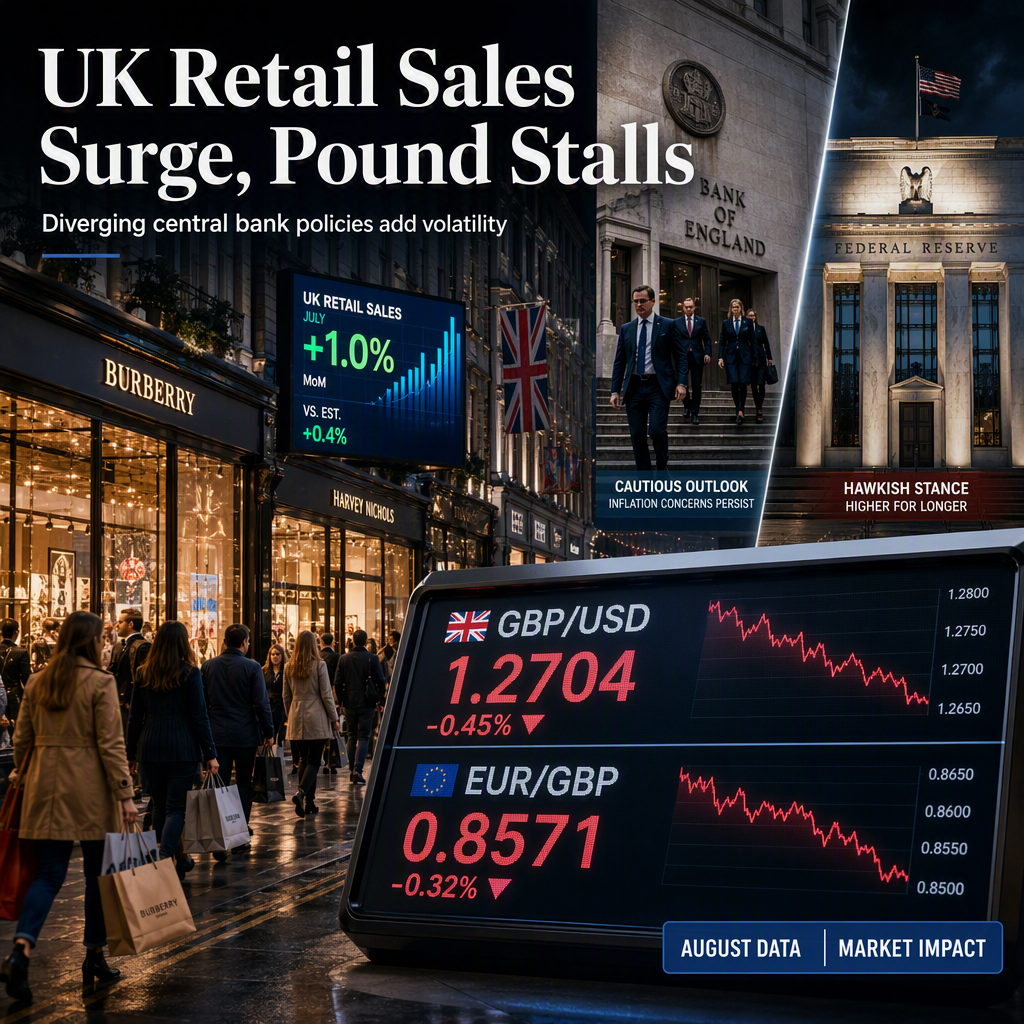
UK Retail Sales data for August showed a stronger-than-expected rebound, with sales rising 0.5% month-over-month, reversing July's 0.5% decline and beating market forecasts for a 0.2% drop [1][2]. On an annual basis, retail sales surged 2.4%, surpassing the projected 1.9% growth rate and the prior month's revised figure of 1.2% [1]. Excluding fuel, sales of all other products rose 0.6%, also outperforming the anticipated 0.2% decline [2].
Despite this positive data, the British Pound (GBP) struggled in currency markets. Against the Euro, the Pound gained, pushing EUR/GBP down to around 0.8590 after three days of Euro gains, as the strong UK retail sales data provided momentum for the GBP [1]. However, against the US Dollar, GBP/USD remained weak, trading at 1.3370 and on track for a 1.15% weekly decline, weighed down by diverging monetary policy decisions between the Federal Reserve and the Bank of England (BoE) [2].
The BoE left its Bank Rate unchanged at 3.75%, with three committee members voting for a hike, mirroring July’s split [2]. BoE Governor Andrew Bailey indicated that further tightening might be necessary if the Middle East conflict persists and second-round inflation effects emerge, but these comments did not provide significant support to the Pound [2]. In contrast, the US Federal Reserve adopted a more hawkish stance, raising rates by 25 basis points to the 3.75%-4% range and signaling a strong focus on inflation, which boosted the US Dollar as markets priced in a nearly 90% chance of another hike this year [2].
In Germany, producer prices rose 4.6% year-on-year in August, exceeding expectations of 4.1% and accelerating from July's 3.0% gain, marking the fastest annual pace since April 2023 [1]. On a monthly basis, producer prices increased 1.1%, matching July's rate and surpassing the expected 0.4% rise [1]. ING economists noted that eurozone industrial production has grown for four consecutive months, supported by Europe's comparative advantage over Asia and increased defense spending, despite global headwinds [1].
Analysts at UOB Group commented that GBP remains at risk of further downside, though conditions are deeply oversold. They noted that a breach of resistance at 1.3435 would indicate stabilization, but any sustained recovery would require overcoming this technical hurdle [2].
CONCLUSION
Despite a robust rebound in UK retail sales, the British Pound failed to gain significant traction, particularly against the US Dollar, due to diverging central bank policies and ongoing market uncertainty. Strong German producer price data and resilient eurozone industrial production add further complexity to the currency landscape. Market sentiment remains cautious, with analysts highlighting technical resistance levels and the potential for further volatility.