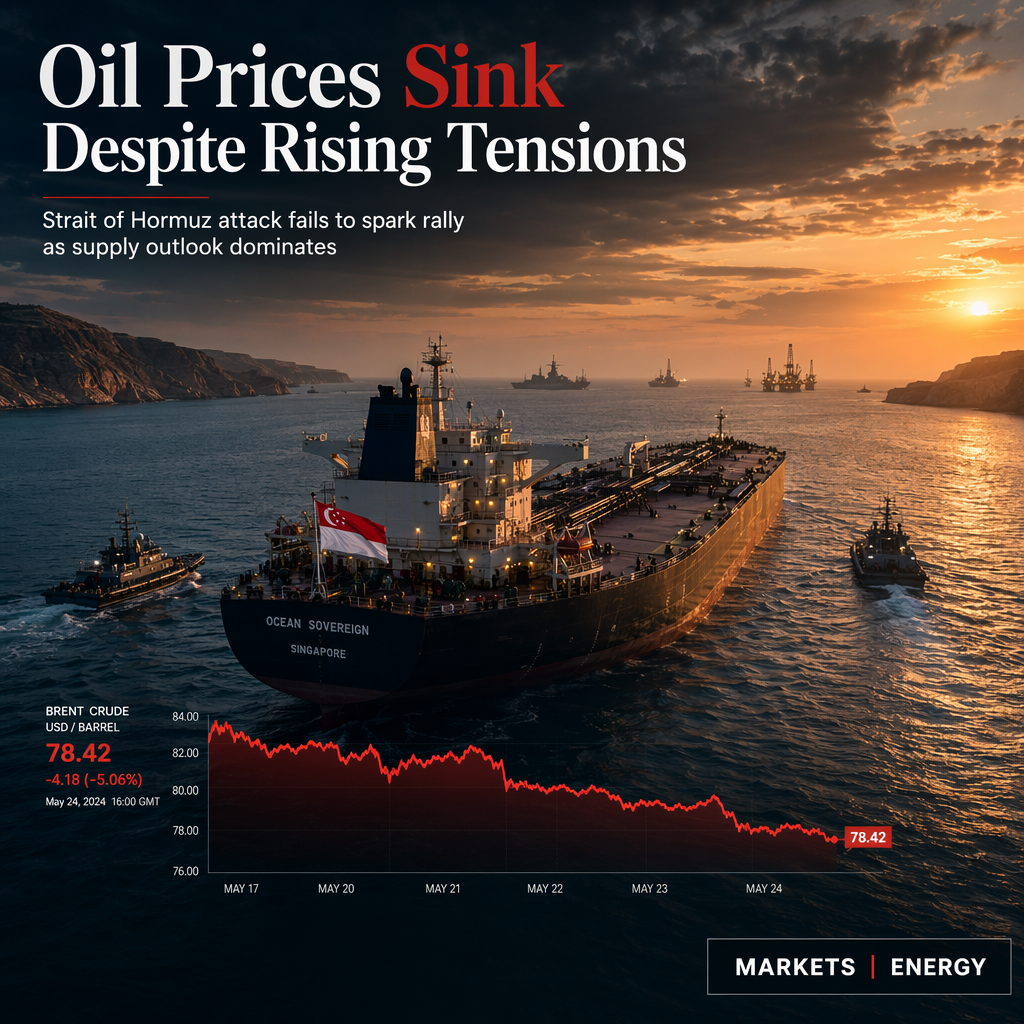
Oil prices fell sharply on Friday, with Brent crude futures for August dropping 1.89% to $73.84 a barrel and U.S. West Texas Intermediate futures for August declining 1.92% to $70.54 per barrel, as investors shifted focus from escalating Middle East tensions to the broader supply outlook [1]. The decline came despite news that a cargo ship sailing under a Singapore flag was attacked near the coast of Oman in the Strait of Hormuz, with a U.S. official attributing the incident to Iran [1]. The United Kingdom Maritime Trade Operations reported no casualties or environmental damage from the attack [1].
Diplomatic efforts are ongoing, with the International Maritime Organization (IMO) temporarily pausing its evacuation plan to reconfirm safety guarantees for ships in the region, according to secretary-general Arsenio Dominguez [1]. Tensions between Iran and the U.S. remain high, particularly over the use of Iranian assets covered under a memorandum of understanding. The speaker of Iran's parliament rejected U.S. claims that unfrozen assets would be used to buy American agricultural products, while U.S. officials insisted that any released funds would remain subject to American approval [1]. Vice President JD Vance stated that if Iranian assets are released, they will be used to purchase American agricultural products to feed the Iranian people [1].
Market analysts expressed skepticism about the effectiveness of recent agreements. Scott Nations, president of Nations Indexes, commented that "there is so much still that is to be questioned about the actual agreement. I think we're being too optimistic, because nothing really has been resolved, and Iran knows that they have the world economy where they want it if they want to shut down the strait" [1].
In addition to geopolitical risks, OPEC faces internal challenges. The United Arab Emirates, OPEC's second-largest producer, exited the cartel in May, and Iraq has reportedly sought a higher production quota, warning the group it could leave if its demands are not met [1].
CONCLUSION
Despite heightened geopolitical risks in the Middle East, oil prices declined as investors prioritized the broader supply outlook and ongoing diplomatic efforts. Unresolved tensions between Iran and the U.S., as well as uncertainty within OPEC, continue to pose risks to market stability. Analysts remain cautious, highlighting that key issues have yet to be resolved.