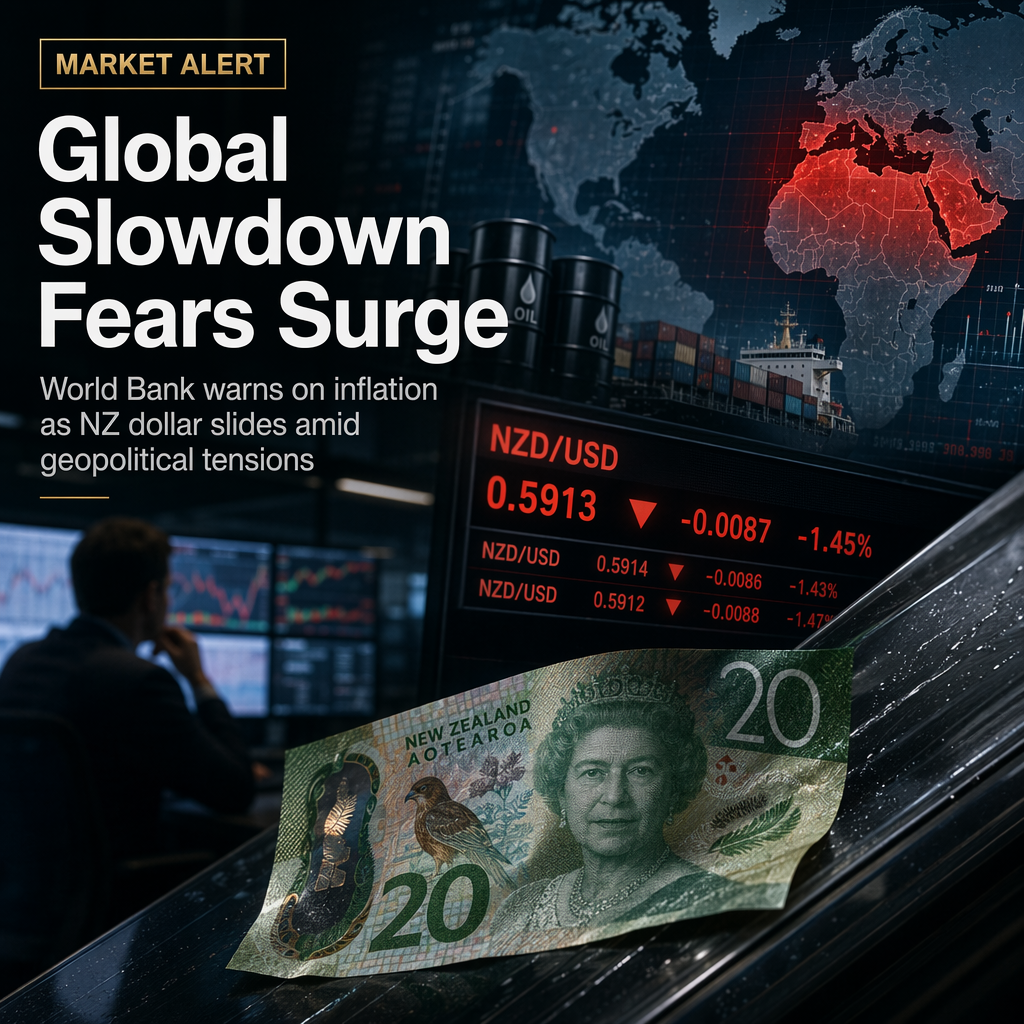
The World Bank has issued a warning that the global economy could be only 'a few months' away from a worst-case scenario, in which global growth slows to 1.3% and inflation rises to 4.5%, according to Chief Economist Indermit Gill. This scenario could be triggered by an escalation of the Middle East conflict and further supply disruptions, which would intensify inflationary pressures and potentially force central banks to keep interest rates higher for longer [1]. The World Bank also highlighted that debt vulnerabilities have accumulated over the years, leaving developing economies particularly exposed, with some countries potentially requiring debt relief. While major economies such as the US, China, and India are largely shielded from the impact of a potential Iran war, developing countries with high debt levels face greater risks [1].
In currency markets, the US Dollar Index (DXY) remained relatively stable, hovering around 101.15 on Wednesday, with the US Dollar showing the strongest performance against the New Zealand Dollar (NZD), which fell by 0.11% on the day [1]. The New Zealand Dollar extended its losing streak for the fifth consecutive day, trading around 0.5810 during European hours, as global risk aversion overshadowed a hawkish outlook from the Reserve Bank of New Zealand (RBNZ) [2]. Despite New Zealand's annual inflation accelerating to 4.1% in Q2—up from 3.1% in Q1 and above both market expectations and the RBNZ's forecast—NZD/USD remained subdued due to heightened risk aversion stemming from escalating geopolitical tensions between the United States and Iran [2].
The hot inflation reading in New Zealand, the highest since Q4 2023, has reinforced market expectations for another RBNZ rate hike in September, following the central bank's July 8 rate increase, its first in three years [2]. RBNZ Chief Economist Paul Conway has warned of sticky inflation, further boosting expectations for policy tightening. However, the broader risk-off sentiment in global markets has weighed on the NZD, as investors seek safety in the US Dollar [2]. According to the CME FedWatch Tool, markets are currently pricing in over 69% odds of at least a 25 basis-point rate hike at the upcoming September Federal Reserve meeting, though the Fed is widely expected to keep rates unchanged for now [2].
The World Bank also noted that developing economies could benefit from productivity gains driven by artificial intelligence, which will be the focus of its forthcoming Development Report [1].
CONCLUSION
The World Bank's warning of a potential global slowdown and renewed inflation, combined with escalating geopolitical tensions, has led to increased risk aversion in financial markets. This environment has pressured the New Zealand Dollar despite strong domestic inflation data and expectations for further RBNZ tightening, while the US Dollar remains stable. Market participants remain cautious, closely monitoring developments in global risks and central bank policy outlooks.