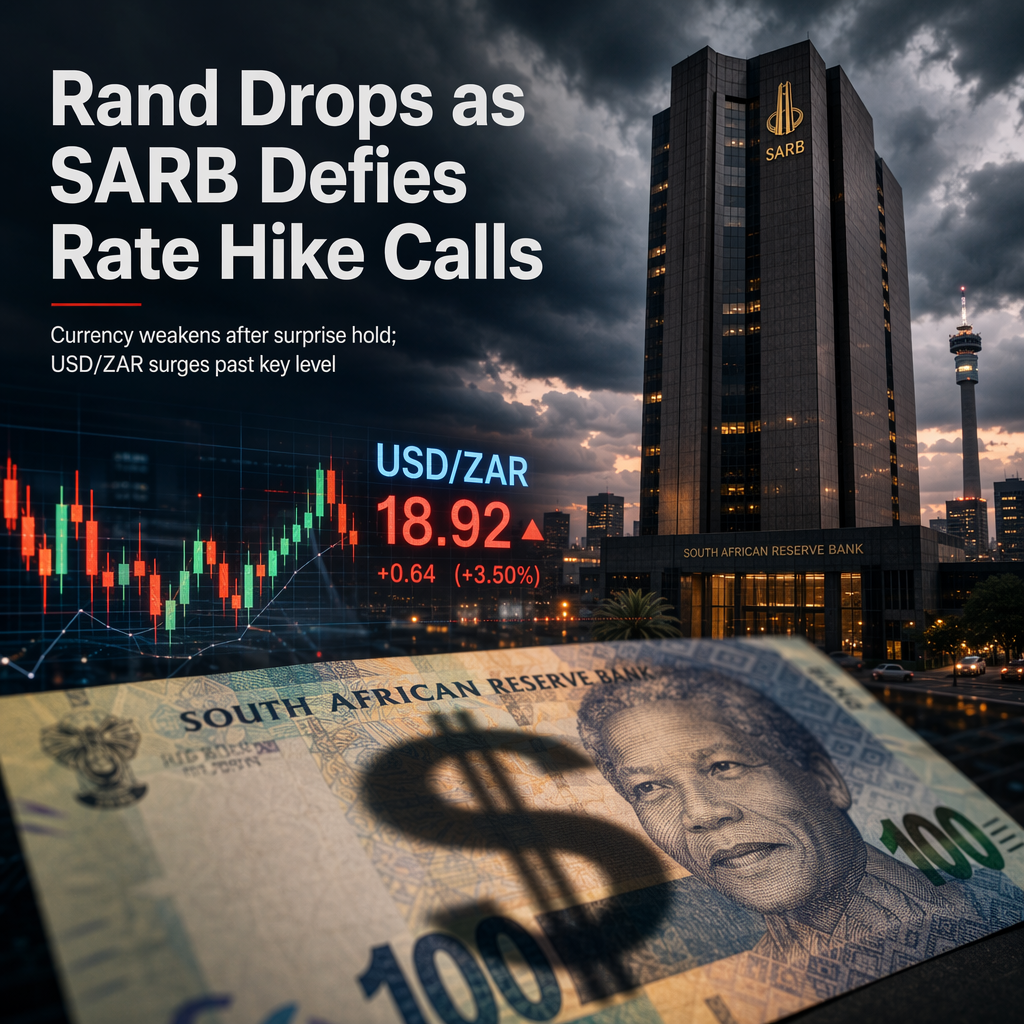
The South African Rand resumed its weakening trend after the South African Reserve Bank (SARB) surprised markets by keeping its policy rate unchanged at 7.0%, with a 4-2 vote, despite expectations for a rate hike [1]. Following the announcement, the USD/ZAR currency pair broke above a multi-month descending trend line and reclaimed its 200-day moving average at 16.5920 for the first time since early April, indicating renewed upside momentum for the US dollar against the Rand [1].
Societe Generale analysts highlighted that key support for USD/ZAR is now seen at the 200-day moving average around 16.57/16.50, with upside targets at 16.92, 17.25, and 17.58/17.72. The late April high at 16.92 is identified as the first hurdle, and a break above this level could extend the uptrend toward the March peak at 17.25 and further projections near 17.58/17.72 [1].
On the macroeconomic front, headline CPI in South Africa rose to 5.0% year-over-year in June, while core inflation edged up to 4.1%, marking the fourth consecutive monthly increase from the 3% low recorded in February [1]. The SARB revised its inflation forecast lower for 2026 but still expects inflation to remain above target through 2028. Governor Kganyago stated that the effects of the May tightening are still feeding through the economy and noted that weak growth remains a concern [1].
The technical breakout above the 200-day moving average and the SARB's unexpected decision have contributed to the Rand's renewed weakness, with analysts emphasizing the importance of defending the 16.57/16.50 support level for any potential reversal [1].
CONCLUSION
The South African Rand weakened sharply after the SARB unexpectedly held rates steady, defying market expectations for a hike. Technical and macroeconomic signals suggest further upside for USD/ZAR, with analysts watching key resistance and support levels closely. Persistent inflation and weak growth remain central concerns for policymakers and market participants.