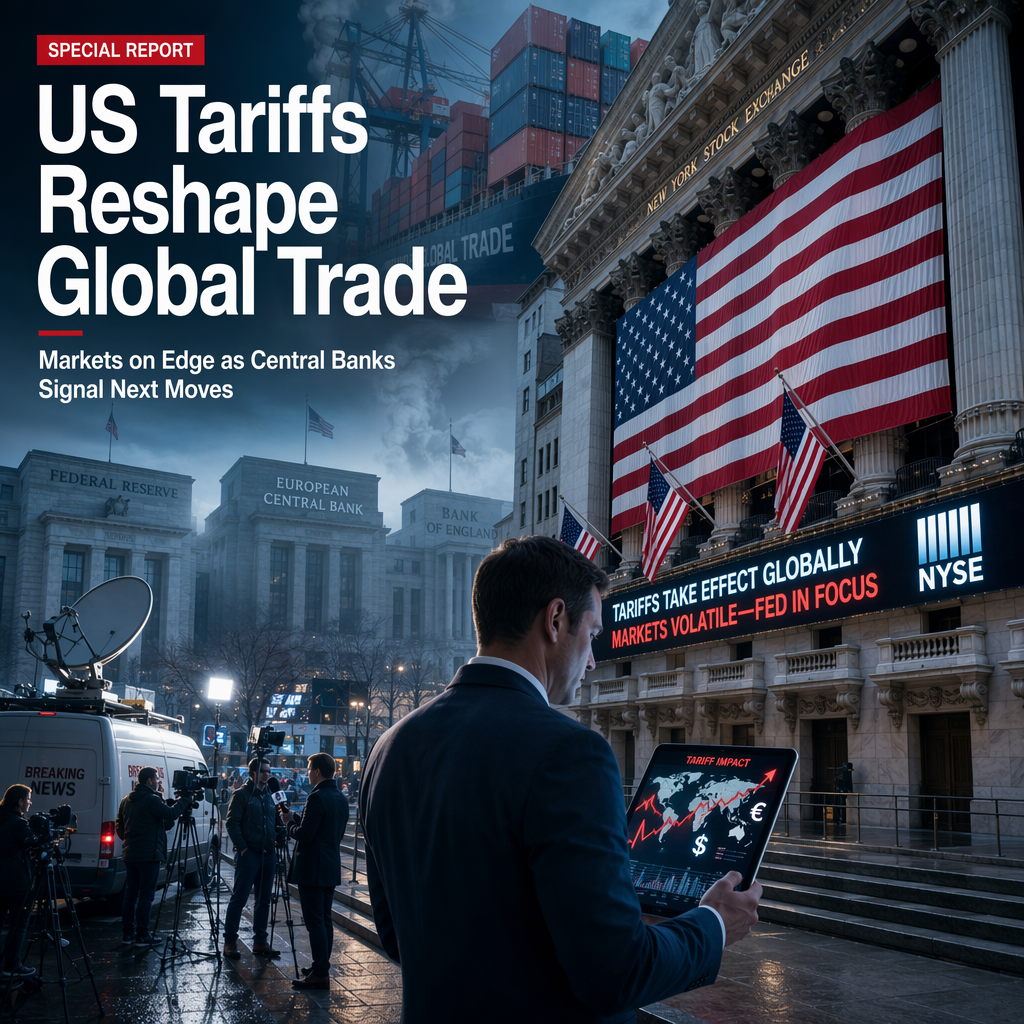
The United States implemented new tariffs on imports from 60 trading partners at rates between 10% and 12.5%, effective Friday, July 24, at 12:01 a.m. Eastern, coinciding with the expiration of previous temporary tariffs. Counting EU member states separately, the measures cover more than 80 countries and 99.4% of all US imports. The administration describes the move as a forced-labor crackdown, utilizing Section 301 of the Trade Act of 1974 after the Supreme Court struck down the prior tariff regime in February. Mexico, the UK, Canada, and India received the lighter 10% rate for adopting or committing to forced-labor import bans, while the EU and Taiwan are capped at 10% and Japan, Switzerland, and South Korea at 12.5% per existing agreements. Fuel, food, fertilizers, cars, metals, and drugs are exempt, as are goods from Canada and Mexico under the North American trade agreement. No countries have announced retaliatory tariffs yet, though New Zealand, Australia, Singapore, and Japan have publicly objected. A Canada-specific tariff could take effect August 19 if no agreement is reached [1][4][5][6].
The new tariffs have contributed to heightened inflation concerns, especially as oil prices surged nearly 8% this week due to Middle East tensions threatening major shipping routes. These factors, combined with strong US economic data—such as the S&P Global Composite PMI rising to 53.6 in July from 51.9 in June—have reinforced expectations that the Federal Reserve may need to raise interest rates. According to the CME FedWatch Tool, markets now see an 80% chance of a rate hike in September, while the Fed is widely expected to keep rates unchanged at its July 28-29 meeting [4][5].
In the Eurozone, the ECB kept its deposit facility rate at 2.25% as expected, but shifted its language to describe inflation risks as 'tilted to the upside,' signaling a higher likelihood of a rate hike in September. The July 23 press conference revealed that while the decision to hold was unanimous, some Governing Council members considered a hike. The Eurozone's preliminary Composite PMI rose to a five-month high of 51.9 in July, beating expectations. Markets are pricing in nearly 75 basis points of ECB tightening over the next year, with a 90% probability of a 25bps hike at the September 10 meeting. However, renewed oil price gains and US Dollar strength have kept EUR/USD under pressure, with the pair trading near a three-week low around 1.1377 [2][3][4].
The Canadian Dollar remains steady against the US Dollar, with USD/CAD trading around 1.4095. While slightly better fundamentals and narrowing spreads have provided some support, ongoing tariff uncertainty and comments from PM Carney about possible Canadian retaliation if no agreement is reached to avoid 50% tariffs next month have kept the CAD from gaining ground. The Canadian Industrial Product Price Index fell 1.4% MoM in June, and the Raw Material Price Index dropped 6.9%, reinforcing expectations that the Bank of Canada may maintain a more accommodative stance than the Fed [5][6].
In the UK, the Bank of England is expected to keep the Bank Rate at 3.75% at its July 30 meeting and hold steady through 2026, despite market pricing for possible further tightening. Softer inflation and wage growth argue against hikes, but higher energy prices and geopolitical risks keep the possibility of a later rate increase alive. Rabobank notes that monetary policy is likely to respond only if a lasting energy shock feeds into wages, prices, or expectations [7].
CONCLUSION
The US's sweeping new tariffs have intensified global trade tensions, fueling inflation concerns and influencing central bank outlooks. While the Federal Reserve, ECB, and Bank of England are all signaling caution, the prospect of further rate hikes remains on the table amid strong US data and rising energy prices. Market sentiment is cautious, with currencies like the Euro and Canadian Dollar under pressure as investors await further policy signals and potential retaliatory actions.