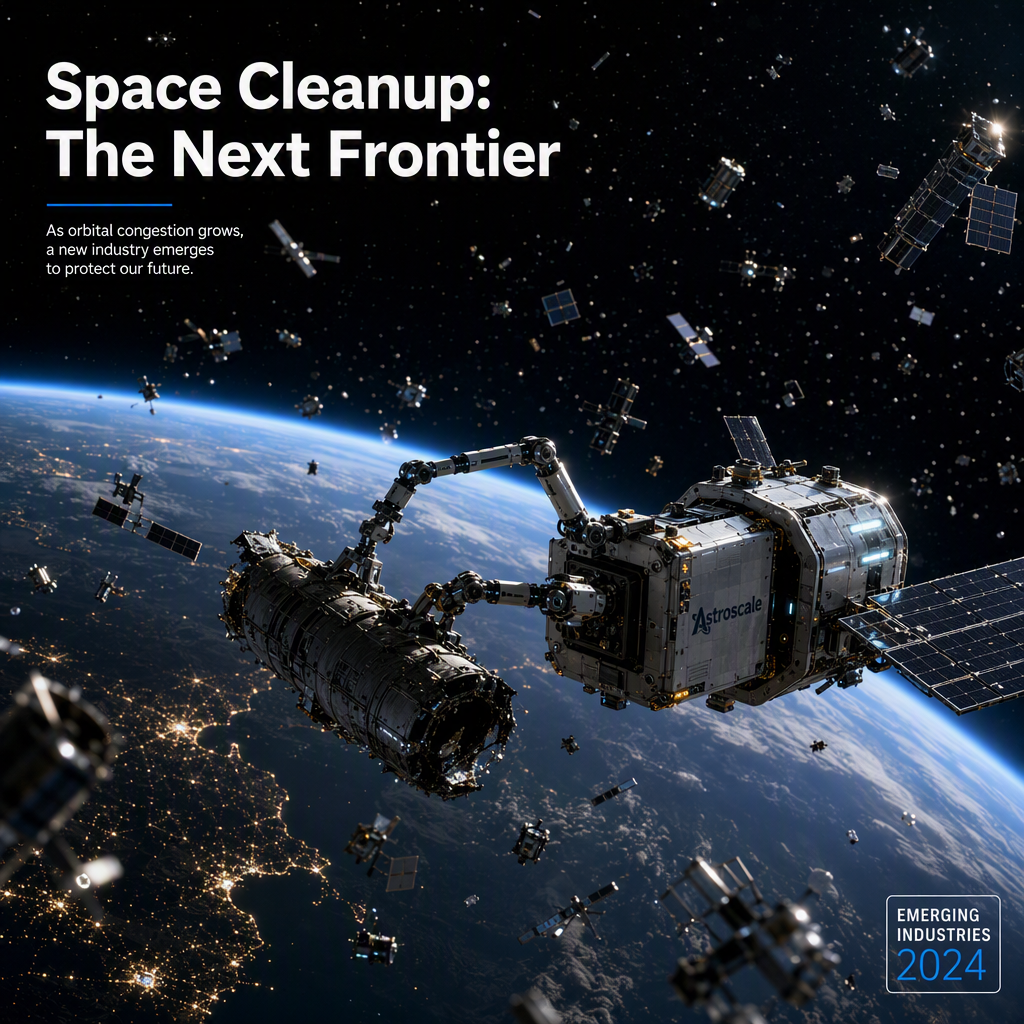
The space surrounding Earth is becoming increasingly crowded due to the growing number of satellites and space debris, which raises the risk of collisions and threatens the sustainability of orbital operations [1]. Companies such as Astroscale and ClearSpace are positioning themselves to capitalize on this challenge, betting that debris removal will evolve into a broader business encompassing satellite servicing, repairs, and life extension [1]. The industry is still in its early stages and is largely supported by government initiatives, with regulation expected to play a pivotal role in fostering commercial demand [1].
Currently, nearly 30,000 objects are tracked in space, with about 18,500 being active satellites and the remainder consisting of debris fragments or spent rocket bodies, according to OrbitRadar [1]. The problem is exacerbated by incidents such as a spent SpaceX Falcon 9 upper stage crashing into the moon after being left on an uncontrolled trajectory, highlighting the long-term risks posed by abandoned space hardware [1]. Experts warn that even if no new satellites are launched, the amount of debris will continue to increase because objects are fragmenting faster than they naturally re-enter the atmosphere, potentially rendering certain orbits unusable [1].
Andrew Faiola, commercial vice president at Astroscale, emphasized the urgency of addressing space debris, stating, "Space is a global commons, and we're mucking it up. We do need to clean it up. There are consequences to just sort of having a throwaway culture in space" [1]. Tim Flohrer, Head of Space Debris at the European Space Agency, echoed concerns about the exponential growth of debris and its impact on orbital safety [1]. Active satellites are now required to perform an increasing number of collision-avoidance maneuvers to mitigate the risk posed by other satellites and fragments [1].
Space infrastructure has become foundational for the global economy, supporting critical functions such as financial transactions, GPS navigation, weather forecasting, and missile tracking [1]. The growing congestion and risk of collisions underscore the importance of developing solutions for debris removal and satellite servicing, with the potential for this sector to become a significant business as regulatory frameworks and commercial demand evolve [1].
CONCLUSION
The escalating issue of space debris is prompting the emergence of a new industry focused on orbital cleanup and satellite servicing. While the market remains nascent and government-backed, companies and experts see significant growth potential as regulation and commercial demand increase. The sustainability of space infrastructure is crucial for the global economy, making debris removal a market-moving topic.