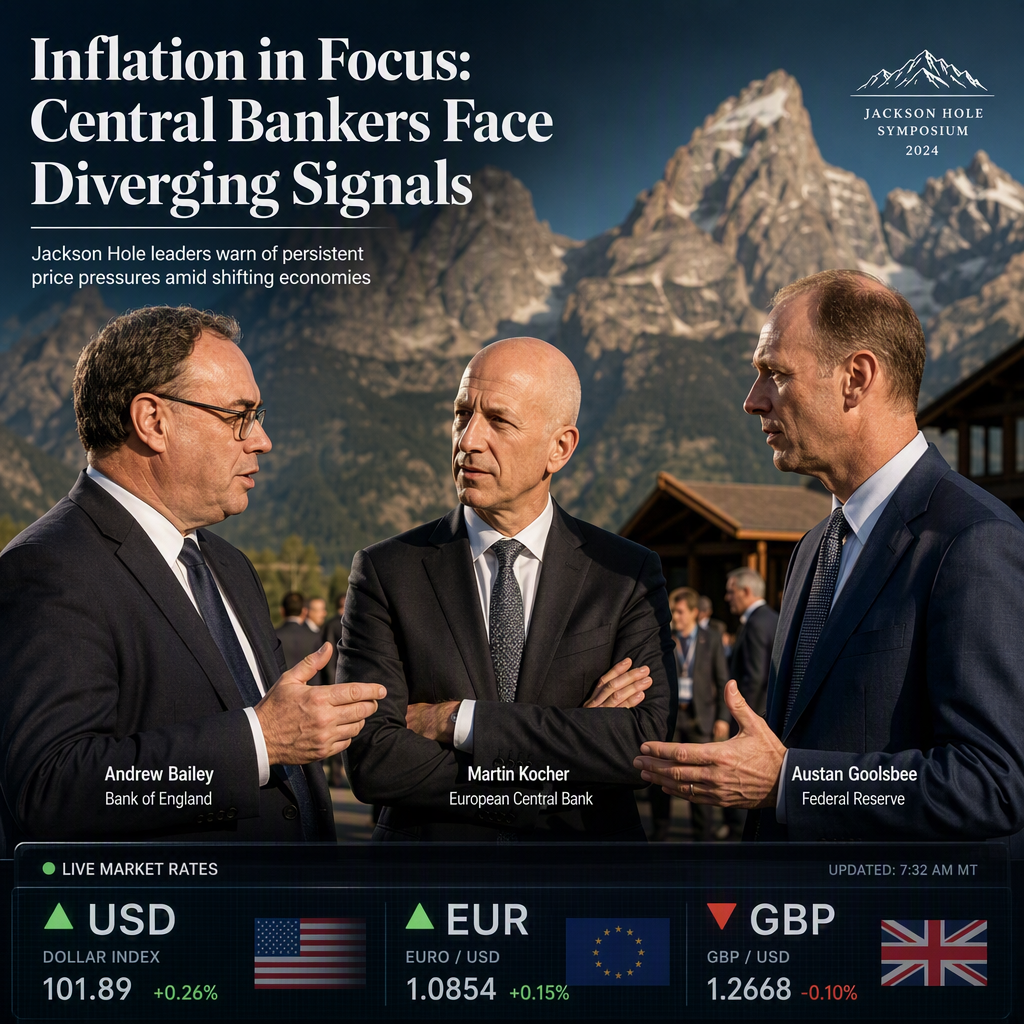
At the Jackson Hole Symposium, central bank officials from the Bank of England (BoE), European Central Bank (ECB), and the US Federal Reserve (Fed) highlighted inflation as a persistent and central concern for their respective economies. BoE Governor Andrew Bailey stated that the UK is experiencing 'quite subdued second-round effects' of inflation and noted a softening labor market, suggesting a cautious, data-dependent approach ahead of the BoE's monetary policy meeting on September 17. Bailey emphasized that the BoE is not pre-committed to any interest rate path and will assess the situation meeting by meeting, adding, 'We are seeing, at the moment, relatively muted second-round inflation effects,' but cautioned that he cannot promise this will continue [1].
In the Eurozone, Austrian National Bank Governor and ECB member Martin Kocher remarked that Europe's economy is showing more momentum and has been more resilient than expected. However, he warned that threats to price stability remain, and stressed the importance of monitoring how long-lived inflation proves to be. Kocher highlighted that there is 'alertness and no complacency' within the ECB regarding inflation risks [2].
From the US, Chicago Fed President Austan Goolsbee identified inflation as the Fed's main issue, noting that it has persisted longer than anticipated and is difficult to address when driven by overheated demand. Goolsbee expressed support for the Fed's decision to hold rates steady at the July FOMC meeting and stated he does not have a strong opinion on the number of FOMC meetings. He also clarified that he does not believe the Fed and Treasury are at cross purposes [3].
Currency market data from all three sources indicate that the US Dollar, Euro, and British Pound were each the strongest against the New Zealand Dollar on the day of reporting. The British Pound showed a 0.46% gain against the US Dollar, while the Euro gained 0.46% against the US Dollar, and the US Dollar gained 0.63% against the Euro [1][2][3]. These movements reflect ongoing market sensitivity to central bank communications and inflation outlooks.
CONCLUSION
Central bankers at Jackson Hole underscored inflation as the dominant challenge, with each region facing unique economic dynamics. While the BoE and ECB signal caution and vigilance, the Fed remains focused on persistent inflation. Currency markets responded with notable strength in the US Dollar, Euro, and Pound, highlighting the high market impact of central bank guidance.