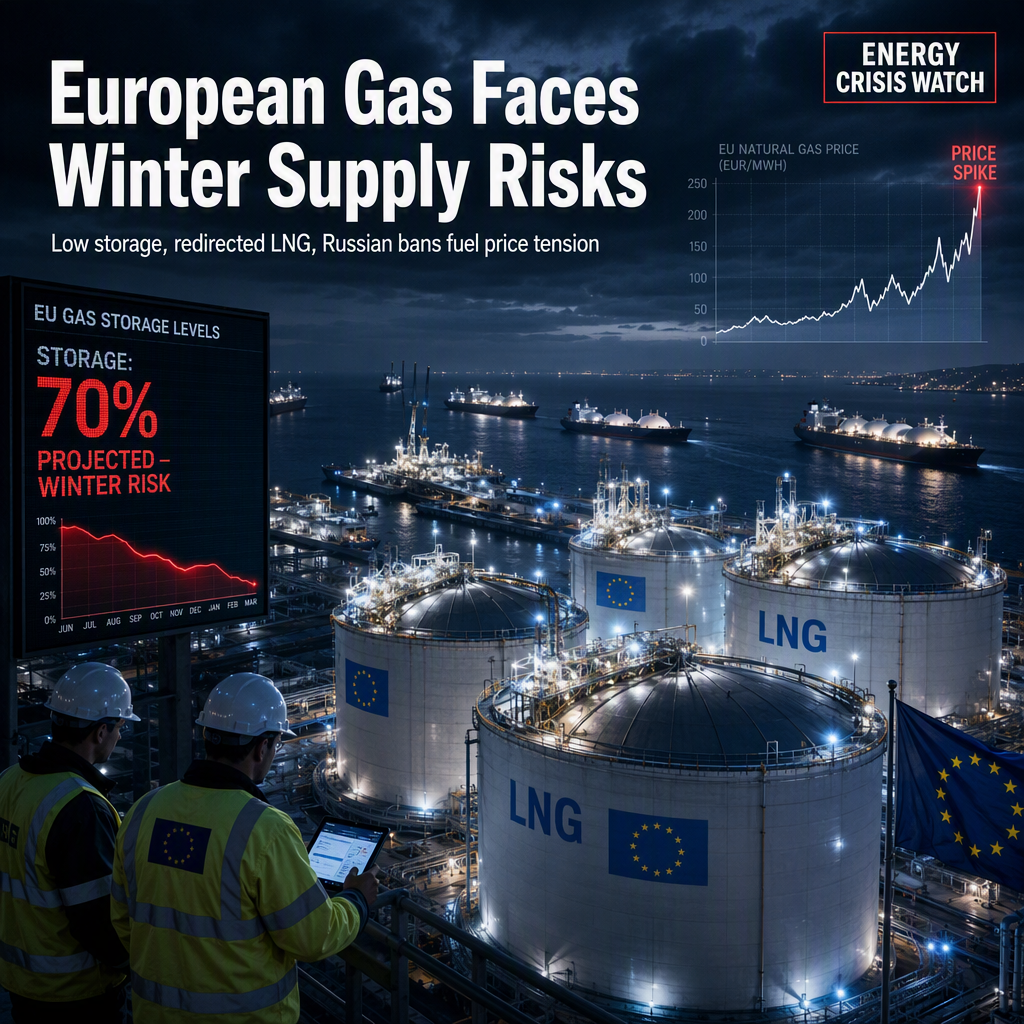
Commerzbank’s Norman Liebke highlights that the European natural gas market is experiencing a tighter structural balance compared to oil, primarily due to the cutoff of Qatari LNG and the redirection of US LNG cargoes to Asia. This shift has led to increased strain on the European market, as reflected in recent price trends. Since the price decline in June, which was triggered by the framework agreement between the US and Iran, oil and gas prices have decoupled, with gas prices showing greater resilience to downward pressure [1].
A key concern is the historically low gas storage levels in Europe, which are currently about 17 percentage points below the five-year average. Under current circumstances, storage levels are projected to barely reach 70% by the start of the heating season, raising risks for winter supply security [1]. The European Commission is increasingly dependent on LNG imports to meet winter demand, but this strategy carries significant price risks. The El Niño weather phenomenon is expected to boost gas demand in Asia in the coming weeks and months, potentially exacerbating the supply tightness in Europe as more LNG cargoes are diverted away from the continent [1].
Further compounding the situation, the EU has decided to ban Russian LNG imports starting early next year and pipeline gas imports from Russia beginning in the fall of 2027. These policy measures are likely to prolong the divergence between oil and gas prices and maintain upward pressure on European gas prices in the foreseeable future [1].
CONCLUSION
The European natural gas market is facing significant supply and storage challenges due to redirected LNG flows, low storage levels, and upcoming bans on Russian imports. These factors are expected to sustain price risks and keep the market structurally tight heading into the winter season.