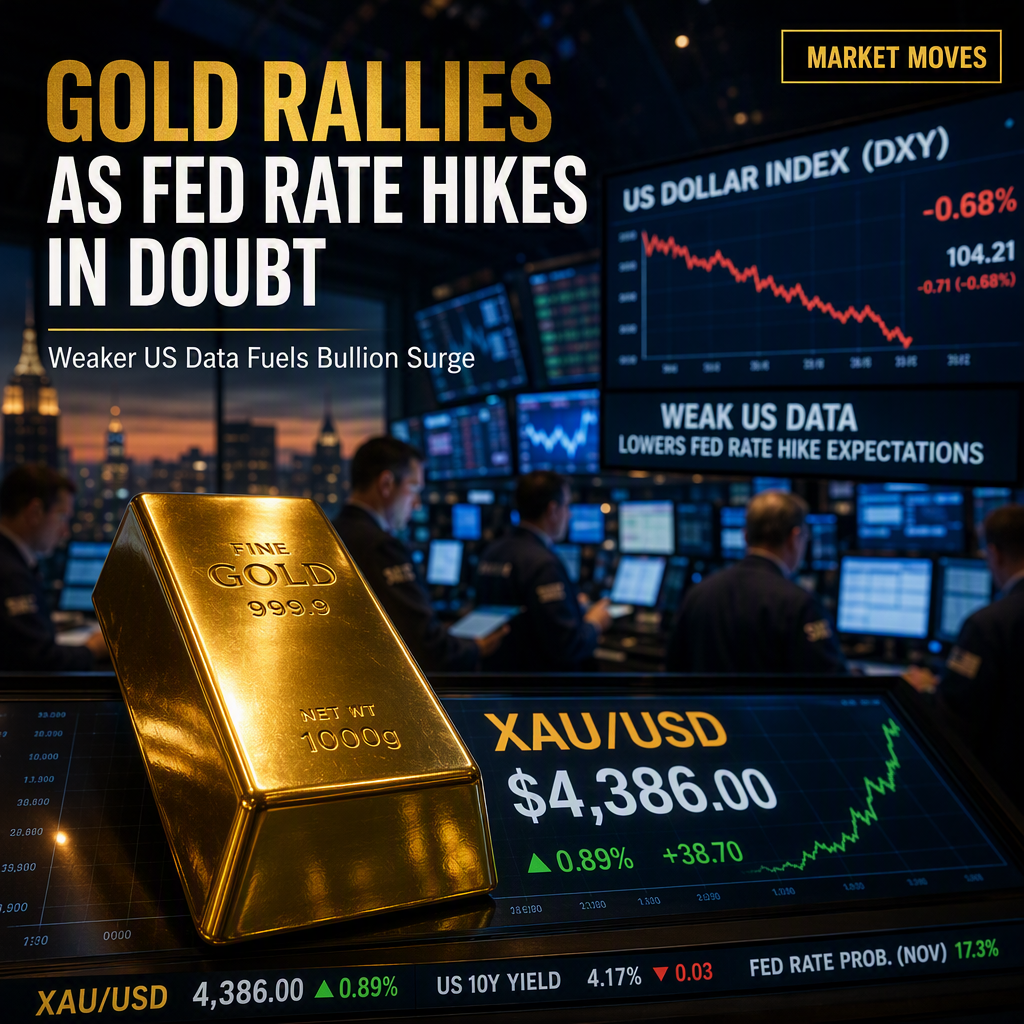
Gold prices rallied on Friday, registering solid gains of nearly 0.90%, as the US Dollar weakened broadly following a week of softer US inflation data, which reduced the likelihood of a Federal Reserve rate hike in September [1]. XAU/USD traded at $4,386, remaining just below the $4,400 threshold [1]. The US Dollar Index (DXY) fell 0.4% to 99.57, as investors trimmed hawkish bets on the Fed ahead of its September meeting [1].
Key economic data contributed to the US Dollar's decline: US Retail Sales ended a five-month growth streak by falling 0.6%, missing expectations for a 0.1% increase, while the Control Group sales, used to calculate consumer spending in GDP, dropped 0.4% after a 0.4% rise in June, according to the US Commerce Department [1]. The University of Michigan Consumer Sentiment index deteriorated from 55.2 to 51.0 in August's preliminary reading, with one-year inflation expectations rising from 4.2% to 4.3% and five-year expectations steady at 3.3% [1].
The swaps market reflected these developments, assigning a 31% probability to a rate hike at the September Fed meeting, down from roughly 55% the previous week, according to Prime Terminal data [1]. The fall in US yields also supported gold prices, with the US 10-year Treasury yield up 3.5 basis points to 4.684% [1].
From a technical perspective, gold is expected to consolidate around the 100-day Simple Moving Average (SMA) at $4,386, with bullish momentum indicated by the Relative Strength Index (RSI). However, buyers have not decisively surpassed the $4,400 level, suggesting potential for a pullback [1]. For further upside, XAU/USD must break above $4,400, which would expose the $4,450 level and the 200-day SMA at $4,504 [1]. On the downside, support lies at the day's low of $4,311, with further levels at $4,300, $4,202, $4,146, and $4,100 [1].
Looking ahead, next week's US economic docket includes housing data, the ADP Employment Change 4-week average, jobless claims, and Flash PMIs, which could further influence gold prices and Fed expectations [1].
CONCLUSION
Gold's rally was driven by weaker US economic data and a decline in Fed rate hike expectations, leading to a softer US Dollar and increased demand for bullion. Technical indicators suggest consolidation near current levels, with upcoming US economic releases likely to shape the next move. Market sentiment remains cautiously bullish as investors await further data.