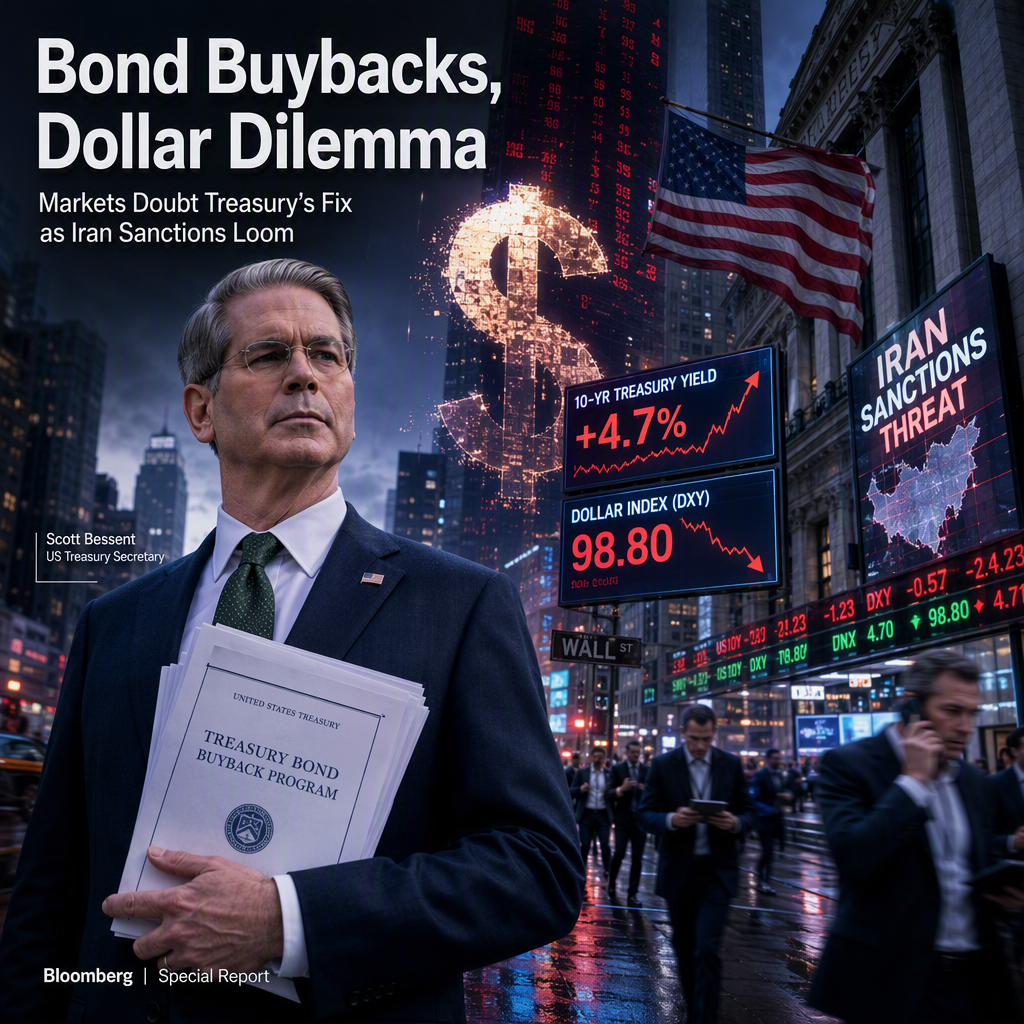
The US Treasury, led by Secretary Scott Bessent, announced plans to expand its long-end bond buyback program, potentially exceeding the initial $4 billion per issue, in an effort to curb elevated yields and address liquidity concerns in the 30-year bond market [1][6]. Despite this intervention, US Treasury yields quickly resumed their upward trajectory, with the 10-year yield steady at 4.7% and long-dated yields marching toward multi-decade highs [1][6]. The US Dollar Index (DXY) remained under pressure, trading around 98.80 and staying slightly above its three-month low of 98.50, after losing about 0.8% on a trade-weighted basis following the Treasury's announcement [1][2][3]. EUR/USD rose above 1.17 for the first time since May, with UOB and Commerzbank analysts suggesting further upside toward 1.1725, barring a break below 1.1615 [3][5]. The Dollar was notably weakest against the Swiss Franc, down 1.5% for the week [2].
Market participants and analysts expressed skepticism about the lasting impact of the Treasury's buyback expansion. Evercore ISI warned the move could backfire, Jefferies called it a "hastily made decision," and JPMorgan noted the potential for higher risk premia, likening the strategy to "paying your mortgage with your credit card" [6]. Commerzbank's Volkmar Baur and Christoph Rieger emphasized that such interventions are unlikely to deliver durable results without a convincing fiscal plan to reduce US debt, highlighting structural risks for the Dollar and the importance of fiscal credibility [3][4]. DBS Group Research echoed that tweaks around buybacks can only have a small, transient impact on markets, given the US budget is set by Congress [2].
Geopolitical tensions further weighed on sentiment, as Washington prepared an "economic D-day" initiative to severely restrict Iran's economy, targeting banks, shipping registries, cash transfers, and smuggling networks. The measures, set to be formally announced on Monday, are expected to reinforce inflation concerns and bolster Federal Reserve rate hike bets, with analysts warning of unintended consequences such as higher inflation expectations and yields [1][2][4]. Treasury Secretary Bessent stated that maximum economic pressure on Iran could reduce the need for significant military intervention [1].
Equity markets reacted negatively to the developments. Wall Street pulled back, with the S&P 500 and Nasdaq Composite dropping 0.9% and 1% respectively on Thursday, leaving the S&P 500 down 1.9% and the Nasdaq off by 2.5% for the week. The Dow Jones Industrial Average fell 1.8% week-to-date, on track for back-to-back weekly losses [6]. Asian stocks showed mixed performance, with gains in South Korea's KOSPI index (boosted by Samsung Electronics and SK Hynix) and Hong Kong's Hang Seng, while Japan's Nikkei 225 and China's Shanghai Composite posted losses or muted moves [4].
Forward-looking statements from Bessent included his belief that the US budget deficit has likely peaked under President Trump, topping $432 billion in July, and that the US can "grow our way out" of its $40 trillion debt pile, though analysts remain unconvinced about the sustainability of this approach [1][6].
CONCLUSION
The US Treasury's expanded bond buyback failed to deliver lasting relief for the Dollar or yields, with skepticism from analysts and market participants about its effectiveness. Rising geopolitical tensions and looming Iran sanctions are expected to reinforce inflation concerns and keep upward pressure on yields. Equity markets have responded negatively, and the Dollar remains vulnerable amid structural fiscal risks.