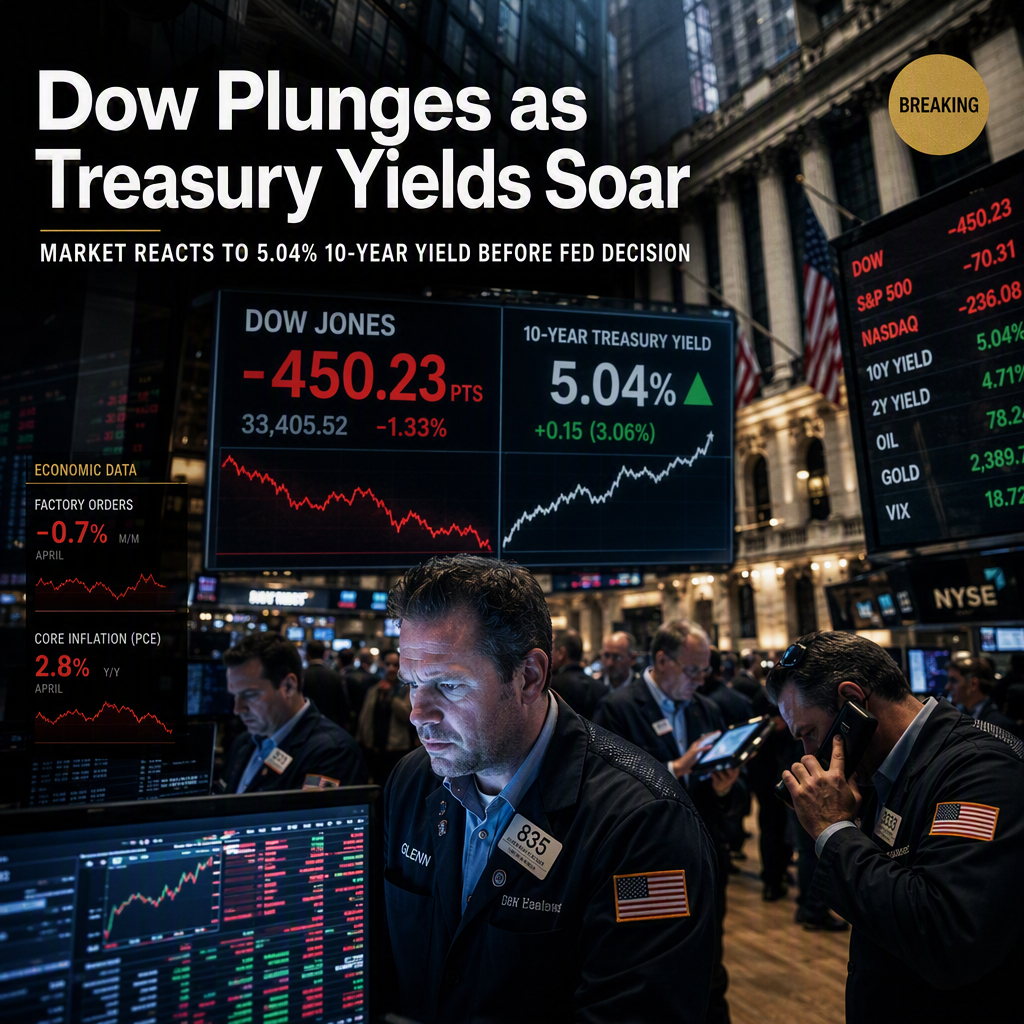
The Dow Jones Industrial Average fell by approximately 450 points, trading just under 52,000, as the market reacted to a surge in the 10-year Treasury yield, which reached 5.04% on Tuesday—its highest level since 2007 [1]. This movement in yields occurred a day before the Federal Reserve's anticipated rate hike, which is expected to be the first since July 2023. Futures market bets placed the probability of a quarter-point hike at 92.5%, indicating that the Fed's decision was largely priced in and not the primary driver of market action [1].
The 10-year Treasury yield, which influences borrowing costs for mortgages, car loans, and corporate bonds, has risen for five consecutive sessions and increased by nearly a third of a point over the past four weeks, even before the Fed's committee vote [1]. The expected Fed hike would move the overnight rate from 3.50-3.75% to 3.75-4.00%, directly impacting banks such as JPMorgan (JPM) and Goldman Sachs (GS), which together comprise about one-sixth of the Dow by share price [1]. For the remaining companies in the index, the rise in the 10-year yield affects their customers' financing costs, impacting demand for products from firms like Caterpillar (CAT) and 3M (MMM) [1].
Recent Treasury buyback operations have also influenced yields. On August 19, the Treasury announced it would at least double its buybacks from $2 billion to $4 billion, causing the 10-year yield to fall to 4.64% that afternoon. However, a subsequent increase in buybacks to $6 billion on September 9 saw the yield rise to 4.85% and the Dow lose about 400 points. The September 10 operation saw $5.19 billion of $10.49 billion in offered debt purchased, as the Treasury declined to pay higher prices. Treasury Secretary Scott Bessent stated last week that the Treasury market is in very good shape, though he later softened his remarks [1].
Economic data released on Tuesday showed the New York Fed factory survey falling to 7.6, well below the forecast of 14.75 and August's reading of 20.6, signaling weakening manufacturing activity. The Philadelphia Fed survey, due Thursday, is forecast to decline from 47.4 to 30.5. These surveys reflect factory orders, which are crucial for companies like Caterpillar and 3M. Meanwhile, consumer prices rose 3.4% year-over-year in August, with fuel prices contributing significantly to inflation—the primary concern the Fed's rate hike aims to address [1].
CONCLUSION
The Dow Jones experienced a significant decline as rising Treasury yields and expectations of a Fed rate hike weighed on the market. Key economic indicators pointed to slowing manufacturing activity and persistent inflation, underscoring the challenges facing both policymakers and corporations. The market's reaction highlights heightened sensitivity to interest rate movements and economic data.