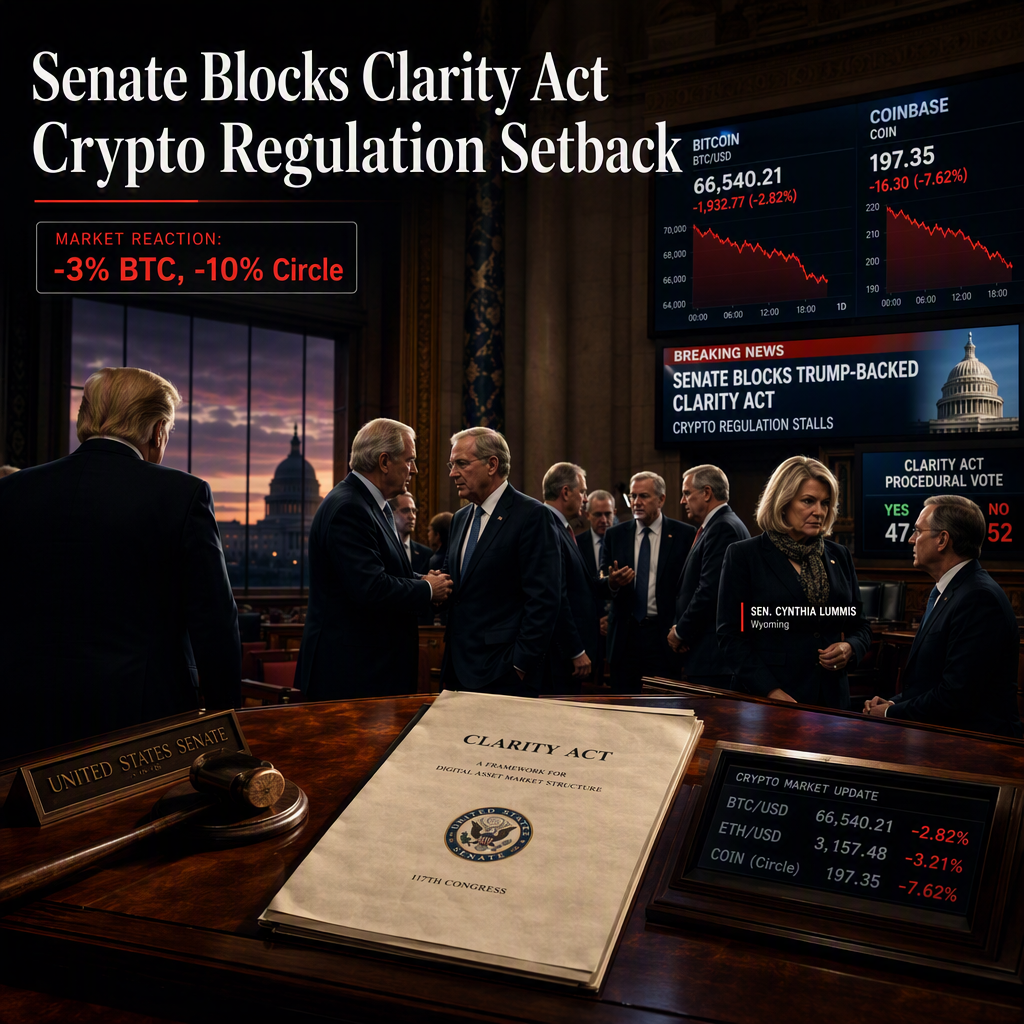
The U.S. Senate failed to advance the Clarity Act, a comprehensive crypto regulatory package backed by President Donald Trump, after a key procedural cloture vote on Tuesday, September 15, 2026, fell short of the 60 votes required to proceed. The final tally was 50 in favor and 49 against, leaving the bill stalled and delivering a significant blow to the cryptocurrency industry's push for clearer federal oversight and market structure [3]. The bill, championed by Sen. Cynthia Lummis (R-Wyo.) and supported by major crypto industry players and the White House, aimed to establish a regulatory framework dividing oversight between the SEC and CFTC, set registration requirements, and strengthen anti-money-laundering protections [1][3].
Despite last-minute revisions, including new ethics restrictions to address Democratic concerns about public officials profiting from crypto ventures, opposition persisted. Democrats were dissatisfied with the bill's ethics language, particularly regarding the Trump family's growing crypto holdings, which contributed to President Trump's income rising by about 250% from just over $620 million to about $2.2 billion between 2024 and 2025, according to financial disclosure forms [1]. Some Republicans also withheld support due to concerns about deposit yields at community banks and the adequacy of anti-money-laundering provisions [1].
Sen. Tim Scott (R-S.C.), a lead sponsor and chairman of the Senate Banking Committee, warned that Democratic opposition could jeopardize America's leadership in the evolving financial markets, arguing that the lack of a federal market structure leaves the U.S. in a 'wild, wild West' scenario for digital assets [2]. Scott emphasized that the debate should focus on the benefits to Americans rather than partisan politics, but acknowledged that some Democrats, including Sen. Elizabeth Warren, were firmly opposed [2].
The market reacted sharply to the bill's failure: bitcoin prices fell 3%, while shares of Coinbase and Circle dropped 8% and 10%, respectively, amid a broader sell-off [3]. Industry executives and investors expressed disappointment, noting that the defeat likely means regulatory clarity will be delayed until at least next year. The SEC and CFTC have taken some steps independently, but the lack of congressional action leaves the industry in limbo [3]. With the midterm elections approaching and Congress set to recess soon, prospects for reviving the bill this session are slim. Sen. Lummis stated, 'I think we're done. It's over,' confirming that the bill is unlikely to return to the floor [1][3].
CONCLUSION
The Senate's failure to advance the Clarity Act marks a significant setback for efforts to establish a comprehensive regulatory framework for the U.S. crypto industry. The defeat triggered a negative market reaction and leaves the industry facing continued uncertainty, with little chance of legislative progress before the midterm elections. Lawmakers and industry participants now expect regulatory clarity to be delayed until at least next year.