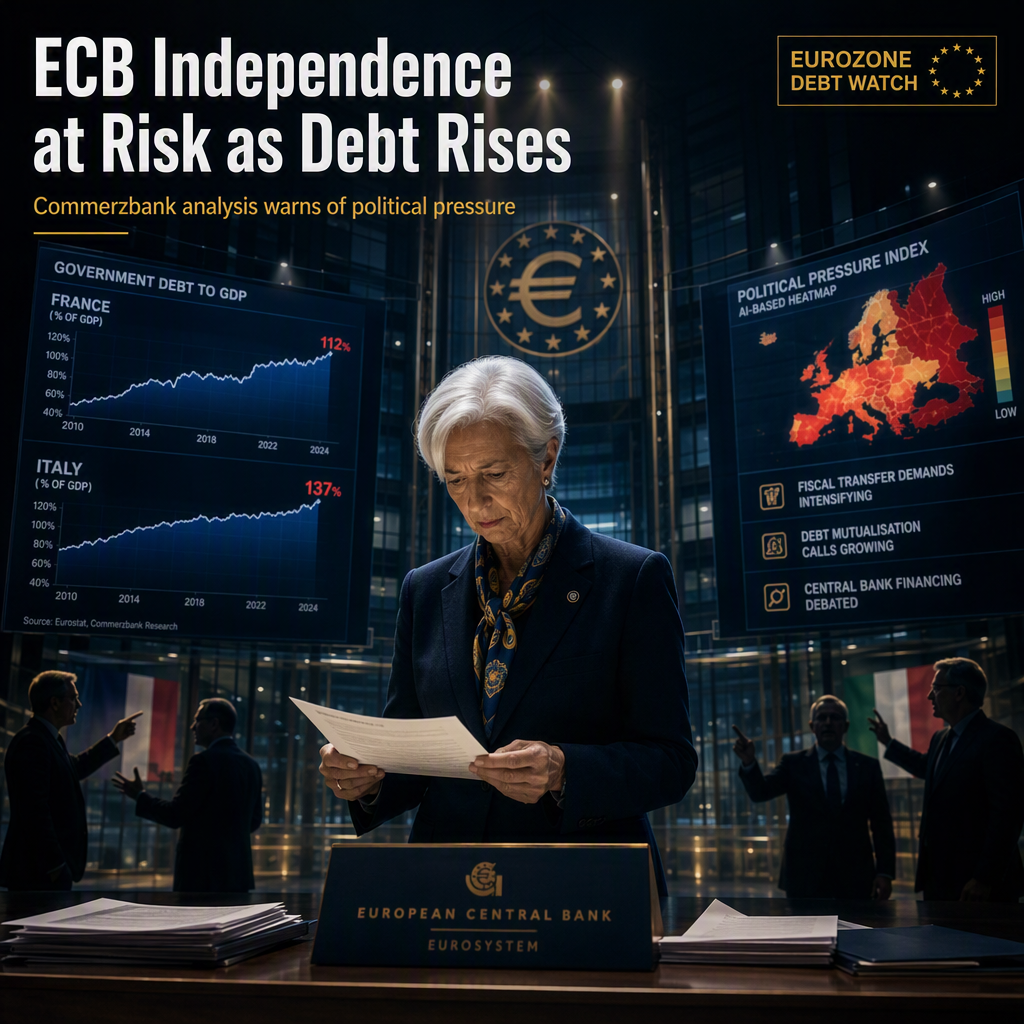
Commerzbank’s Dr. Marco Wagner has raised concerns about the increasing risks to the European Central Bank’s (ECB) independence as eurozone government debt levels rise. Using a Central Bank Pressure Index (CBPI) based on AI analysis of politicians’ statements, Wagner highlights that political pressure on the ECB tends to intensify during periods of fiscal stress, as seen during the sovereign debt crisis, when politicians made clear demands on the central bank [1].
Wagner notes that, unlike the U.S., where criticism may come from a single individual, the eurozone has seen collective political pressure, especially during crises. In recent years, the COVID-19 pandemic and the energy price crisis linked to the war in Ukraine have strained government finances, but explicit demands on the ECB were limited. This restraint is attributed to the ECB’s swift launch of the Pandemic Emergency Purchase Program (PEPP) and the 750 billion euro Next Generation EU (NGEU) financial package, which was financed through shared debt. Both the PEPP and NGEU are now being phased out or are in their final stages [1].
Despite these support measures, many European countries continue to face strained financial situations. The rise in yields over the past few years has increased the interest burden on public budgets, and efforts to consolidate finances have been limited. According to Commerzbank’s estimates, debt-to-GDP ratios in France and Italy, already at 120% and 130% respectively, are likely to continue rising [1].
Wagner warns that, in this environment, the risk of politicization for the ECB is likely to increase. The CBPI developed by Commerzbank indicates that there are repeated attempts by leading politicians to influence the ECB, suggesting that the central bank’s independence could come under renewed threat as fiscal pressures mount [1].
CONCLUSION
Commerzbank’s analysis highlights that rising debt levels in the eurozone, particularly in France and Italy, are increasing the risk of political pressure on the ECB. As support programs wind down and fiscal consolidation remains limited, the ECB’s independence may face renewed challenges. Market participants should monitor these developments for potential impacts on eurozone monetary policy.