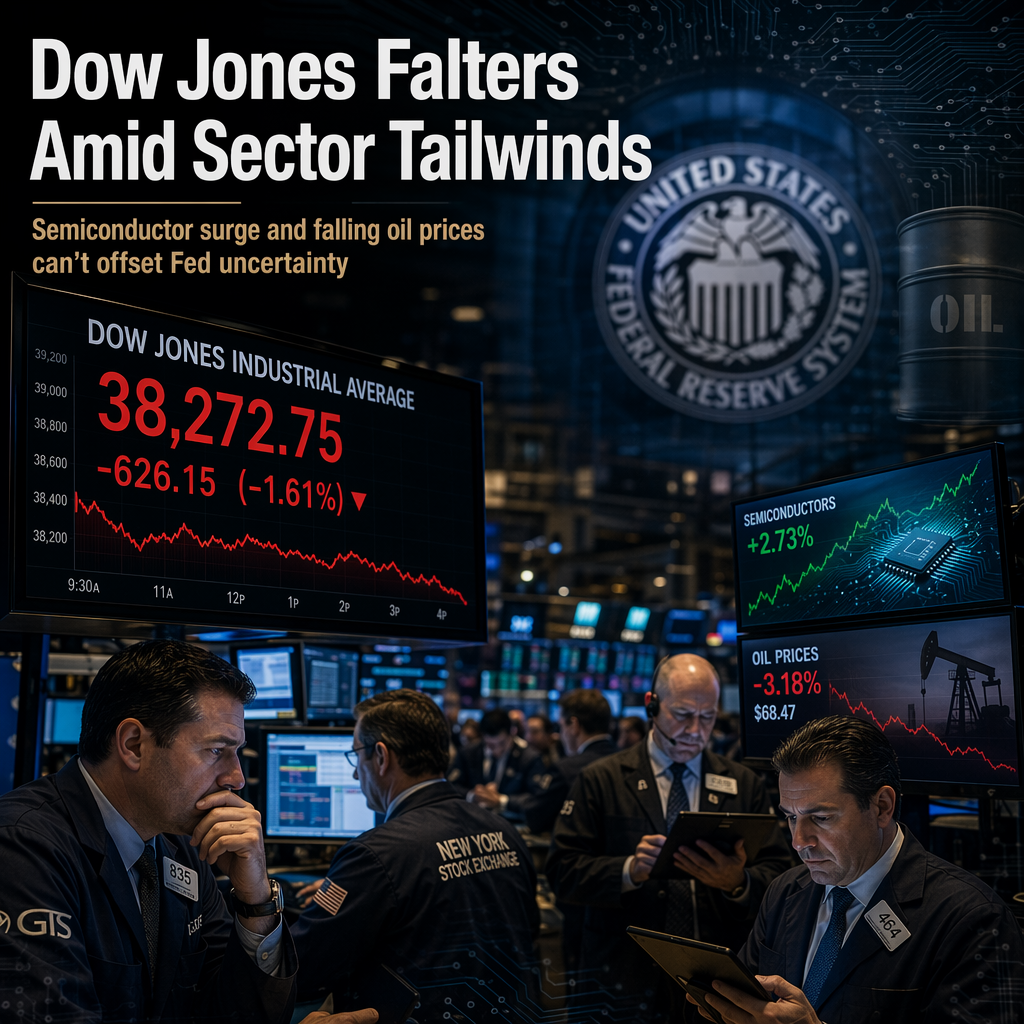
The Dow Jones Industrial Average (DJIA) struggled to recover on Thursday following a hawkish Federal Reserve selloff on Wednesday, despite positive developments in the semiconductor sector and a notable decline in crude oil prices [1]. The index briefly spiked toward 51,900 in overnight trading but faced heavy selling pressure, settling near 51,600 and remaining in the lower third of its daily range. This lackluster performance occurred even as semiconductor stocks surged: Intel rose approximately 10% after the White House announced a chip-design partnership with Apple, Micron climbed about 6%, Nvidia gained over 1%, and a benchmark semiconductor fund increased by more than 5% [1]. However, the Dow was unable to benefit fully from this rally, as it no longer includes Intel, which was removed from the index in late 2024, and its composition limits exposure to the semiconductor upswing [1].
Energy markets also provided a tailwind, with West Texas Intermediate (WTI) crude oil dropping around 3% toward $74 and Brent crude falling nearly as much to about $77. This decline followed news that tankers carrying more than 12 million barrels had cleared the Strait of Hormuz, subsequent to a memorandum of understanding between Washington and Tehran [1]. Some market participants suggested that lower oil prices could help reduce inflation and ease pressure on the Fed, but these assumptions remain unverified, particularly regarding the sustainability of the de-escalation and the broader inflation picture, which is driven by services and wages [1].
The market continues to digest Wednesday's Federal Open Market Committee (FOMC) meeting, the first chaired by Warsh. The updated dot plot revealed that nine out of eighteen officials now expect higher rates in 2026, signaling a hawkish shift. Warsh himself did not submit a forecast and emphasized the importance of price stability, leaving investors with uncertainty about future policy direction [1]. This lack of clarity, combined with a committee split on whether the next move will be a rate hike, has created a communication vacuum that equity markets are punishing [1].
Despite favorable sector moves and energy price declines, the Dow remains weighed down by Fed uncertainty and its limited exposure to the semiconductor rally. The market's inability to rally with these tailwinds underscores the impact of monetary policy ambiguity and index composition on performance [1].
CONCLUSION
The Dow Jones Industrial Average failed to capitalize on positive sector and energy developments due to ongoing uncertainty from the Federal Reserve and its own limited exposure to the semiconductor rally. Market sentiment remains cautious as investors await clearer signals from Fed Chair Warsh and the FOMC. The combination of hawkish policy expectations and communication gaps continues to weigh on blue-chip equities.