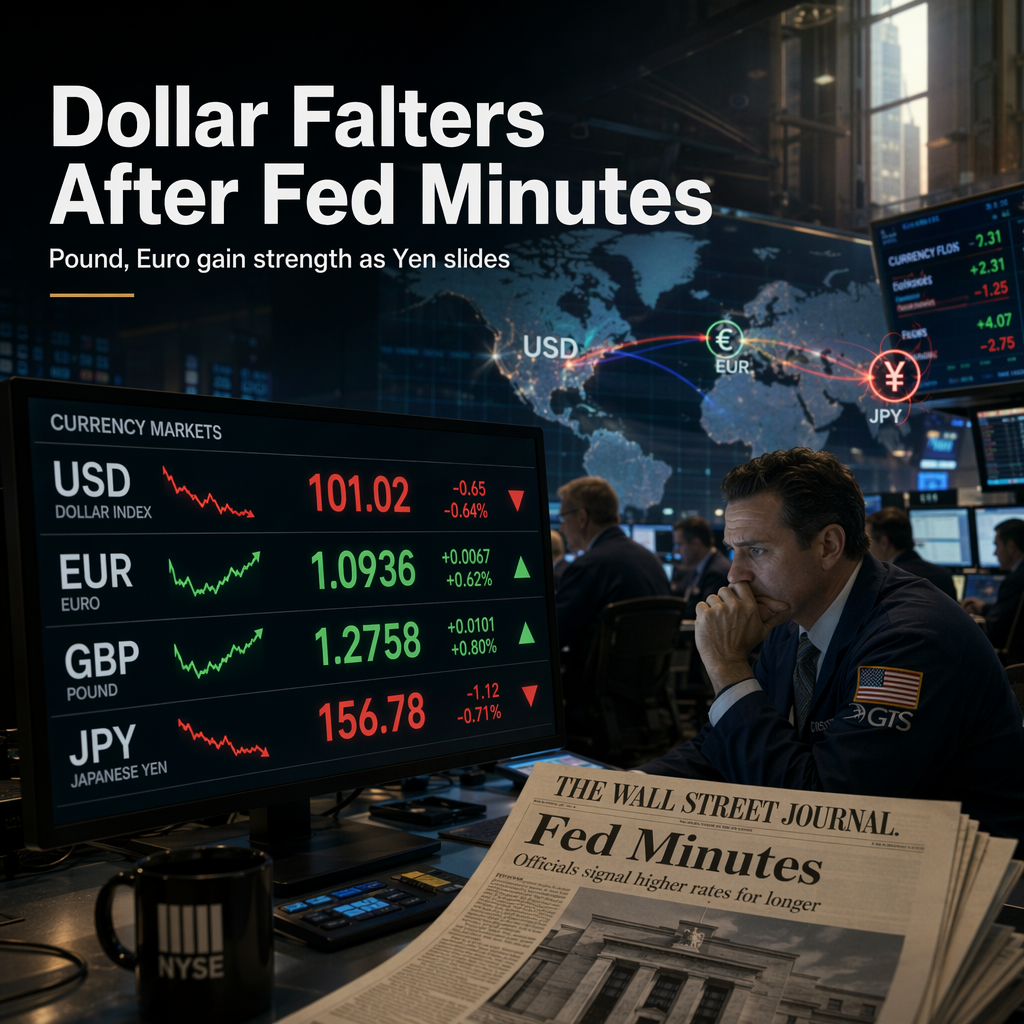
The US Dollar Index (DXY) hovered near the 101.00 region on Wednesday as investors digested the Federal Open Market Committee (FOMC) Minutes from the June 16-17 meeting, the first under Federal Reserve Chair Kevin Warsh [1]. The Minutes reinforced the Fed’s cautious stance, with policymakers unanimously agreeing to leave rates unchanged and continuing to see upside inflation risks as elevated [1]. Several participants warned that factors such as stronger AI-related investment, higher tariffs, and renewed tensions in the Middle East could keep price pressures persistent [1].
The FOMC Minutes leaned toward a 'higher-for-longer' narrative, with a few policymakers judging that another rate hike could eventually become appropriate if inflation evolves along a less favorable path [1]. Despite this hawkish tone, the US Dollar failed to gain strong traction, as investors also weighed softer growth expectations and recent weakness in US labor data [1].
In currency markets, the US Dollar was the strongest against the Japanese Yen, rising 0.26% against JPY, while it weakened against the Euro (-0.11%), British Pound (-0.30%), Canadian Dollar (-0.25%), Australian Dollar (-0.11%), New Zealand Dollar (-0.50%), and Swiss Franc (-0.04%) [1]. EUR/USD recovered toward the 1.1430 area, supported by renewed selling in the US Dollar, although gains were limited due to ongoing concerns about inflation persistence [1]. GBP/USD advanced above 1.3400, reaching fresh multi-week highs as the Pound benefited from broad USD weakness [1]. USD/JPY remained supported near multi-decade highs at 162.50 as the Japanese Yen continued to underperform against the Greenback [1].
The market reaction suggests that, despite the Fed’s hawkish signals, concerns about US growth and labor market softness are weighing on the Dollar, allowing other major currencies to strengthen against it [1].
CONCLUSION
Despite hawkish FOMC Minutes and persistent inflation concerns, the US Dollar struggled to gain traction as investors focused on softer growth and labor data. The British Pound and Euro advanced, while the Japanese Yen continued to weaken against the Dollar. Market sentiment remains cautious, with the Fed’s higher-for-longer stance balanced by concerns over US economic momentum.