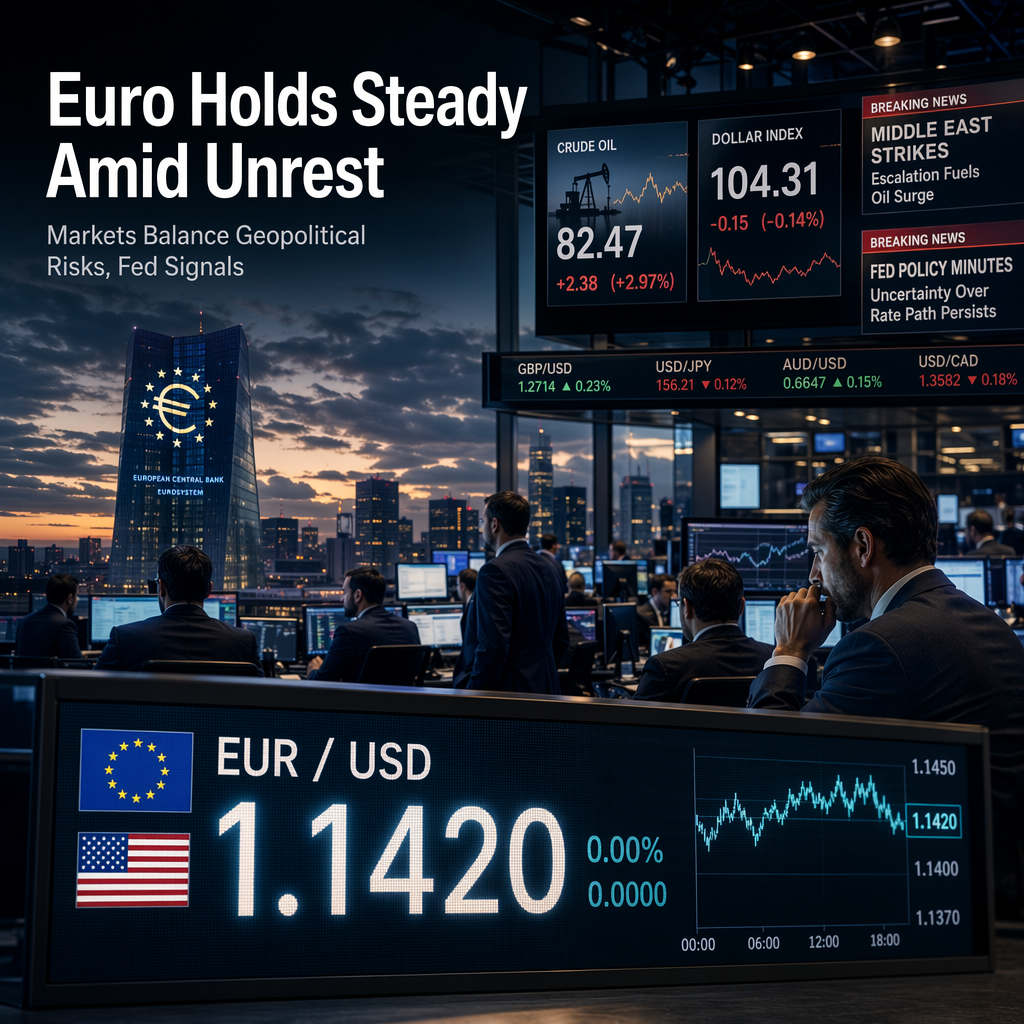
The Euro remained stable against the US Dollar on Wednesday as geopolitical tensions escalated in the Middle East, with the United States conducting additional strikes against Iran near the Strait of Hormuz for the second consecutive day [1]. At the time of reporting, the EUR/USD pair traded at 1.1420, rebounding from daily lows of 1.1391 [1]. The US Central Command confirmed these military actions, stating they aimed to degrade Iran's ability to threaten freedom of navigation in the region [1].
Financial markets responded swiftly to these developments, with risk appetite diminishing and US equity markets closing the session with losses [1]. Crude oil prices surged, as Western Texas Intermediate (WTI) rose 3.57% to $74.77 per barrel [1]. The US Dollar Index (DXY), which measures the dollar against a basket of six currencies, increased by 0.10% to 101.20 [1].
On the monetary policy front, the Federal Reserve released minutes from its latest meeting, revealing a unanimous decision to hold interest rates steady and noting a stable labor market [1]. Most Fed officials preferred to avoid previous dovish language, opting for a shorter policy statement, and expressed mixed views on whether current policy is restrictive [1]. Money markets reflected an 18% probability of a 50-basis-point rate hike in September and a 52% chance of a 25-basis-point increase [1].
In Europe, the economic calendar was light, but comments from European Central Bank (ECB) officials highlighted ongoing uncertainty. Bundesbank's Joachim Nagel remarked that, following Iran's attacks, 'we are back where we began,' advocating for a meeting-by-meeting approach, while ECB's Primož Dolenc expressed uncertainty about the central bank's next steps in two weeks [1].
Looking ahead, markets are focused on upcoming US Initial Jobless Claims data and Germany's Trade Balance, as well as forthcoming inflation figures from Germany and France [1]. Technical analysis shows EUR/USD trading at 1.1416, below key moving averages and within a downward channel, with the Relative Strength Index at 40 indicating persistent, though not extreme, selling pressure [1].
CONCLUSION
The Euro's stability reflects a balance between heightened geopolitical risks and evolving monetary policy expectations. Market sentiment remains cautious, with investors closely monitoring upcoming economic data and central bank signals for further direction.