
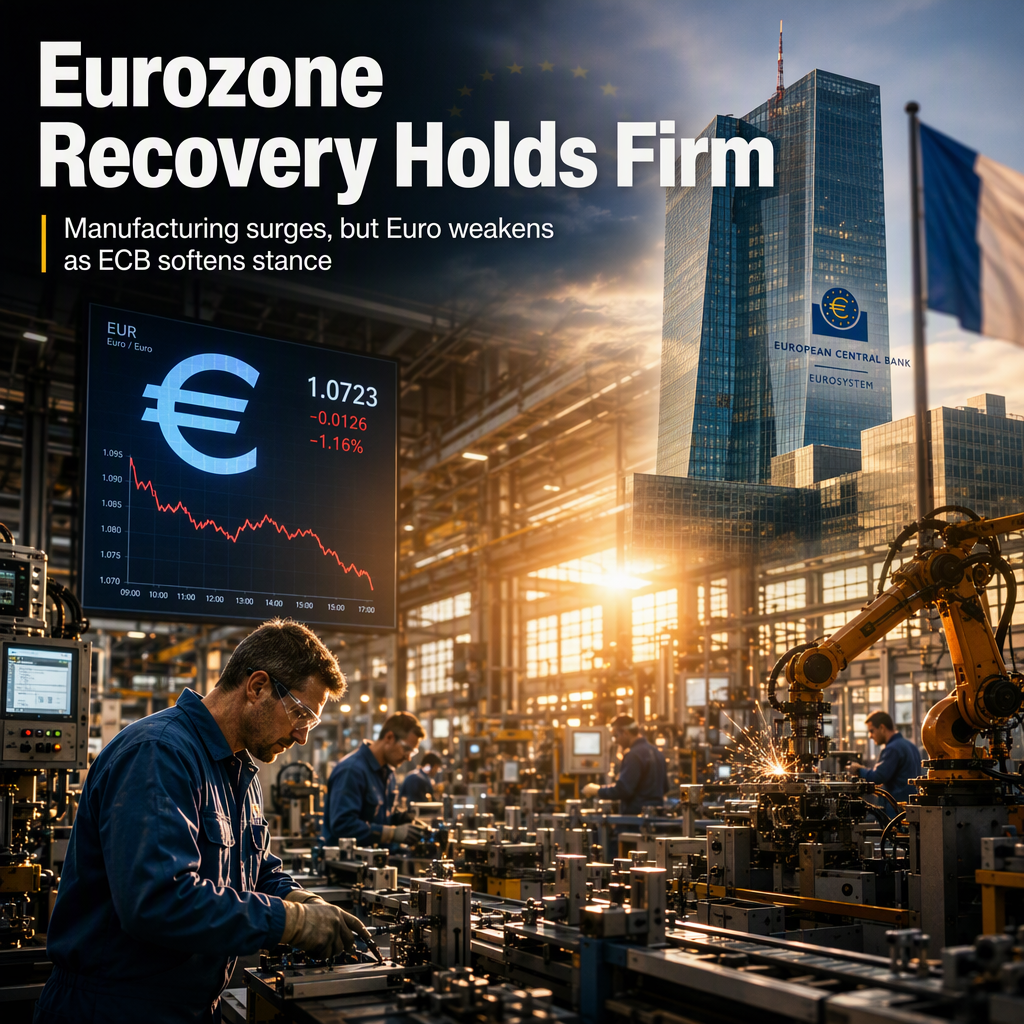
BNY’s Geoff Yu asserts that the Eurozone economic recovery remains robust, even as the Euro (EUR) continues to weaken against other currencies [1]. Recent data shows the Eurozone manufacturing PMI held at a four-year high in September, with factory output expanding at its fastest pace in nearly five years. Additionally, new orders and backlogs are rising, indicating a clear strengthening in demand across the region [1].
Despite these positive economic indicators and a recent European Central Bank (ECB) rate hike, the Euro’s nominal effective exchange rate has declined by 1.4% since the beginning of September [1]. This decline started before concerns about France’s fiscal position became a significant source of weakness and volatility for the currency. The Euro was previously considered overvalued, with stretched interest-rate expectations and limited short positioning, which left room for adjustment [1].
ECB President Christine Lagarde has acknowledged that current front-end interest-rate levels would 'slow growth,' and recent moves in global bond markets are tightening financial conditions further through the fiscal channel, as echoed by ECB Chief Economist Philip Lane [1]. In response, the French government has announced fiscal consolidation measures, with related legislation expected to pass in the fourth quarter [1]. Expectations for year-end ECB rates have subsequently fallen below pre-decision levels, contributing further to Euro weakness [1].
Unlike the 2011–2012 period, there has been no spillover from volatility in French government bond (OAT) futures into foreign exchange markets. Ten-day realized EURUSD volatility remains within its range since May, even as OAT futures volatility has spiked. The ECB’s retreat from firm rate guidance has also helped dampen FX volatility [1].
CONCLUSION
The Eurozone economy is showing resilience, with strong manufacturing data and rising demand, but the Euro continues to weaken due to fiscal concerns and a softer ECB stance. Market volatility in the Euro remains contained, and fiscal consolidation measures in France are expected in the coming months. Overall, the market takeaway is that economic recovery persists, but currency weakness is likely to continue.