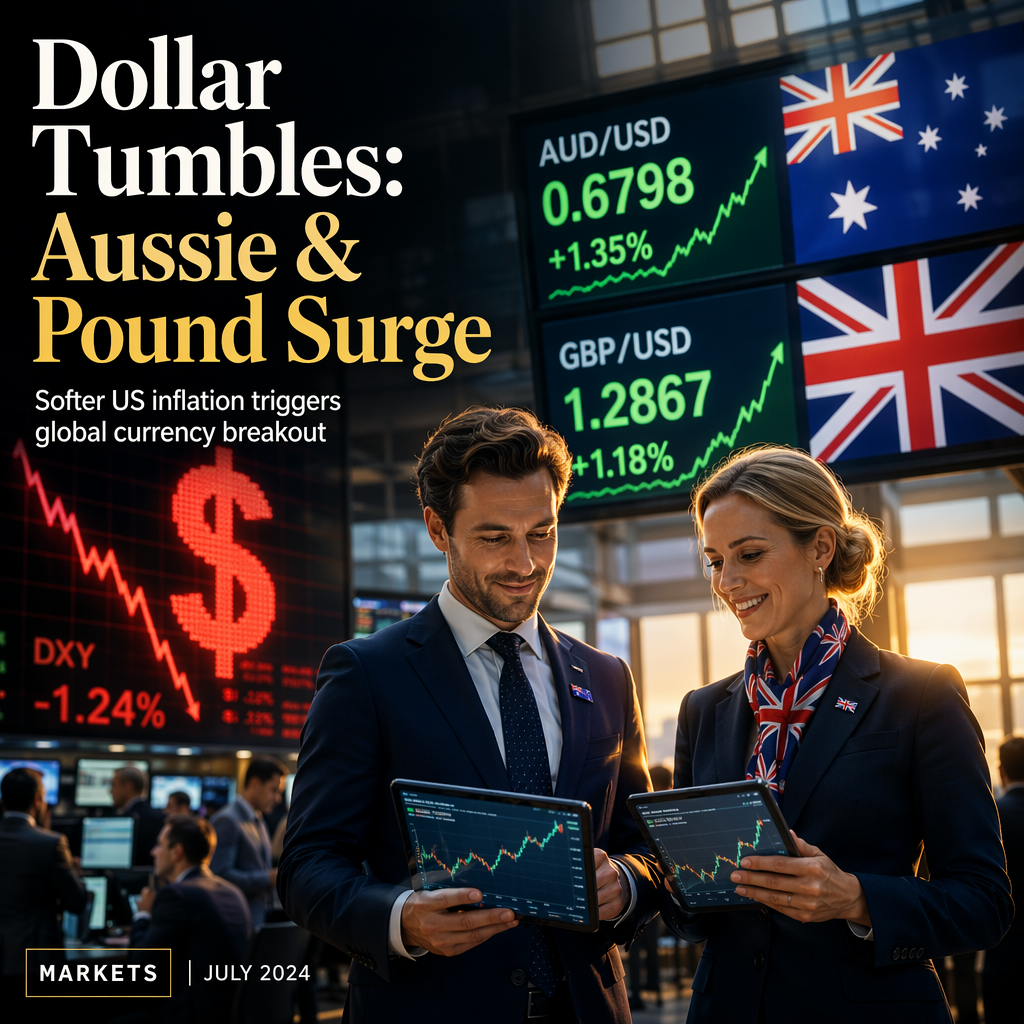
Both the Australian Dollar (AUD) and the British Pound Sterling (GBP) experienced significant gains against the US Dollar following the release of softer-than-expected US Producer Price Index (PPI) data for June. The AUD opened near 0.6975, climbed above 0.7000 for the first time since mid-June, and traded near 0.7005 at the time of writing, up 0.44%. The currency briefly touched 0.7021 before retreating, stalling at the 50-day Exponential Moving Average (EMA) of 0.7016. This move marks the first test of the declining 50-day average since the AUD's breakdown in mid-June, highlighting the technical significance of the level [1].
The GBP, meanwhile, surged more than 1% in one of its strongest sessions of the year, trading near 1.3540 after clearing both the 200-day EMA and the 1.3400 handle. The session saw the Pound break out of a month-long consolidation, with July's price action previously compressed between the 50-day and 200-day EMAs (1.3376 and 1.3385, respectively) and the 1.3400 shelf. The breakout shifts the burden of proof onto Dollar bulls for the first time in months [2].
The catalyst for these moves was the US June PPI, which fell 0.3% month-over-month and slowed to 5.5% year-over-year, undercutting the 6.2% consensus. The core measure also missed, printing 4.7% YoY against 5.2% expected. This data extended a run of cooler-than-expected US inflation readings and led to a broad selloff in the Dollar, as markets reassessed the likelihood of a Federal Reserve rate hike by September, which had been priced at nearly 70% earlier in the month. The Fed Chair's Capitol Hill testimony was interpreted as neutral rather than hawkish, further weighing on the Dollar [1][2].
For the AUD, additional support came from Chinese economic data: Q2 GDP grew 0.9% quarter-over-quarter (matching consensus but slowing from 1.3%), while annual growth missed at 4.3% versus 4.5% expected. However, June industrial production beat expectations at 5.3% YoY (vs. 4.6% consensus), and retail sales returned to growth at 1% (vs. -0.1% expected). These activity beats were seen as more relevant for Australian exporters than the GDP miss, helping the AUD maintain its gains through the data releases [1].
In the UK, the market is fully pricing a Bank of England rate hike in September, with a second increase this year nearly priced in as well. Ten-year gilt yields are hovering near 5% amid concerns over war-driven energy costs and their impact on inflation. Political developments, including the Labour leadership contest and the expected appointment of Andy Burnham as Prime Minister, were noted but not seen as drivers of Sterling's rally [2].
CONCLUSION
Softer US producer price data triggered a broad selloff in the Dollar, propelling both the Australian Dollar and British Pound to notable gains. Technical breakouts and supportive domestic or partner economic data reinforced these moves. The market's focus remains on inflation and central bank policy expectations, with the Fed's next steps under renewed scrutiny.