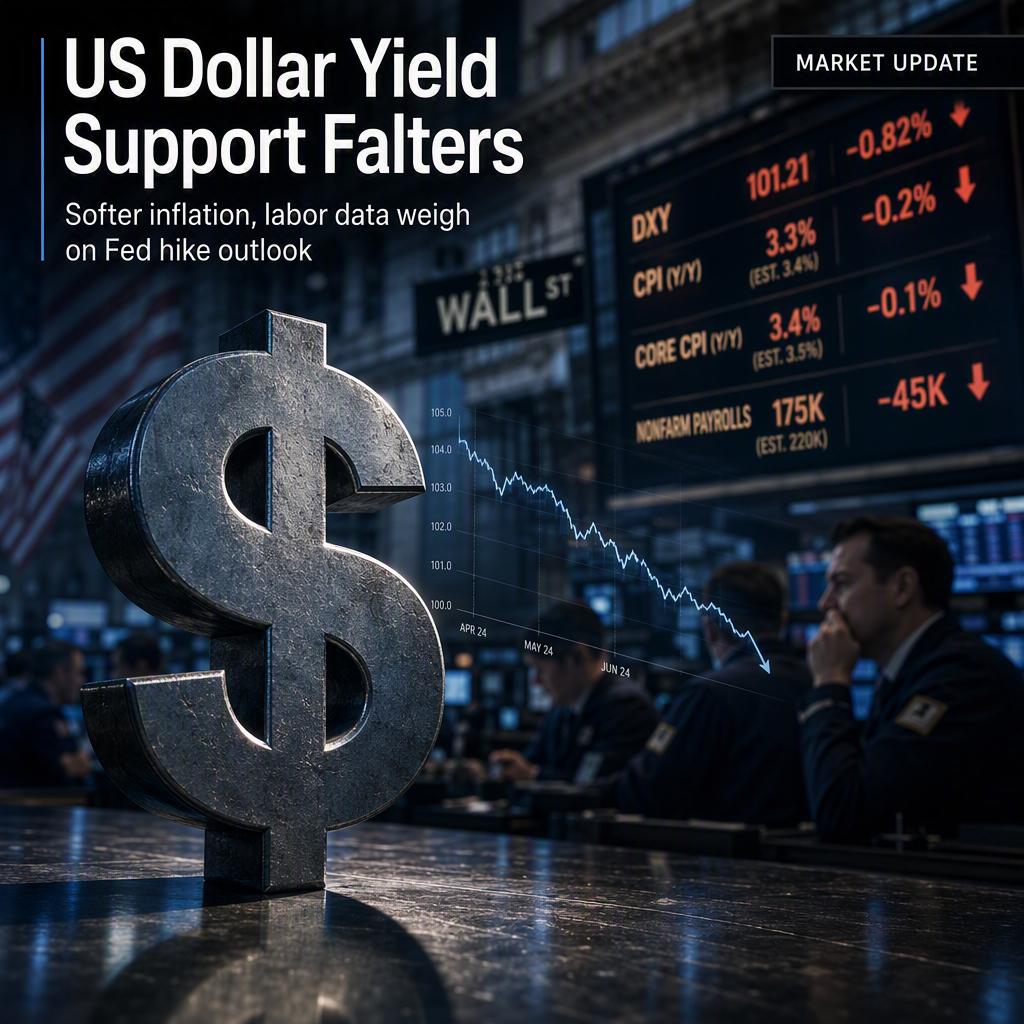
The US Dollar's yield support has weakened following softer US CPI inflation and labor data, according to DBS Group Research economist Philip Wee [1]. The DXY Index remained confined within a 99.4–100.1 range after a sell-off in USD/JPY, which was linked to joint US-Japan interventions [1]. US CPI inflation matched market expectations and was not strong or weak enough to move the DXY Index out of its established range [1].
Market participants sharply reduced the implied probability of a September Federal Reserve rate hike, dropping it to 40% overnight from 72% at the end of July. This shift was attributed to negative nonfarm payrolls data released last Friday and slower CPI inflation readings [1]. Average hourly earnings were also modestly lower, tracking core inflation amid a softer-than-expected labor market, which suggests that Fed officials may be less concerned about a resurgence of inflationary pressures similar to those seen after Covid-19 [1].
Additionally, a widening US budget deficit and a weaker fiscal position are seen as undermining the yield advantage of US bonds, which has traditionally supported the US Dollar [1]. These fiscal risks are capping the DXY Index and contributing to the reduced probability of further rate hikes [1].
CONCLUSION
Softer US inflation and labor data, combined with growing fiscal risks, have eroded the US Dollar's yield support and led markets to sharply lower expectations for a September Fed rate hike. The DXY Index remains range-bound as investors reassess the outlook for US monetary policy.