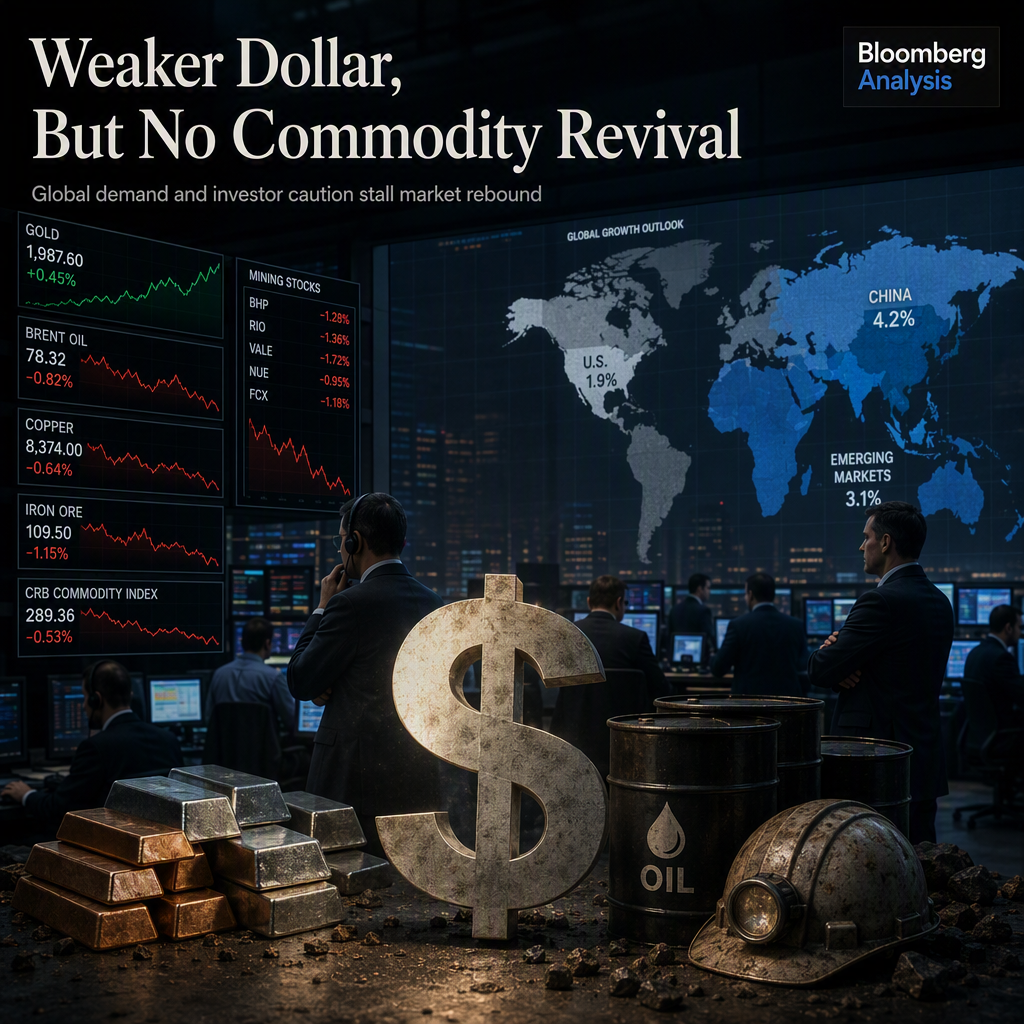
According to Geoff Yu at BNY, while a less hawkish Federal Reserve has led to a weaker U.S. dollar, this shift has not resulted in a broad-based rally across commodities. Institutional investors continue to sell metals and mining stocks, and emerging market (EM) commodity sovereign debt remains under pressure, despite lower U.S. real yields. Additionally, the initial surge in commodity FX buying has quickly dissipated [1].
Yu emphasizes that the primary missing catalyst for a sustained commodity recovery is stronger global demand, particularly from China. He notes that, aside from gold, there is no evidence of the broad commodity move necessary to revive the 'debasement' trade that was prominent in January and February. The credibility of the Federal Reserve is important, but Yu argues that correlated trades across global assets require a credible growth backstop, which is difficult to achieve if U.S. economic data begin to weaken materially [1].
The analysis further highlights that a weaker dollar alone is insufficient to boost commodity prices or the economies linked to them, especially while U.S. investors remain satisfied with domestic nominal and real yields. Commodity-linked economies must therefore generate their own growth and total-return narratives to fully benefit from easier global financial conditions. The previous environment, characterized by a wide yield advantage over the U.S. and robust Chinese demand supporting export revenues, is not expected to return in the near term [1].
CONCLUSION
The current environment of a weaker dollar has not sparked a broad commodity rally, as institutional investors remain cautious and global demand—especially from China—remains subdued. Without a credible growth catalyst, commodity-linked assets are unlikely to see sustained gains, and economies tied to these markets must seek alternative drivers for recovery.