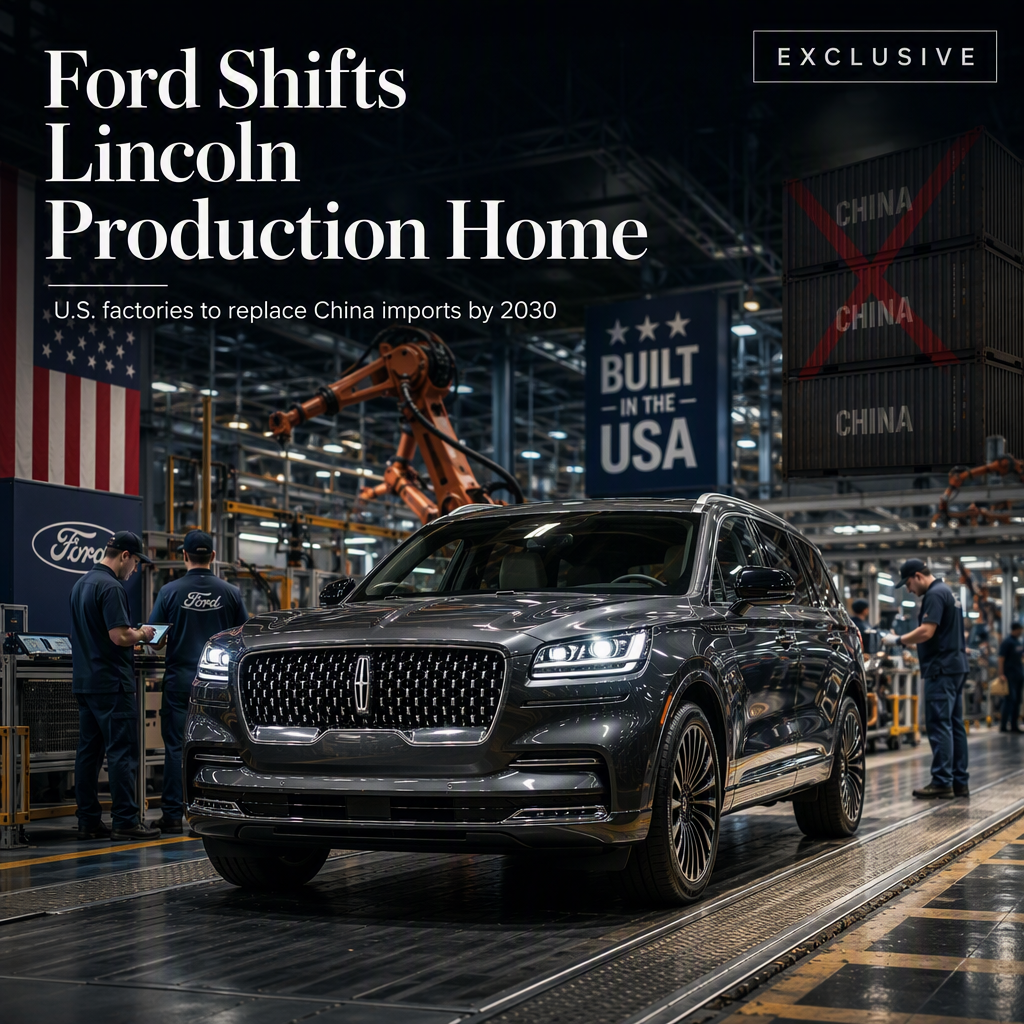
Ford Motor Company announced plans to expand U.S. production of its Lincoln vehicles starting in 2030, with the goal of phasing out imports from China for the luxury brand's American customers [1]. The company stated that this expansion is expected to generate thousands of direct and indirect U.S. jobs, though it did not disclose the specific investment amount or identify which U.S. plants would receive the additional production [1].
Currently, the Lincoln Nautilus is assembled at the Changan Ford plant in Hangzhou, China, and exported to the U.S., while previous generations were produced in Canada [1]. Ford did not specify whether Nautilus production would move to the U.S. under the new plan or which other China-imported vehicles would be affected [1]. The announcement comes amid ongoing industry challenges related to higher costs, tariffs, and shifting global trade policies [1]. According to Ford's latest annual report, the company incurred approximately $3 billion in gross costs from tariffs implemented or revised in 2025, with a $2 billion impact on earnings before interest and taxes after offsets [1]. However, Ford did not confirm whether tariffs or trade considerations influenced the decision to phase out Lincoln imports from China [1].
Lincoln already manufactures several vehicles in the U.S., including the Navigator at the Kentucky Truck Plant in Louisville and the Aviator at the Chicago Assembly Plant, both of which are also exported to international markets [1]. Ford reported assembling over 2 million vehicles in the U.S. in 2025, more than any other automaker, and leading the industry in U.S. vehicle exports and hourly autoworker employment [1]. The company employs approximately 56,300 hourly manufacturing workers in the U.S. [1].
Despite the announcement, several details remain unclear, such as which models will be produced domestically, the specific locations for production, and the total investment planned for the expansion [1].
CONCLUSION
Ford's decision to boost U.S. Lincoln production and phase out imports from China by 2030 signals a strategic shift toward domestic manufacturing and job creation. While the move addresses industry challenges related to tariffs and trade uncertainty, key details about the expansion remain undisclosed. The market impact is medium, with potential long-term benefits for Ford's U.S. operations and workforce.