
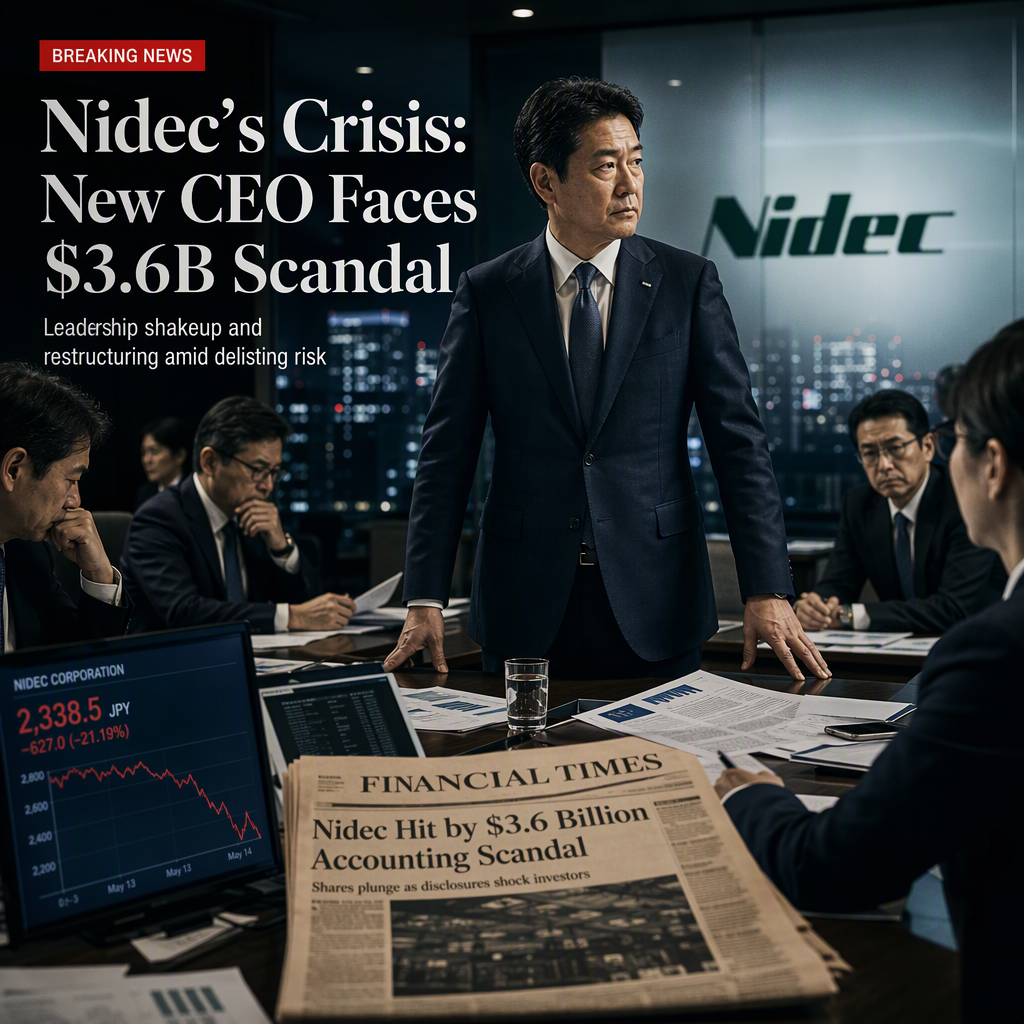
Nidec, a prominent Japanese motor manufacturer, is facing a major crisis following the disclosure of billions of dollars in impairment losses stemming from an accounting scandal. The company recently announced impairment losses totaling $3.6 billion, primarily related to write-downs in its electric vehicle motor business, which has placed Nidec on the brink of delisting [1]. In response, Nidec has appointed Michio Kaida as its new President and CEO. Kaida, who has risen from a group company to the top ranks, is known for his determination and has been long praised by founder Shigenobu Nagamori for his leadership abilities. However, some observers question whether Kaida represents a true break from the past due to his longstanding ties to the company [1].
The scandal has triggered a wave of restructuring efforts, including the planned sale of Nidec's electronic parts unit to private equity firm Carlyle, signaling a shift in strategy amid ongoing financial turmoil [1]. Market analysts attribute the write-downs to the expansion drive and aggressive profit pursuit under previous leadership, a point acknowledged by Kaida, who stated, "The expansion drive and profit chase were behind the write-downs" [1].
In the wake of the scandal, Nidec is racing to shore up governance, especially as its auditor has withheld earnings sign-off. The company is implementing new compliance measures and restructuring its leadership to restore investor confidence [1]. Japanese regulators are also increasing pressure on top executives, including Kaida, to ensure transparent and accurate financial reporting, placing responsibility for preventing accounting fraud squarely on their shoulders [1].
Despite these challenges, Nidec remains a key player in the motor manufacturing sector. However, its recent losses and governance crisis have led to heightened scrutiny from investors and the market. The company’s shares have reacted negatively to the news, reflecting uncertainty about the speed and effectiveness of the turnaround led by Kaida. Kaida has emphasized the need for a new approach to governance and accountability, underscoring his commitment to transforming Nidec’s corporate culture and financial practices [1].
CONCLUSION
Nidec's $3.6 billion impairment losses and risk of delisting have prompted a leadership change and major restructuring efforts. The market has responded negatively, reflecting investor uncertainty about the company's turnaround prospects. Kaida's commitment to improved governance and accountability will be critical as Nidec seeks to restore confidence and stabilize its operations.