
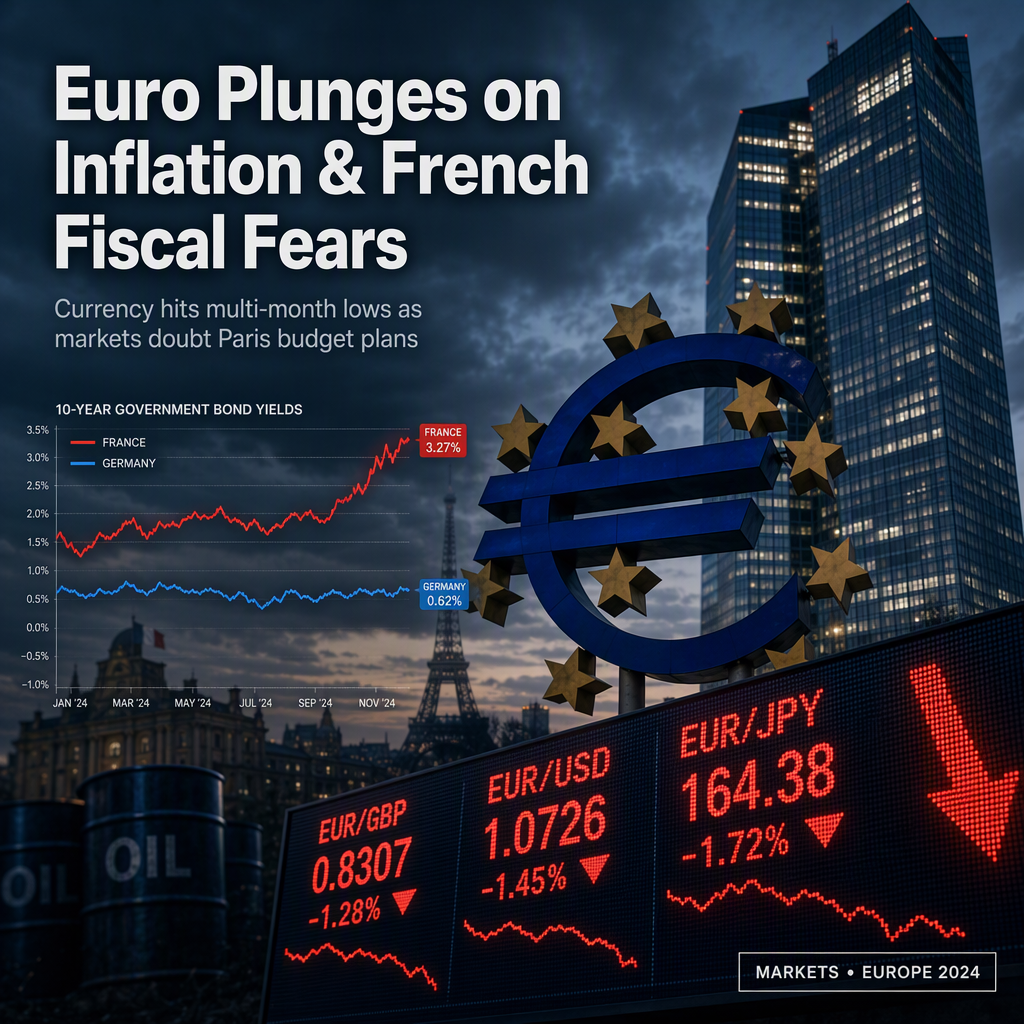
The Euro (EUR) experienced a sharp decline against major currencies, notably hitting fresh two-and-a-half-month lows against the British Pound (GBP) just above 0.8500, and registering a weekly drop of more than 1% [1]. This weakness was attributed to a combination of surging Eurozone inflation, elevated oil prices, and escalating borrowing costs in France, making the Euro the weakest performer among G8 currencies this week [1][3]. Eurostat's preliminary Harmonised Index of Consumer Prices (HICP) for September showed headline inflation accelerating to a three-year high of 3.8% year-on-year, up from 3.2% in August and surpassing expectations of 3.6%. Core HICP, excluding food and energy, rose moderately to 2.5% from 2.4%, matching market forecasts [1][2].
French fiscal concerns were front and center, with the gap between German and French government bond yields widening beyond 140 basis points, the highest since 2012 [1]. French bond yields surged to 4.96%, their highest since 2002, as public debt reached 119% of GDP [3]. France's Finance Minister Roland Lescure presented the 2027 budget bill, aiming to reduce the deficit from 5% of GDP next year to the EU limit of 3% by 2029 [3]. However, market experts and Brown Brothers Harriman (BBH) analysts expressed skepticism about the bill's passage through a divided parliament, noting political hurdles and the fiscal watchdog's warning that the budget's economic assumptions are 'optimistic' [3]. BBH suggests that a rollover of the 2026 budget is likely, given limited appetite for compromise ahead of the presidential election in April 2027 [3].
On the broader currency markets, the Euro was down 0.35% against the Japanese Yen (JPY) and was the weakest against the Swiss Franc (CHF) [3]. The heat map of currency movements confirmed the Euro's underperformance across the board [3]. In the UK, the Pound drew support from hawkish Bank of England comments, but strategists at Rabobank cautioned that with over 100 basis points of policy tightening already priced in, further GBP upside is limited and the currency could soften as rate hike risks are reined in [1].
Analyst opinions from BBH and FXStreet Insights highlight that while above-target Eurozone inflation gives the European Central Bank (ECB) scope for further rate hikes—swaps markets imply nearly 75 basis points of tightening to 3.25% over the next twelve months—stronger US growth and France's worsening budget situation keep EUR/USD risks skewed to the downside in the coming months [2][3].
CONCLUSION
The Euro's sharp decline is driven by surging inflation and mounting fiscal risks in France, with skepticism over the government's ability to pass its budget and concerns about optimistic economic assumptions. Despite potential ECB rate hikes, analysts see downside risks for the Euro, especially against the backdrop of stronger US growth and persistent political uncertainty in France. Market sentiment remains negative, and the Euro is expected to stay under pressure in the near term.