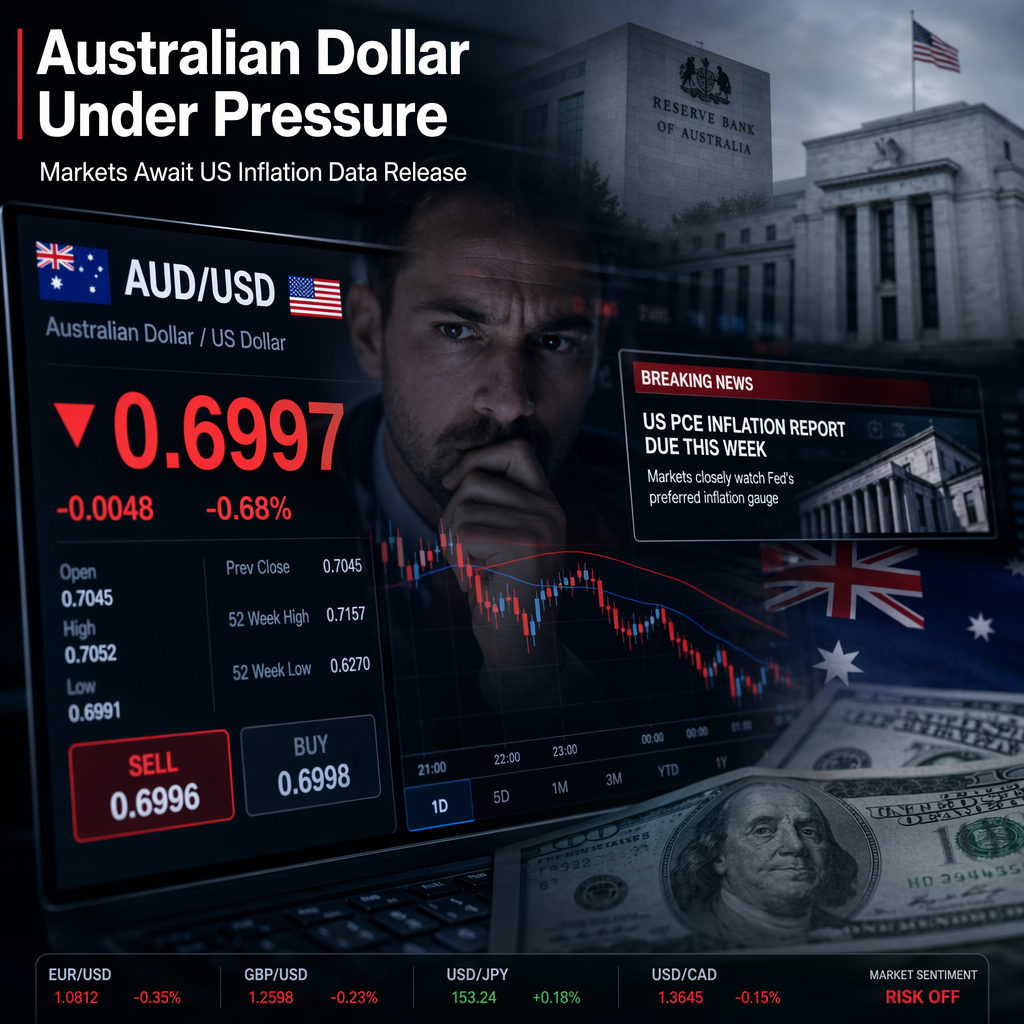
The Australian Dollar (AUD) declined toward the 0.7000 level against the US Dollar (USD) on Monday, with the AUD/USD pair trading at 0.6997 as investors exercised caution ahead of the upcoming US Personal Consumption Expenditures Price Index (PCE) report, which is the Federal Reserve’s preferred measure of inflation [1]. The US PCE inflation data is scheduled for release on Thursday, and a stronger-than-expected reading could reinforce expectations for the Federal Reserve to maintain a hawkish policy stance, potentially supporting the US Dollar and exerting further downward pressure on the AUD/USD pair [1].
Earlier in the day, the People's Bank of China (PBoC) left interest rates unchanged, a decision that also influenced sentiment toward the Australian Dollar due to Australia’s significant trade exposure to China [1]. Technical analysis indicates that AUD/USD maintains a bearish near-term tone, trading below both the 20-period and 100-period Simple Moving Averages (SMA) at approximately 0.7013 and 0.7075, respectively [1]. The Relative Strength Index (RSI) is around 38, suggesting persistent downside pressure [1].
Immediate resistance for the pair is identified at 0.7002, with a more substantial barrier near 0.7013–0.7020, aligning with the 20-period SMA. A sustained move above these levels would be necessary to alleviate the current selling pressure, with the 100-period SMA near 0.7075 acting as a higher resistance level [1]. On the downside, notable support is seen at 0.6995, which could help prevent a deeper decline in the near term [1].
CONCLUSION
The Australian Dollar is under pressure as markets await the US PCE inflation data, with technical indicators pointing to continued downside risk. The outcome of the US inflation report and ongoing developments in China are likely to determine the next direction for AUD/USD.