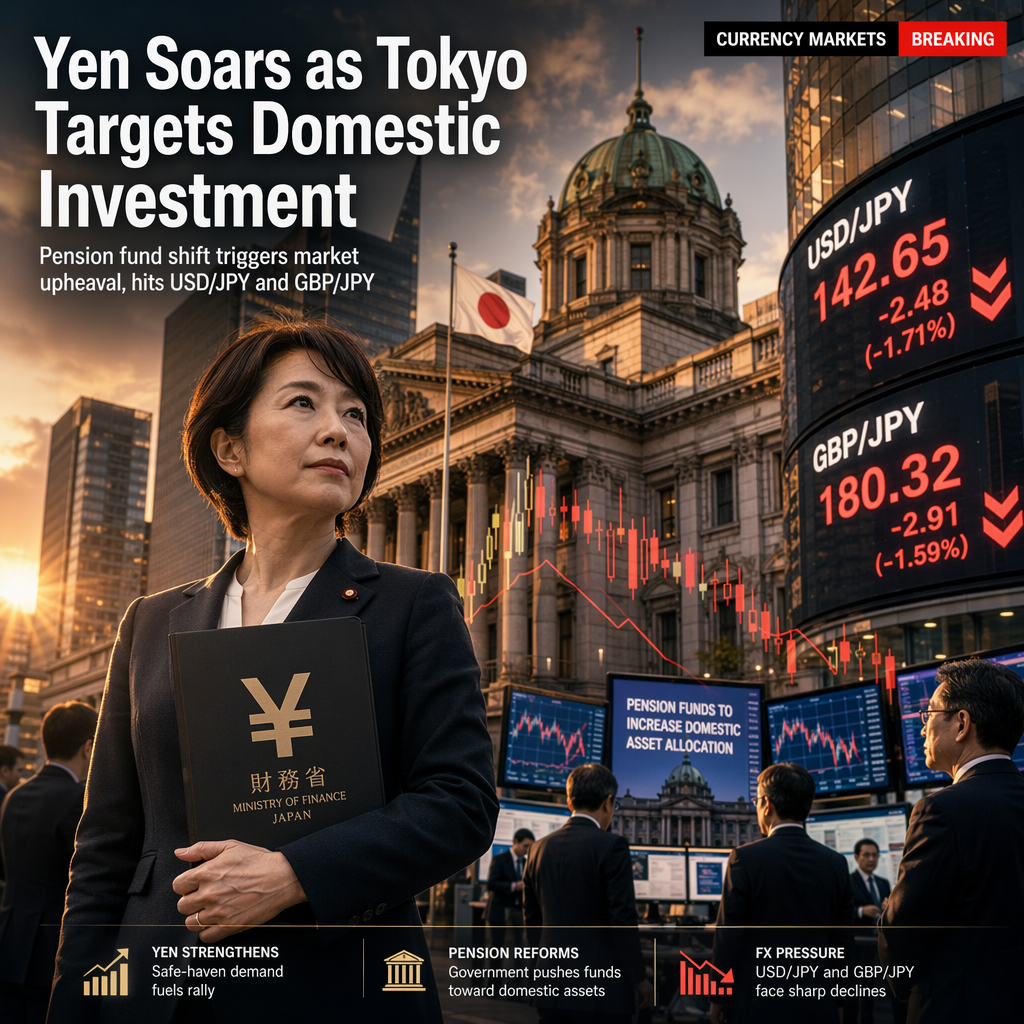
The Japanese Yen (JPY) rallied sharply across major currency pairs on Friday following an announcement by Japan’s Finance Minister Satsuki Katayama. Katayama stated that the government plans to encourage pension funds, which manage more than USD 1.8 trillion in assets, to increase their holdings of domestic financial assets. This move is seen as a more effective strategy to support the Yen than direct market interventions, and it immediately triggered aggressive JPY short-covering and a broad-based Yen recovery [2][4]. The government also anticipates gradual increases in interest rates as it pursues a proactive fiscal policy stance, and discussions are underway to expand Japanese Government Bond (JGB) products aimed at households [2].
The USD/JPY pair experienced a 100-pip reversal, with the Dollar holding losses below 161.75 and trading at 161.70, as technical indicators showed bearish momentum. Downside attempts have so far been contained near 161.30, with resistance at 161.75 and 162.30, while the 40-year high at 162.84 remains out of reach for now [4]. The GBP/JPY cross also saw heavy selling, dropping below 217.00 after reaching a 16-year high around 218.00 the previous day. The Yen was the strongest currency against the US Dollar and Canadian Dollar, with percentage gains of 0.44% and 0.47% respectively [2][4].
Despite the Yen’s strength, the British Pound drew support from reduced UK political uncertainty and expectations of a 25 basis points Bank of England rate hike by year-end, likely in December. This rate differential is expected to sustain the JPY carry trade, potentially limiting further losses for GBP/JPY [2]. Meanwhile, the US Dollar Index (DXY) recovered to near 100.85 but remained 0.1% down from Thursday’s close, as geopolitical tensions between the US and Iran faded and market focus shifted to rate differentials and upcoming US CPI data. ING analysts noted that fading geopolitical risk has kept the Dollar sidelined, with rate differentials moving against USD in some cases, and only modest upside risks for the Dollar if oil prices remain contained [5].
The Bank of Japan (BoJ) is expected to revise up its fiscal 2026 GDP forecast in the July quarterly report, while keeping interest rates unchanged but maintaining guidance to continue raising rates. The BoJ remains focused on the risk of inflation overshooting its target. The Japanese Yen showed no immediate reaction to these headlines, with USD/JPY down 0.45% to near 169.70 at press time, after recovering some early losses [1].
According to [1], the BoJ’s policy shift away from ultra-loose monetary policy in March 2024 has contributed to Yen strength, reversing the depreciation trend seen in previous years. However, [4] reports the Yen’s surge was primarily driven by the pension fund announcement, highlighting a discrepancy in the immediate catalyst for the Yen’s move.
CONCLUSION
The Japanese Yen’s surge was driven by government plans to redirect pension fund investments into domestic assets, resulting in sharp declines in USD/JPY and GBP/JPY. While the BoJ’s policy outlook and geopolitical factors played a role, market focus remains on rate differentials and technical levels. The Yen’s strength is expected to persist as domestic policy initiatives and rate expectations continue to influence currency markets.