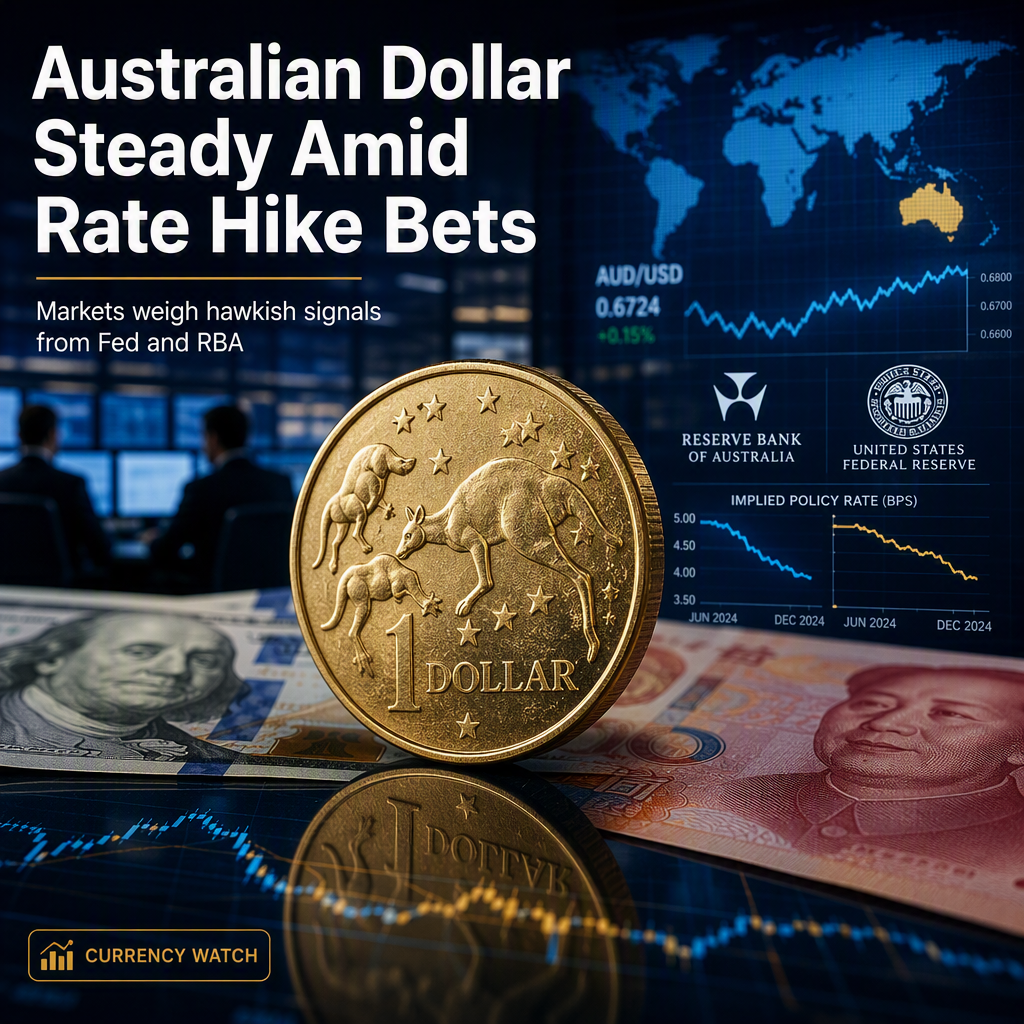
The Australian Dollar (AUD) remained firm on Monday, with the AUD/USD pair trading around 0.7167 as markets assessed hawkish expectations from both the Reserve Bank of Australia (RBA) and the US Federal Reserve (Fed) [1]. The US Dollar (USD) experienced a modest pullback, cushioning the downside for the AUD. This comes after Fed Chair Kevin Warsh's speech at the Jackson Hole symposium on Friday, where he emphasized that inflation remains well above target and reiterated the Fed's commitment to using interest rates as the primary tool to restore price stability [1]. Following Warsh's remarks, traders repriced the probability of a September Fed rate hike, with the CME FedWatch Tool indicating a 65% chance of a 25-basis-point increase at the next meeting [1]. This initially sent the USD to over one-week highs and pushed front-end Treasury yields higher, but the Greenback lost momentum on Monday, with the US Dollar Index (DXY) falling 0.27% to 99.41 [1].
Geopolitical tensions, particularly renewed hostilities between the US and Iran, have kept energy-driven inflation risks elevated, reinforcing the case for major central banks to maintain a hawkish stance [1]. On the Australian side, FX strategists at OCBC noted that while their base case is that the RBA has reached the end of its tightening cycle, stronger-than-expected CPI data and resilient household spending have increased the risk of another rate hike [1]. As a result, markets have fully priced in an additional 25bp hike by the end of 2026, up from around a 55% probability previously [1].
Looking ahead, OCBC remains constructive on the AUD over the next one to two quarters, citing its attractive carry and the potential for further Chinese policy stimulus as supportive factors [1]. Key upcoming data releases include Australia's Q2 Gross Domestic Product (GDP) figures and S&P Global PMI surveys for August, as well as China's RatingDog PMI for August, which is particularly significant given China's status as Australia's largest trading partner [1].
CONCLUSION
The Australian Dollar is holding steady amid shifting expectations for both the Fed and RBA, with markets now fully pricing in a potential RBA rate hike by end-2026. Upcoming economic data from Australia and China will be closely watched for further direction, while ongoing geopolitical tensions and inflation risks continue to influence central bank policy outlooks.