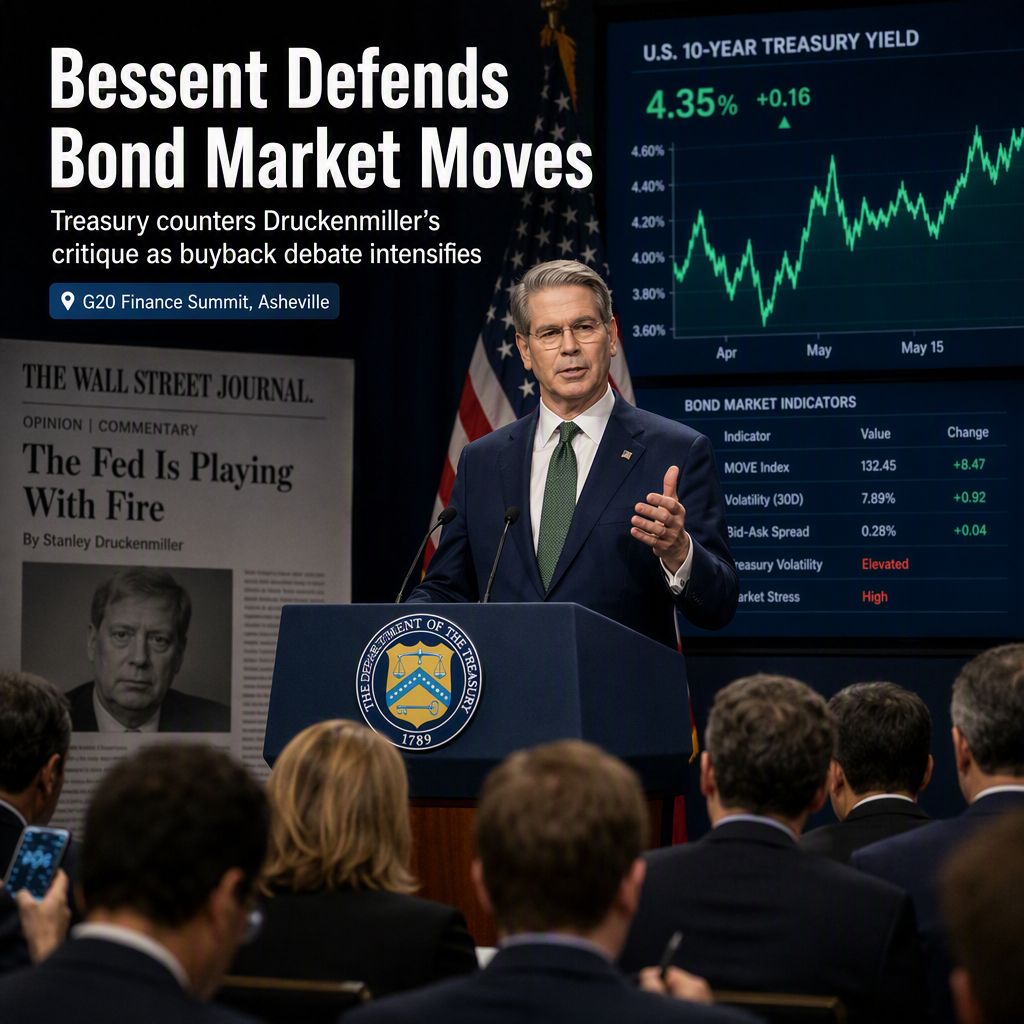
Treasury Secretary Scott Bessent publicly defended the Trump administration's recent intervention in the U.S. bond market, responding to pointed criticism from billionaire investor Stanley Druckenmiller. Speaking at the Group of 20 finance ministers meeting in Asheville, North Carolina, Bessent emphasized that the U.S. bond market has been the best performing market since President Trump took office, despite global trends of rising bond yields. Bessent stated, 'Not in the U.S. They're flat since the president came in,' countering observations that yields have increased worldwide [1].
Druckenmiller, in a Wall Street Journal op-ed published on August 24, described the Treasury's decision to more than double the size of its government debt repurchases as a 'mistake.' He argued that such interventions only postpone solvency concerns and ultimately increase the eventual cost, stating, 'You can't buy your way out of a solvency conversation with liquidity tools. You can only postpone the conversation and raise the eventual price.' Druckenmiller noted that the administration's announcement initially caused bond yields to drop sharply, but they rebounded the following day [1].
Bessent acknowledged having spoken with Druckenmiller after the op-ed was published, describing the conversation as 'fine,' but also remarked that Druckenmiller 'changes his mind a lot, and he doesn't like losing money,' suggesting that Druckenmiller may have lost money on the day his editorial was released. Bessent reiterated his commitment to ensuring that market fundamentals, not market participants, dictate policy, and highlighted that the U.S. remains the best performing bond market. He also indicated that the accelerated buyback of government debt could exceed the announced $4 billion [1].
The market implications of the intervention were immediate, with bond yields dropping sharply following the announcement, but then rebounding a day later. No specific forward-looking analyst opinions were provided, but Bessent's comments suggest a continued focus on fundamentals and potential for further buybacks beyond the $4 billion figure [1].
CONCLUSION
Treasury Secretary Bessent's defense of the administration's bond market intervention highlights a divide between policymakers and prominent investors like Druckenmiller. While the intervention temporarily impacted yields, the debate underscores ongoing concerns about the long-term effects of such policies. The U.S. Treasury may continue or even expand its buyback program, with market participants closely watching for further developments.