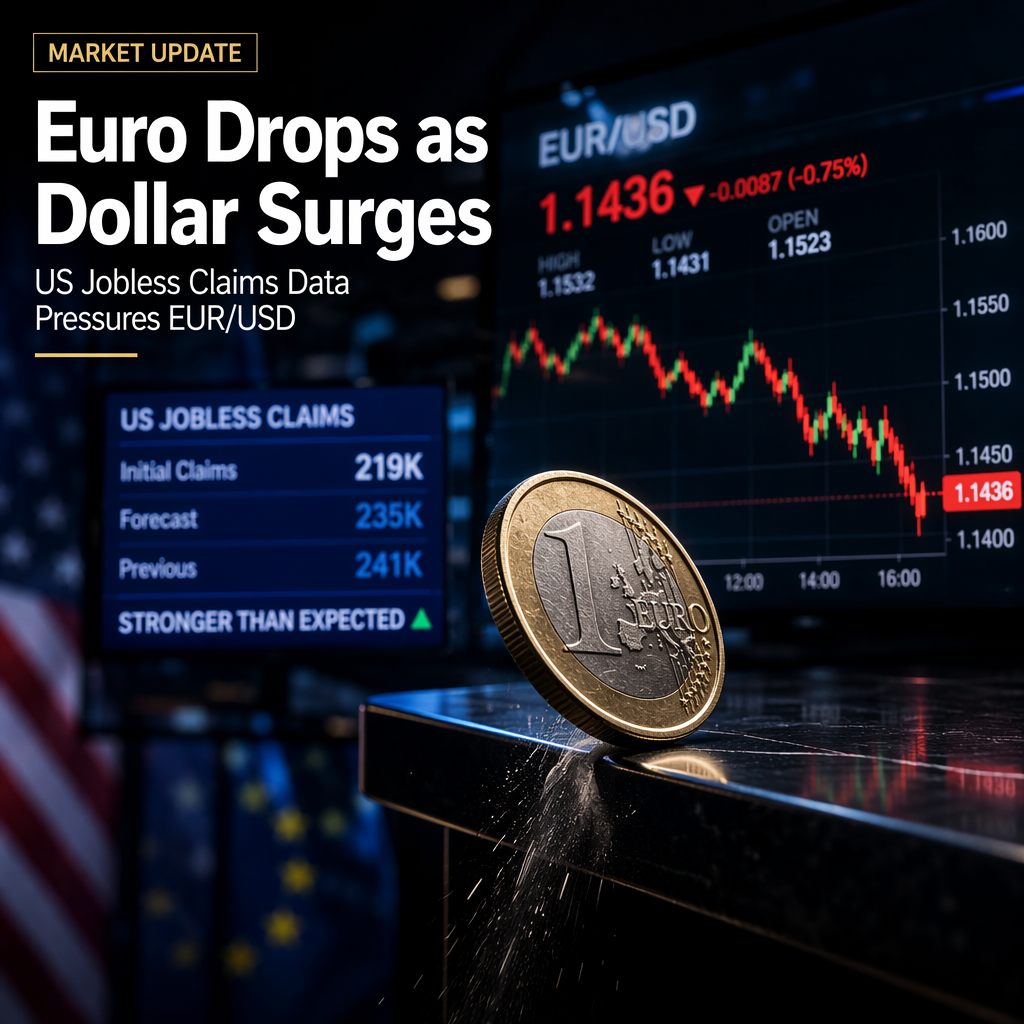
The Euro declined against the US Dollar on Thursday, with EUR/USD trading near 1.1440 and retreating approximately 0.2%. This movement was driven by stronger-than-expected US labor market data, which supported the Greenback. Specifically, US Initial Jobless Claims fell to 208,000 for the week ending July 11, outperforming expectations of 217,000 and the previous week's 216,000, indicating that layoffs remain limited and bolstering the US Dollar despite indications of softer consumer spending [1].
US Retail Sales increased by 0.2% month-over-month in June, aligning with expectations but slowing from May’s 1.0% rise. The Retail Sales Control Group also advanced 0.5%, matching forecasts but below the prior 0.8%, suggesting a moderation in consumption momentum [1].
In the Eurozone, investors are awaiting June inflation data. The Core Harmonized Index of Consumer Prices (HICP) inflation is expected to remain at 2.4% year-over-year and 0.2% month-over-month, while headline HICP is forecast to decline 0.1% on the month. A softer inflation reading could reinforce expectations for a less restrictive European Central Bank (ECB) policy stance, potentially placing additional pressure on the Euro [1].
From a technical perspective, EUR/USD trades at 1.1436, maintaining a mildly bullish bias as it remains above both the 20-period Simple Moving Average (SMA) at 1.1428 and the 100-period SMA at 1.1413. The Relative Strength Index (RSI) around 50 suggests balanced momentum, with dips potentially attracting buying interest as long as the pair stays above the moving average floor. Key resistance levels are noted at 1.1447, 1.1457, 1.1466, and 1.1472, while immediate support is seen at the 20-period SMA (1.1428) and stronger support at the 100-period SMA (1.1413). A sustained drop below the latter could weaken the current constructive tone and lead to deeper consolidation [1].
CONCLUSION
Stronger-than-expected US jobless claims data has strengthened the US Dollar and pressured the Euro, with EUR/USD trading lower. Investors are now focused on upcoming Eurozone inflation data, which could influence expectations for ECB policy and further impact the currency pair.