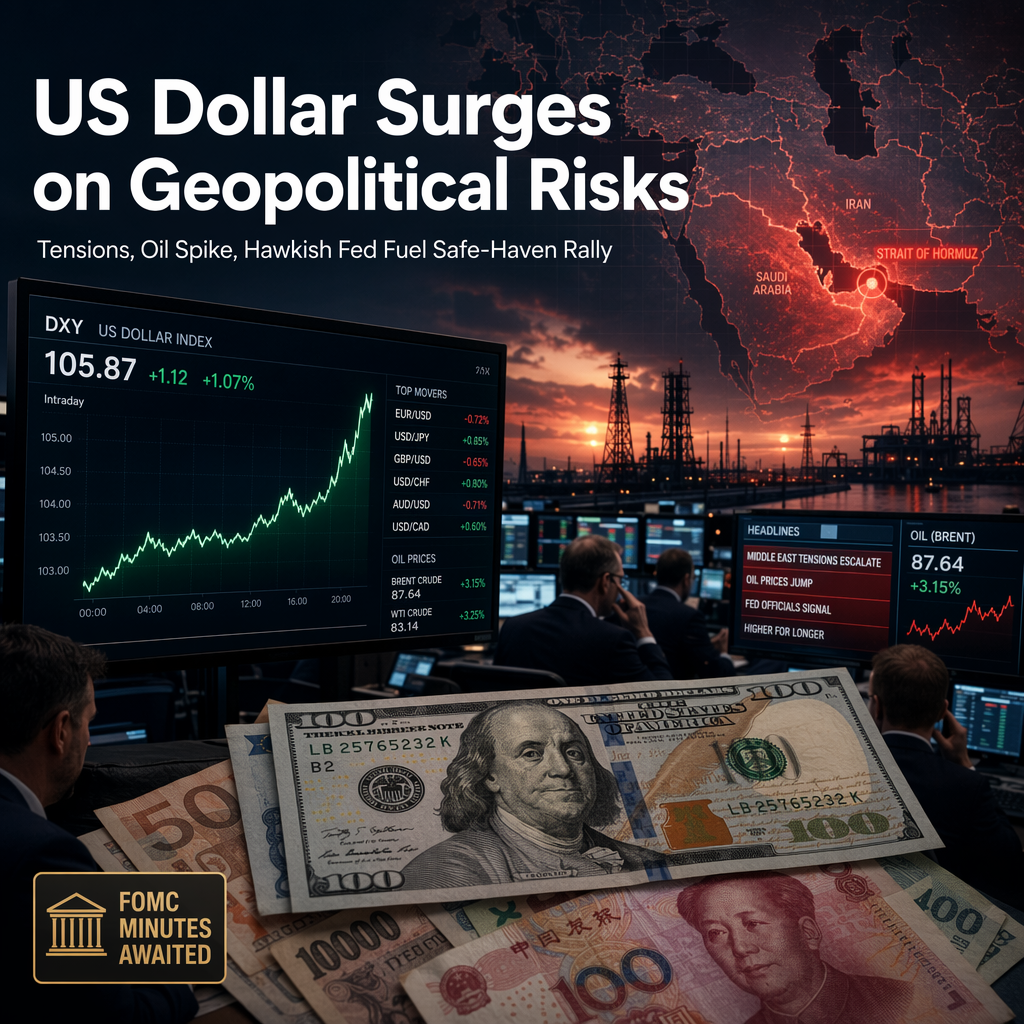
The US Dollar Index (DXY) climbed to a five-day high around 101.20 on Wednesday, supported by renewed geopolitical tensions between the United States and Iran, as well as increased market expectations for a Federal Reserve rate hike in September [1][3]. President Donald Trump declared the ceasefire deal with Iran 'over,' and warned of potential further military action, including the possibility of taking over Kharg Island. Iran responded by threatening to close the Strait of Hormuz if attacked again, escalating concerns in the region [1]. However, Reuters reported that Trump did not repeat these remarks during a closed NATO meeting, highlighting some uncertainty in official statements [1].
The heightened tensions pushed West Texas Intermediate (WTI) crude oil prices up to $74.50 per barrel, marking an increase of more than 8% for the week and reviving inflation concerns [1][3]. The US Dollar benefited from its safe-haven status, with the strongest gains against the Japanese Yen (+0.36%) and moderate moves against other major currencies [1]. The Australian Dollar (AUD) remained under pressure, trading near 0.6920, as risk-off sentiment weighed on growth-sensitive currencies. Technical analysis showed AUD/USD below key moving averages, with resistance at 0.6925 and support at 0.6907 [2].
Market participants are closely watching the release of the June Federal Open Market Committee (FOMC) meeting minutes, the first under Fed Chair Kevin Warsh, scheduled for 18:00 GMT. According to the CME FedWatch Tool, the probability of a September rate hike has risen to 68%, up from 58% the previous day [1]. ING FX strategist Francesco Pesole expects the minutes to 'cement the hawkish message' and support the US Dollar, though he does not anticipate a major repricing of interest rate expectations following last week's softer US jobs report [1][3]. Pesole also notes that equity jitters and firm oil prices have reinforced the Dollar's safe-haven appeal, and expects DXY to remain rangebound with upside risks to 101.50-102.0 unless large JPY interventions occur [1][3].
Trump's additional comments about cutting off all trade with Spain and calling Madrid a 'terrible partner' in NATO contributed to broader market uncertainty, but had limited direct impact on AUD/USD [2]. Meanwhile, China's Manufacturing PMI improved to 50.3 in June and Non-Manufacturing PMI rose to 50.2, suggesting fragile expansion and influencing Australia's commodity outlook [2].
According to [1] and [3], the market's focus remains on the Fed's hawkish stance and the upcoming FOMC minutes, which are expected to clarify the seriousness of potential rate hikes. While the Dollar is supported by geopolitical risks and tightening expectations, analysts anticipate mostly rangebound trading in the near term, with modest upside risks.
CONCLUSION
The US Dollar Index has strengthened on the back of Middle East tensions and expectations of a hawkish Federal Reserve, with oil prices surging and risk-off sentiment pressuring growth-sensitive currencies like the Australian Dollar. Analysts expect the FOMC minutes to reinforce the Fed's hawkish message, supporting the Dollar but not triggering a major repricing of rate expectations. Market participants remain focused on macroeconomic developments and geopolitical risks, with the Dollar likely to trade in a range with some upside potential.