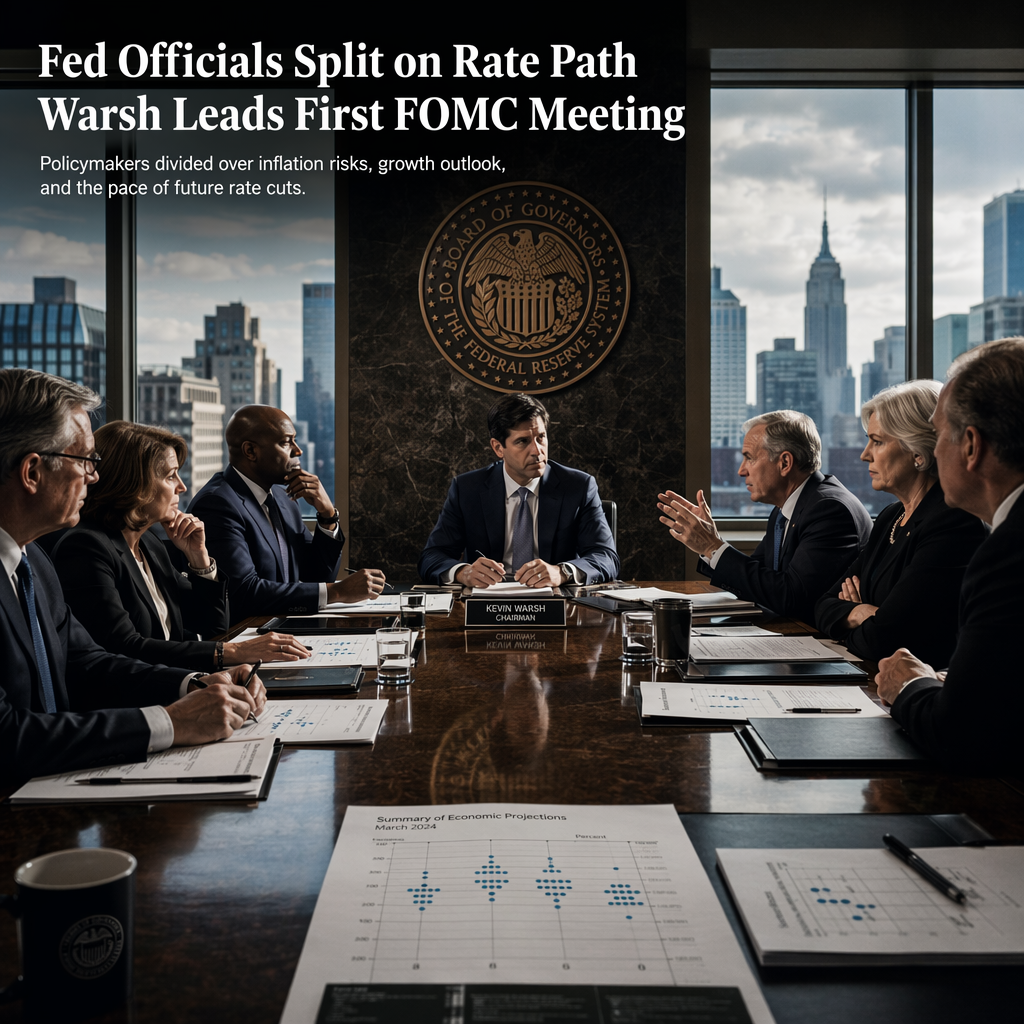
Federal Reserve officials were divided on the future direction of interest rates during the June 16-17 meeting, which was Kevin Warsh's first as chairman of the Federal Open Market Committee (FOMC), according to minutes released on July 8, 2026 [1]. Policymakers discussed scenarios in which inflation could ease, potentially allowing for lower rates, while others considered the possibility of persistent price increases that might necessitate rate hikes [1]. Despite these differing views, the committee unanimously voted to keep the Fed's benchmark funds rate unchanged in the 3.5%-3.75% range, where it has remained throughout 2026 [1].
The minutes highlighted that "many participants indicated that the appropriate level of the federal funds rate would be within or slightly below the current target range at the end of this year," while "many other participants... assessed that the appropriate level... would be above the current target range at the end of this year" [1]. The dot-plot grid of individual members' expectations, which did not include Warsh, narrowly tilted toward one rate hike this year, followed by a cut in each of the next two years [1].
The meeting summary emphasized that future policy actions would depend on incoming information, reflecting the committee's data-dependent approach [1]. Notably, the post-meeting statement was significantly shorter than usual, aligning with Warsh's view that Fed officials should communicate less about future intentions [1]. The statement also removed prior language indicating an easing bias, with most participants preferring not to repeat such language [1].
Overall, the minutes provided a broad overview of the two-day session, during which the FOMC reaffirmed its commitment to restoring price stability and streamlined its communication to the public [1].
CONCLUSION
The Federal Reserve remains divided on the direction of interest rates, with no clear consensus among officials on whether to raise or lower rates by year-end. The committee's unanimous decision to hold rates steady and its shift toward more concise communication signal a cautious, data-driven approach amid ongoing economic uncertainty.