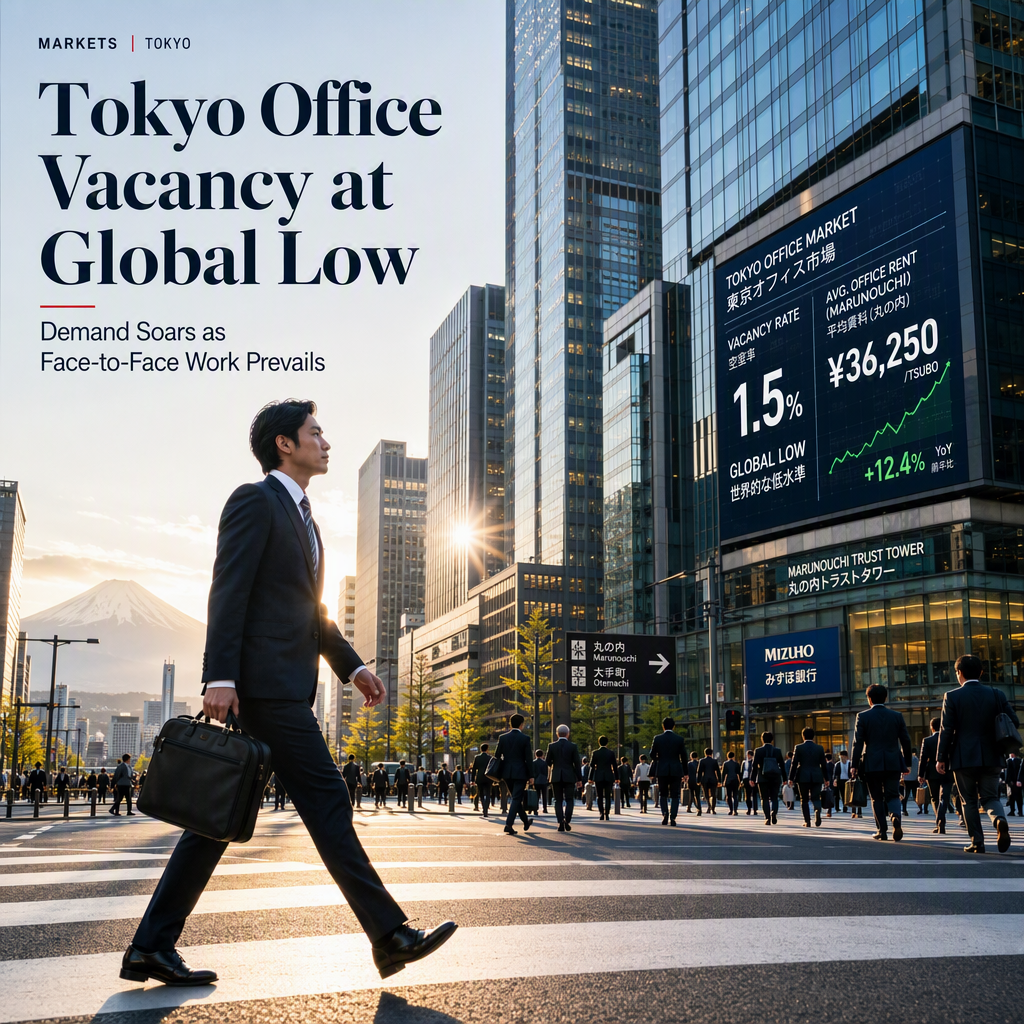
Tokyo's office vacancy rate dropped to 1.5% in the first quarter of the year, marking the lowest level among major global cities, as companies increasingly bring employees back to the workplace for face-to-face collaboration [1]. This trend contrasts sharply with other global cities, where remote work remains prevalent and office occupancy continues to decline [1]. The slower adoption of artificial intelligence-driven work processes in Japan has contributed to sustained demand for office space, as traditional working styles persist [1].
The tight market conditions have pushed Tokyo office rents to fresh three-decade highs, with vacancy rates falling below 2% for the first time since the pandemic began [1]. Market analysts attribute the resilience of Tokyo's office sector to cultural preferences for in-person work and corporate policies emphasizing employee presence [1]. Financial data from the first quarter shows continued strength in the office property sector, with rents rising and occupancy rates tightening [1].
Investor and developer sentiment remains positive, with expectations of further rental growth as demand continues to outpace supply [1]. Technical analysis indicates strong support for Tokyo office rents at current levels, with resistance likely if vacancy rates rise above 2% [1]. Local brokers advise that Tokyo office assets are attractive for long-term investors due to stable fundamentals and low risk of oversupply [1].
Tokyo and Seoul are noted as exceptions to the global trend, maintaining strong demand for office properties while other major cities experience declining occupancy and an exodus from their capitals [1]. Market analysts highlight Tokyo's unique position in its quick recovery and sustained demand post-pandemic, supported by a stable economic environment and conservative adoption of AI technologies [1].
CONCLUSION
Tokyo's office property market stands out globally, with vacancy rates at historic lows and rents at multi-decade highs. The city's preference for face-to-face work and gradual adoption of AI technologies continue to drive robust demand, making Tokyo a highly attractive market for investors and developers. Market sentiment remains positive, with expectations of further rental growth as supply remains tight.