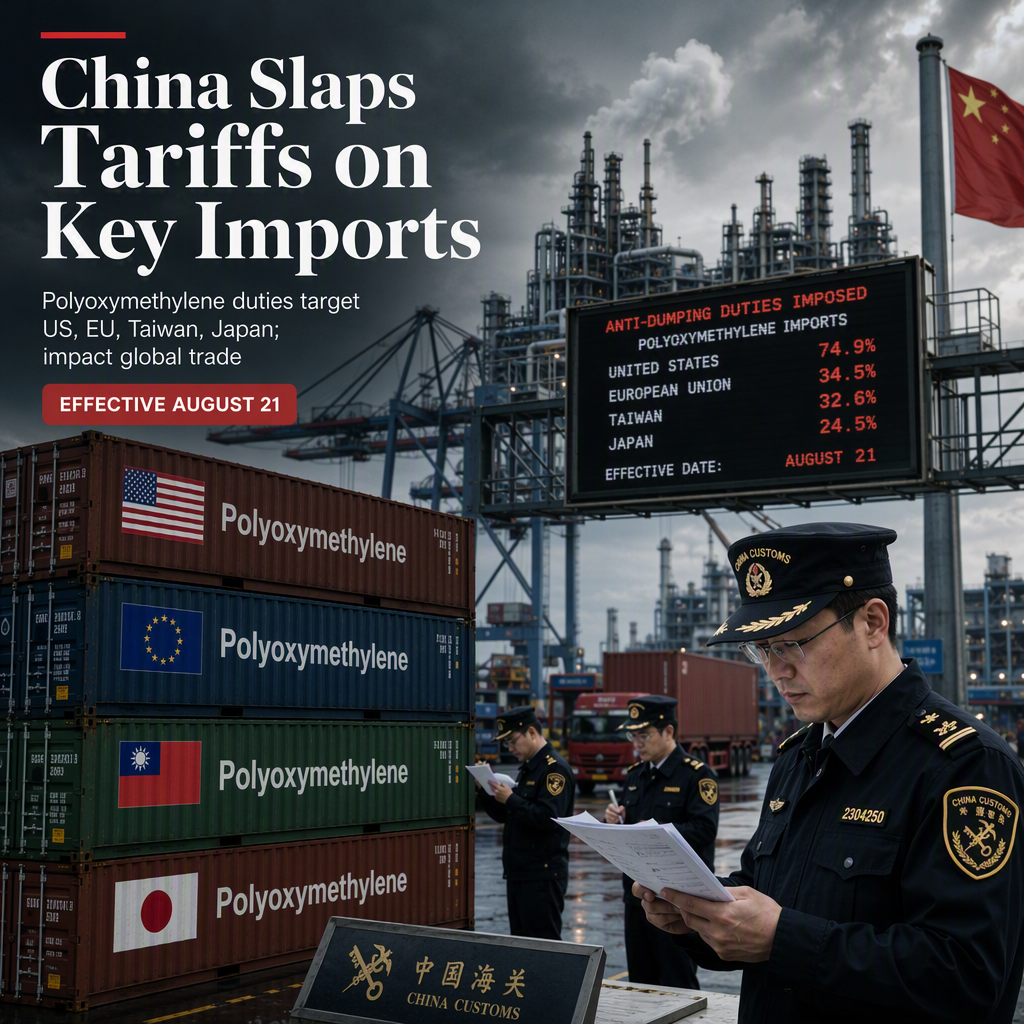
China's Commerce Ministry announced on Thursday that it will impose anti-dumping tax rates on imported polyoxymethylene from the United States, European Union, Taiwan, and Japan, effective August 21 [1]. Specific corporate tax rates were detailed: Daicel Corporation will face a 35.5% anti-dumping duty rate, Daicel HPP Taiwan Co., Ltd. will be taxed at 3.8%, Polyplastics Co., Ltd. will be subject to a 35.5% rate, and Polyplastics Taiwan Co., Ltd. will face a 32.6% duty rate [1].
The announcement is part of China's ongoing efforts to protect domestic producers from foreign competition by levying tariffs on imported goods. Tariffs, as explained in the article, are customs duties designed to give local manufacturers a price advantage over imported products [1]. The move is likely to impact international trade flows and could affect the competitiveness of foreign polyoxymethylene producers in the Chinese market.
Market reaction to the news was evident, with the AUD/USD trading 0.17% lower on the day at 0.7112, suggesting a modest negative sentiment in currency markets following the announcement [1].
The article also provides context on global tariff strategies, noting that US President Donald Trump has indicated plans to use tariffs to support American producers and lower personal income taxes, particularly targeting imports from Mexico, China, and Canada [1]. However, the focus of this news is on China's anti-dumping measures targeting polyoxymethylene imports.
CONCLUSION
China's decision to impose anti-dumping duties on polyoxymethylene imports from several major economies is expected to impact international trade and the competitiveness of affected companies. The immediate market reaction was a slight decline in the AUD/USD, reflecting cautious sentiment. The new tariffs, effective August 21, signal China's continued use of protectionist measures to support domestic industries.