
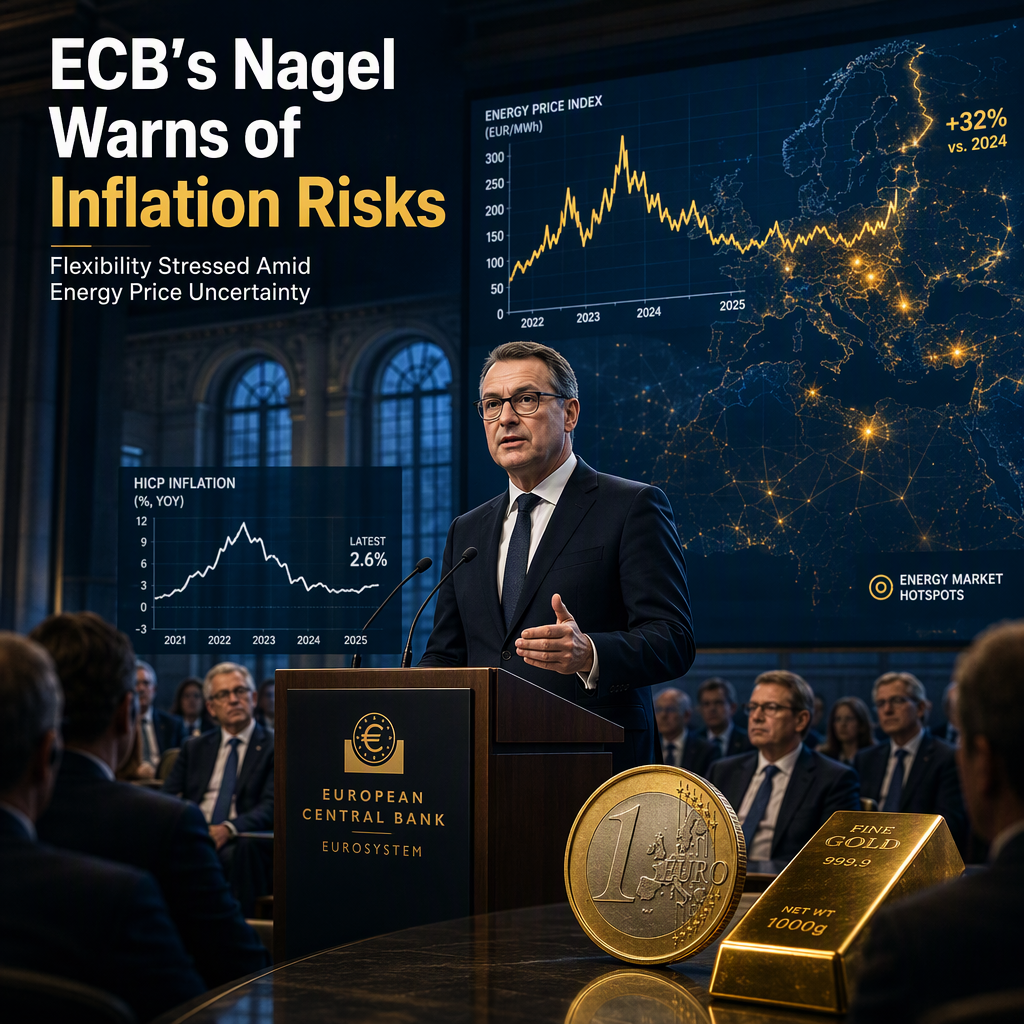
European Central Bank (ECB) policymaker and Bundesbank President Joachim Nagel stated in a speech in Sorrento, Italy, that there are currently no clear signs that inflation has fed through to price and wage setting, indicating that the impact of energy shock-driven inflation has not yet translated into wage growth [1]. Nagel emphasized that longer-term market-based and expert expectations remain consistent with the Eurosystem’s 2% inflation target [1].
Nagel highlighted that upward risks dominate the inflation outlook, citing factors such as low gas storage levels, the need for Europe to purchase substantially higher volumes during the winter, destruction of refining capacity driving up refined petroleum product prices, and additional risks to food prices from drought, wildfires, and fertilizer shortages [1]. He noted that these risks increase the relative attractiveness of bonds among reserve asset managers and that the case for diversification into gold remains significant due to ongoing geopolitical stress and credit risk associated with high debt levels [1].
Nagel’s comments were interpreted as a modest hawkish shift, with a 7.2/10 FXS Speechtracker score compared to his historic average of 6.6/10, suggesting reluctance to ease policy quickly and reinforcing a bias toward keeping options open for further tightening if needed [1]. Despite this, the Euro (EUR) showed no immediate reaction, with EUR/USD down 0.3% to near 1.1215 at press time, even after recovering most of its early losses [1].
Nagel’s stance that “uncertainty calls for flexibility, not inaction” signals that the ECB is not committing to a dovish stance and may consider further tightening if inflation risks persist, supporting expectations of a more persistent anti-inflation policy [1].
CONCLUSION
ECB’s Nagel underscored significant upward inflation risks and advocated for policy flexibility, signaling a modestly hawkish stance. While the Euro showed little immediate reaction, markets may reassess the path of future rate cuts in light of persistent inflation concerns and energy market vulnerabilities.