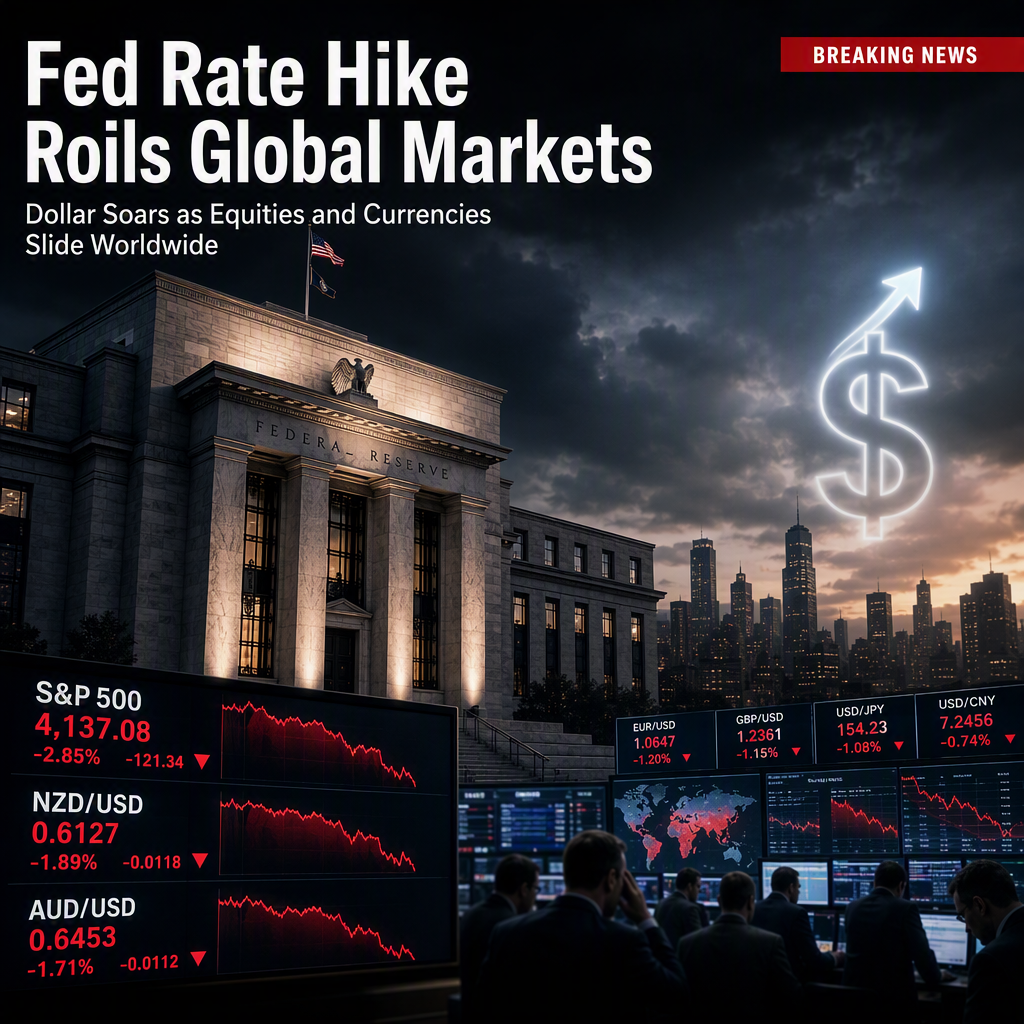
The Federal Reserve raised its benchmark interest rate by 25 basis points to a range of 3.75%–4.00% on September 16, 2026, marking its first rate hike since 2023 and signaling at least one more increase before year-end according to its latest projections [1]. The decision was unanimous, with Chair Kevin Warsh emphasizing persistent inflation as the central concern and highlighting the resilience of the U.S. economy, but refraining from pre-committing to further tightening, instead stressing data dependence amid ongoing geopolitical uncertainty [1]. The move was framed as supporting a 'timelier return' to the Fed's 2% inflation target, with the dot plot indicating at least one additional hike in 2026 [1].
The market reaction was swift and broad-based. The U.S. dollar surged, while stocks, gold, and oil all declined. The S&P 500, for example, climbed through the morning to about 7,618 before reversing and sliding to around 7,523 after the Fed's announcement [1]. The U.S. 10-year yield and other asset classes also responded sharply to the news [1].
The impact of the Fed's hike was felt globally, particularly in currency markets. The New Zealand Dollar (NZD/USD) fell for six consecutive sessions, dropping from near 0.5900 on September 8 to just above 0.5700 after the Fed's decision, approaching its July low of 0.5625 [2]. Despite the Reserve Bank of New Zealand raising its cash rate to 2.75% on September 2, the widening gap with the Fed's new midpoint of 3.875% contributed to the Kiwi's decline [2]. The Fed's upward revision of U.S. growth forecasts and removal of any rate cuts from 2027 projections further pressured risk-sensitive currencies like the NZD [2].
Similarly, the Australian Dollar (AUD/USD) slid for four out of the last five sessions, falling from a September high near 0.7250 to just under 0.7100, breaking below its 50-day average for the first time in six weeks [3]. This occurred despite the Reserve Bank of Australia's higher cash rate of 4.35% and expectations of another hike before year-end [3]. The AUD's decline was attributed to the global risk-off sentiment and the U.S. dollar's strength following the Fed's hawkish stance, with the largest drop occurring on the day of the Fed's announcement [3].
Forward-looking, the Fed's projections suggest at least one more rate hike in 2026, while the RBNZ and RBA both signal potential further tightening, though the market is currently pricing in a pause for the RBNZ in October and a possible hike in December [2][3]. Upcoming economic data, such as New Zealand's Q2 GDP and Australian central bank commentary, may influence future moves, but for now, the market bias for both NZD/USD and AUD/USD remains bearish below key resistance levels [2][3].
CONCLUSION
The Federal Reserve's rate hike to 3.75%–4.00% and hawkish outlook triggered a sharp rally in the U.S. dollar and broad declines in global equities and risk-sensitive currencies, including the New Zealand and Australian dollars. Despite higher domestic rates in New Zealand and Australia, both currencies fell as investors favored the dollar amid expectations of sustained U.S. growth and higher rates. The market remains cautious, with further moves likely dependent on upcoming economic data and central bank signals.