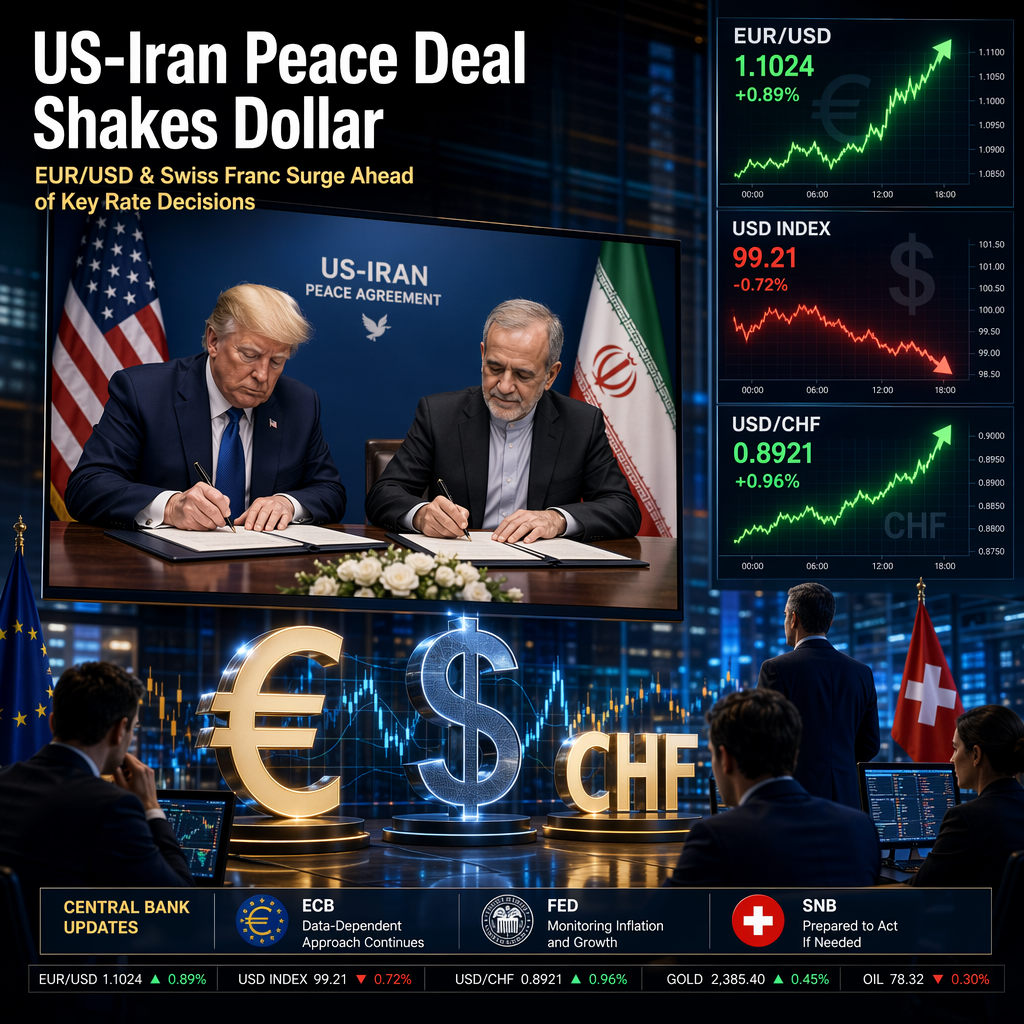
The US Dollar weakened against both the Euro and the Swiss Franc on Thursday following the announcement of an interim agreement between the United States and Iran to end hostilities and reopen the Strait of Hormuz. This development boosted investor confidence and prompted profit-taking on the USD after its recent rally to a high not seen since late March [1][2]. Specifically, the EUR/USD pair rebounded from its lowest level since late March (1.1480-1.1475) to reach a fresh daily high around 1.1525 during the Asian session, supported by the softer USD and a hawkish signal from the European Central Bank (ECB) [1]. Meanwhile, the USD/CHF pair lost momentum, trading around 0.7985 in the early European session, as the Swiss Franc strengthened ahead of the Swiss National Bank's (SNB) rate decision [2].
The US-Iran deal was signed electronically by US President Donald Trump and Iran’s President Masoud Pezeshkian, with Pakistan’s Prime Minister Shehbaz Sharif stating that the agreement is taking immediate effect after being signed by both Washington and Tehran [2]. The ECB's hawkish stance provided additional support to the Euro, while expectations for a US Federal Reserve (Fed) rate hike in December could limit further USD losses and cap gains in the EUR/USD pair [1]. The Fed left interest rates unchanged at 3.50%-3.75% during its June policy meeting but signaled the possibility of higher rates later in the year as it monitors inflation effects from the Iran conflict [2]. Traders have now fully priced in a rate hike in the coming months, with the Fed prioritizing price stability [2].
Technical analysis indicates that the EUR/USD remains below the 200-period Simple Moving Average (SMA) on the 4-hour chart, maintaining a bearish near-term tone. The Moving Average Convergence Divergence (MACD) is in negative territory, and the Relative Strength Index (RSI) is around 38, suggesting persistent downside pressure despite the recent recovery [1]. Key resistance levels for EUR/USD are noted at 1.1575-1.1580 and 1.1600, with the 200-period SMA at 1.1638 acting as a strong barrier. A drop below 1.1500 could expose the pair to further weakness [1].
For the Swiss Franc, the SNB is expected to keep its key policy rate at 0% at the June meeting and for the rest of the year, according to a Reuters poll of economists [2]. Bank of America’s Europe economist Chiara Angeloni stated, “Our base case remains the zero‑interest‑rate policy stays in place until end-2027,” citing Switzerland’s low inflation and the opposing forces from FX and energy prices [2].
CONCLUSION
The US-Iran peace agreement has triggered a broad weakening of the US Dollar, lifting both the Euro and Swiss Franc ahead of key central bank decisions. While the ECB’s hawkish tone supports the Euro, expectations for a Fed rate hike may limit further USD losses. The SNB is anticipated to maintain its zero-interest-rate policy, reinforcing the Swiss Franc’s safe-haven appeal.