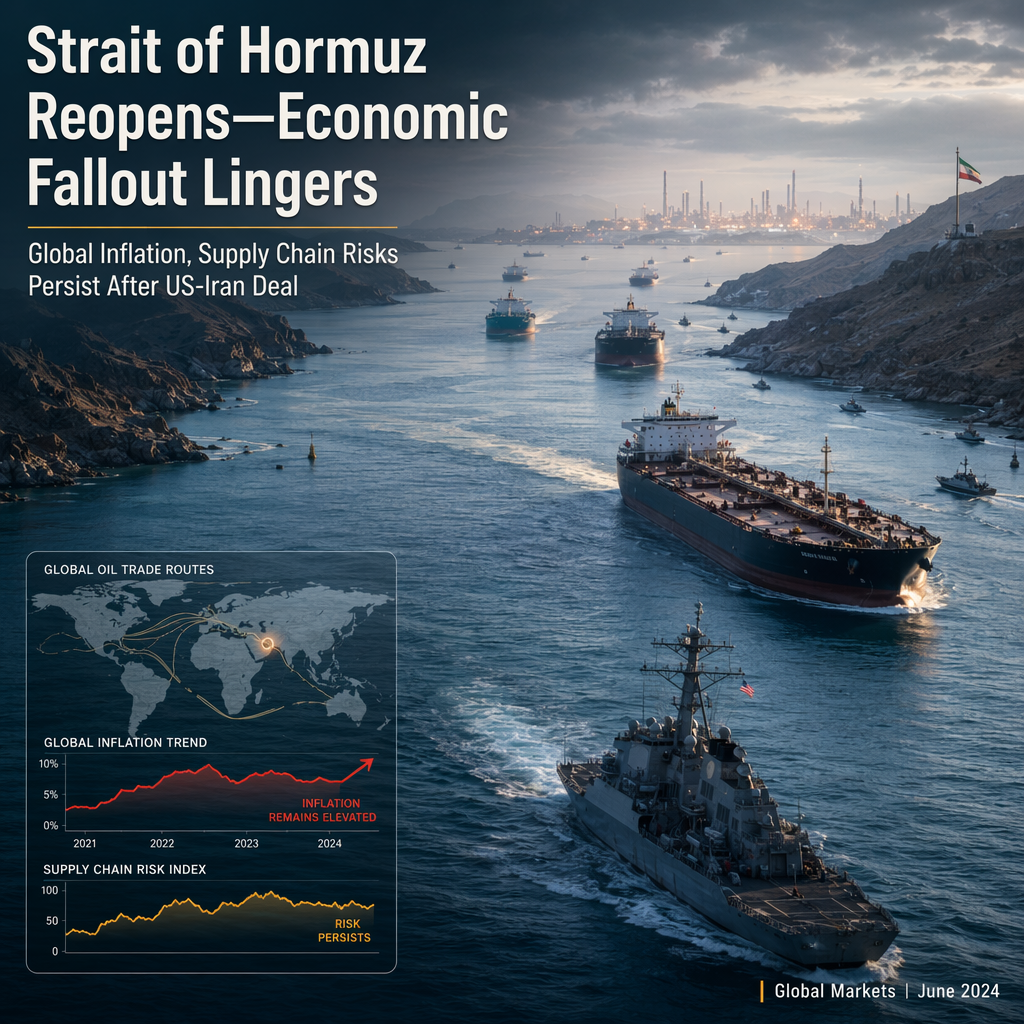
The United States and Iran have signed a 60-day memorandum of understanding to reopen the Strait of Hormuz, easing immediate risks to global energy supplies and the broader economy after nearly four months of war that disrupted supply chains and drove up inflation [1][2]. According to Rabobank, the agreement has kept the Strait open, though ship crossings remain limited, and the US ended its naval blockade ahead of the previously agreed 30-day deadline [1]. However, Iran may introduce maritime fees for ships crossing the waterway after the 60-day negotiating period, a move opposed by President Trump, leaving future oil transit costs and geopolitical risks unresolved [1].
Analysts cited by CNBC warn that while the reopening of the Strait has reduced the most acute threat to energy supplies, the economic damage from the conflict will take months to unwind [2]. Simon MacAdam of Capital Economics noted that higher inflation is already 'baked in' across many economies, with energy and fertilizer price increases expected to take months to filter through to end-consumers [2]. Oil prices have retreated to around $80 a barrel, down from a peak of $118 in March during the height of the conflict, and Goldman Sachs has cut its oil price forecast, projecting Brent to average $80 in late 2026 and $75 in 2027 due to a faster-than-expected recovery in Persian Gulf crude flows [2].
The World Bank recently lowered its global economic growth forecast to 2.5%, the slowest pace since the pandemic, and expects global inflation to rise to 4% this year, up from 3.3% in 2025, even if oil flow disruptions ease soon [2]. Fertilizer prices could increase by as much as 38% this year due to supply disruptions and shortages of key inputs from the Gulf [2]. Europe is expected to face particular pressure, with natural gas storage levels historically low and inflation in Europe and Japan projected to rise by an additional 3 to 4 percentage points as US liquefied natural gas export prices increase [2].
Central banks have responded to the crisis with policy adjustments. The European Central Bank raised interest rates last week for the first time in nearly three years, while the Bank of England and the US Federal Reserve kept rates unchanged but signaled a more hawkish stance [1][2]. The Fed, under new Chairman Kevin Warsh, raised its forecast for personal consumption expenditures inflation to 3.6% by December, up from 2.7% projected in March, and nine of the 18 voting members expect at least one rate hike before year-end [2]. The Bank of England described its unchanged rate as an 'active hold,' reflecting the ongoing uncertainty [1][2].
Both sources highlight that, despite the immediate relief from the reopening of the Strait, logistical delays, backlogs of vessels, and the potential introduction of maritime fees by Iran could further delay a full recovery in freight flows and energy markets [1][2].
CONCLUSION
The reopening of the Strait of Hormuz has alleviated immediate risks to global energy supplies, but both sources emphasize that the economic fallout, including elevated inflation and supply chain disruptions, will persist for months. Central banks remain cautious, with policy tightening and inflation forecasts revised upward, reflecting ongoing uncertainty and the potential for further market volatility.