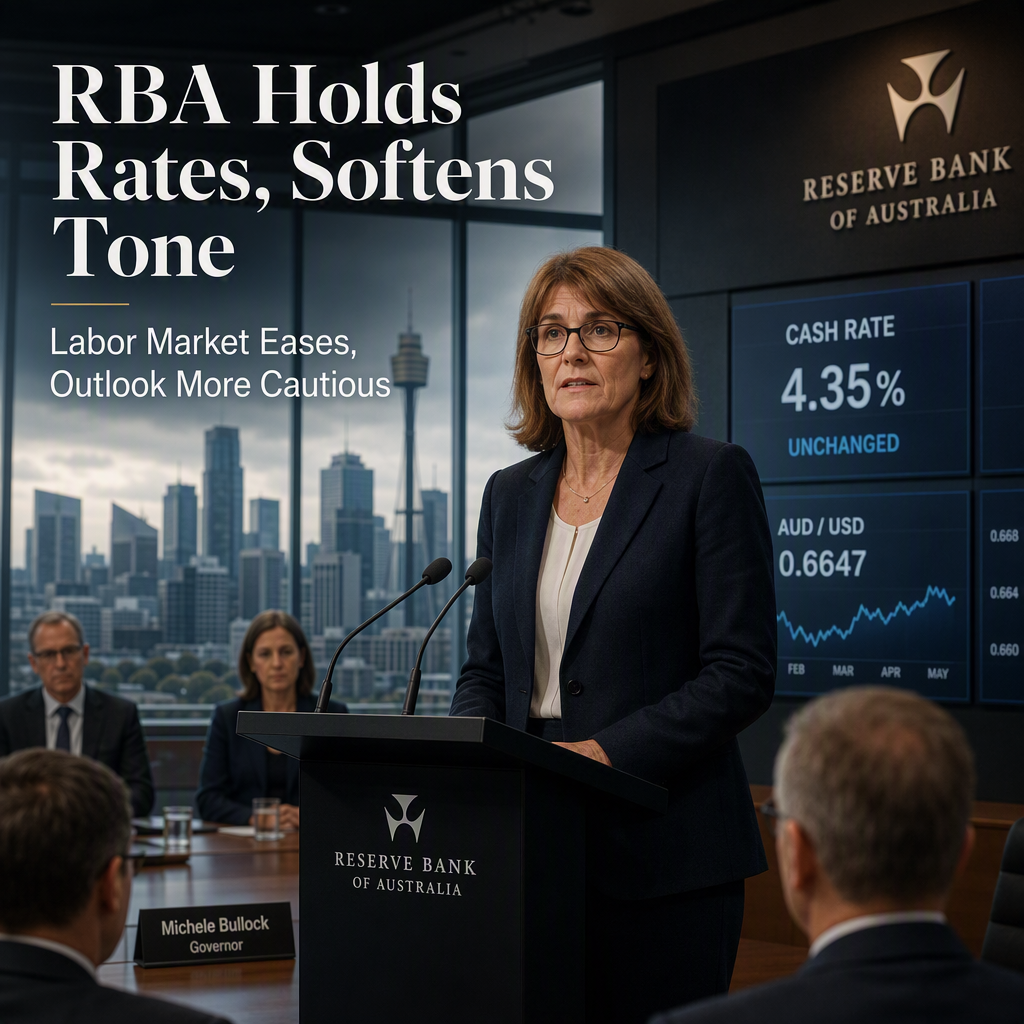
The Reserve Bank of Australia (RBA) maintained its policy rate at 4.35% for the second consecutive meeting, a decision that was widely anticipated by the market and reached unanimously by the Board. The RBA described its current policy as 'somewhat restrictive' and acknowledged that labor market conditions have eased more than expected in recent months [1].
While the central bank reiterated that 'inflation is still too high' and noted that 'risks to inflation are judged to be skewed to the upside,' it softened its hawkish stance. The Board's guidance shifted, now stating it is prepared to 'increase the cash rate further if upside risks [to inflation] materialise,' compared to the previous, more open-ended 'if needed' language [1]. The RBA also updated its forecasts, raising the unemployment rate projection across the forecast horizon and lowering its trimmed mean inflation projections through June 2027 [1].
Following the policy announcement, the AUD/USD currency pair dipped briefly but recovered most of its losses during Governor Michele Bullock’s press conference. Bullock emphasized that it was 'quite possible' a further rate hike could be necessary, highlighting that Australia’s economy is still operating above capacity [1].
Despite the softened hawkish bias, the Australian dollar remains supported by attractive carry and the country's strategic exposure to commodities linked to energy, AI, and defense sectors [1].
CONCLUSION
The RBA's decision to hold rates and soften its hawkish guidance signals a more cautious approach amid easing labor market conditions. While the risk of further hikes remains if inflation pressures re-emerge, the market reaction was muted, with the AUD/USD quickly recovering. The outlook for the Australian dollar continues to be underpinned by favorable carry and commodity exposure.