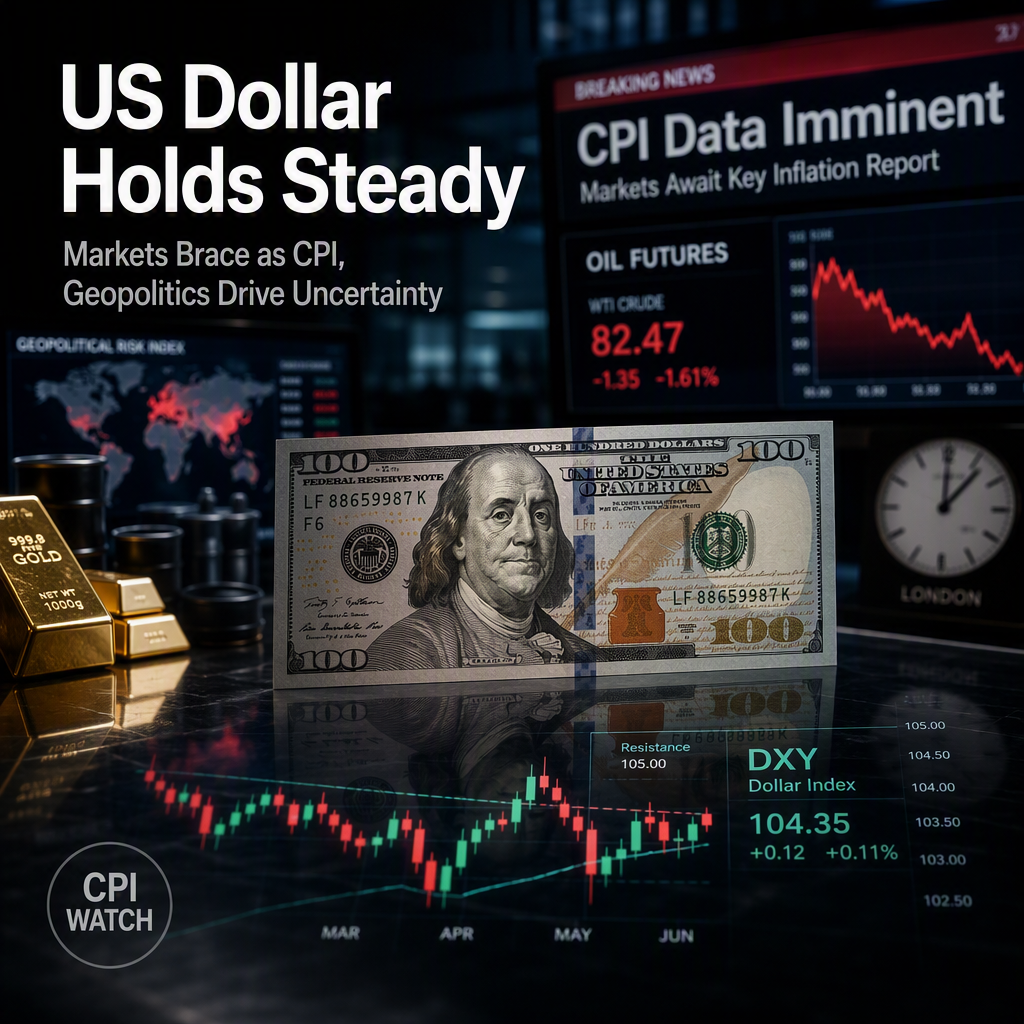
The US Dollar (USD) has remained largely rangebound ahead of the upcoming US Consumer Price Index (CPI) release, with market participants closely watching for any upside surprise that could shift Federal Reserve (Fed) rate hike expectations for the September meeting [1][5]. Analysts at OCBC note that unless core CPI prints at 0.3% MoM or higher in July, above the 0.2% consensus forecast, expectations for a September rate hike are unlikely to materially increase [1][5]. The Dollar Index (DXY) trades at 99.85, approaching the key 100.00 resistance level, with technical indicators showing a shift into bullish territory but not yet confirming a decisive trend [5]. The USD was the strongest against the British Pound, with a daily change of -0.13% for GBP/USD [5].
Weak US Nonfarm Payrolls (NFP) data for July, described by ING as "surprisingly weak" with a 23k monthly decline and 103k downward revisions to previous months, has led traders to pare back hawkish Fed bets. The CME FedWatch tool shows the odds of the Fed holding rates steady in September have increased to 50% from 30.4% a month ago [2]. Despite this, rising oil prices driven by the US-Iran standoff have brought inflation concerns back into focus, with the CME FedWatch tool indicating a 51.9% chance of a rate hike at the September meeting [3].
Geopolitical tensions, particularly regarding the reopening of the Strait of Hormuz, have kept oil prices elevated (WTI at $81.30, up over 6% this week) and supported the USD near recent lows [3]. Iran has set firm conditions for reopening the Strait, including demands for reparations and lifting sanctions, while President Trump has responded with his own compensation demands [3]. Qatar reports positive progress in negotiations between Iran and Oman [3]. These developments have also underpinned gold prices, with XAU/USD pausing near two-month highs at $4,435 before pulling back to $4,390 [3]. Debasement concerns and scrutiny of Fed independence, including reported attempts to remove Fed Governor Lisa Cook and frequent contact between President Trump and Fed Chair Kevin Warsh, have added pressure on the USD and supported gold [1].
In currency markets, coordinated intervention by Japan’s Ministry of Finance and the US Treasury led to a sharp drop in USD/JPY, but HSBC strategists expect the pair to remain rangebound within a wider band, capped by periodic intervention and supported by persistently negative real rates in Japan [4]. They caution that intervention alone is unlikely to change the broader trend without improved Japanese fundamentals [4]. GBP/USD trades marginally lower around 1.3500, with technical analysis showing support at 1.3455 and resistance at 1.3558, as buyers maintain near-term control [2].
Forward-looking statements from TD Securities suggest that a modest rebound in July CPI will not be enough to push the Fed toward hikes, with attention shifting to August inflation data and Thursday's Producer Price Index (PPI) as key inputs for future policy decisions [3]. OCBC analysts echo that the USD is likely to remain trapped in narrow ranges unless a strong inflation signal emerges [1][5].
CONCLUSION
The US Dollar remains stable as markets await the July CPI report, which is expected to be a pivotal factor in shaping Fed rate hike expectations. Geopolitical tensions and weak payrolls data have contributed to a cautious market tone, with carry trades and gold supported by ongoing uncertainty. Unless inflation surprises to the upside, analysts expect the USD to stay rangebound, with intervention and technical factors influencing major currency pairs.