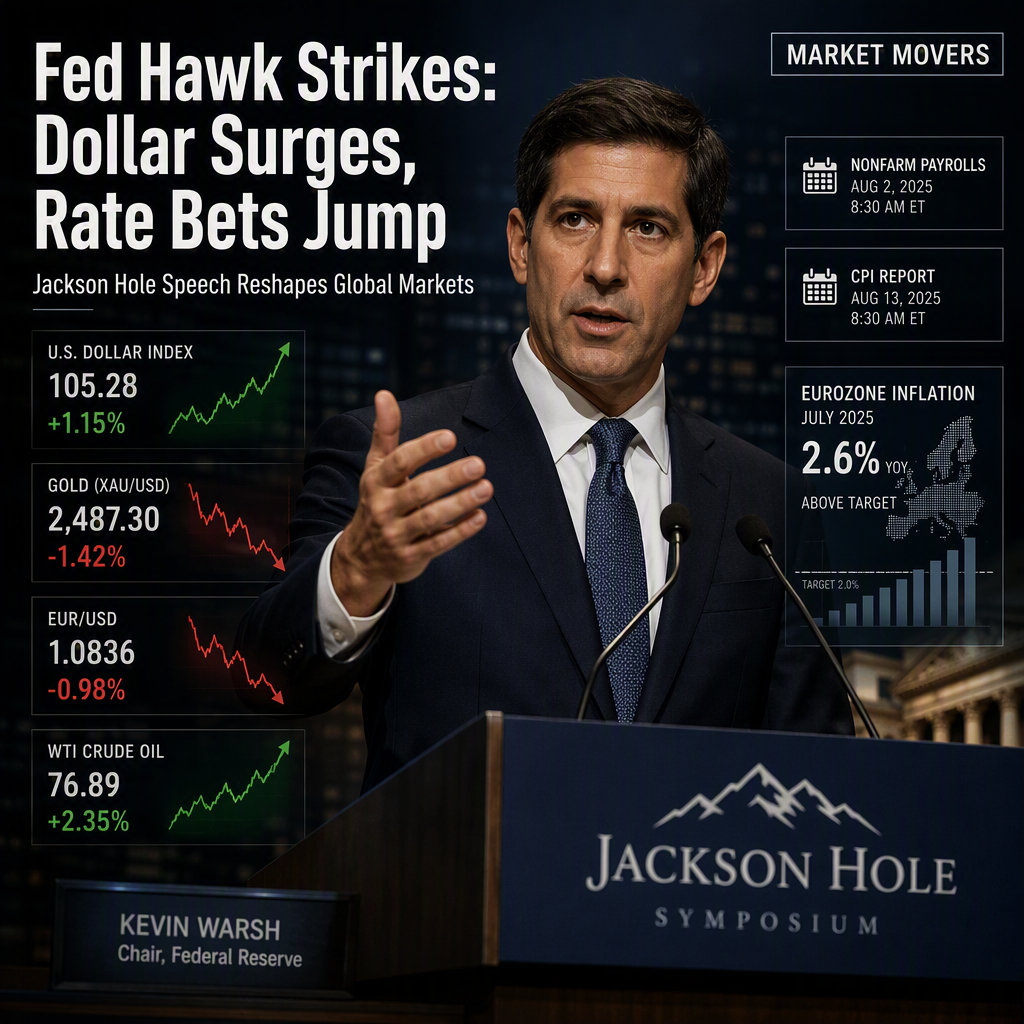
The core event across all sources is Federal Reserve Chair Kevin Warsh's unexpectedly hawkish speech at the Jackson Hole Symposium, which has significantly shifted market expectations for US monetary policy and impacted global financial markets [2][3][5][6]. Warsh emphasized that the Fed still has 'work to do' to bring inflation down to its 2% target, expressing dissatisfaction with recent inflation data and openness to further rate hikes unless underlying inflation improves convincingly [2][3][5][6]. This marked a notable shift from his prior communication strategy and rebuilt his credibility as an inflation fighter, according to Rabobank's Elwin de Groot [6].
Following Warsh's remarks, markets repriced the probability of a September Fed rate hike sharply higher. The CME FedWatch Tool shows odds rising to 61% or 62%, up from 36% or 38% before the speech [2][3][4]. BNY's Geoff Yu notes that the market now expects nearly one and a half cumulative hikes by year end, with the US Dollar strengthening and the curve flattening [5]. Danske Bank strategists and Rabobank analysts highlight that upcoming US economic data, especially the Nonfarm Payrolls (NFP) report on September 4 and CPI on September 11, will be crucial for determining the Fed's next move and shaping market sentiment [2][5][6]. Consensus for NFP is a rebound to 58,000 after last month's -23,000 print, with a strong number likely to validate Warsh's hawkish message [5].
The hawkish Fed repricing has had immediate market implications. The US Dollar rose, exerting pressure on other currencies such as the Euro and New Zealand Dollar [2][4][5]. The Euro remains near 1.1600, weighed down by both Fed hike bets and geopolitical tensions in Iran, where US military strikes and Iranian retaliation have dampened risk appetite [2]. Gold fell about 3.2% on Friday after Warsh's speech, with buyers cautious amid higher rate expectations, though a modest pullback in the Dollar and Treasury yields on Monday lent some support [3]. Meanwhile, higher oil prices—up 3.5% to $85.60 per barrel—add upside risks to inflation as Middle East tensions intensify [3].
In Europe, Brown Brothers Harriman’s Elias Haddad expects Eurozone August headline CPI to accelerate to 3.3% year-on-year, with core inflation steady at 2.5%, supporting ECB tightening expectations [1]. Swaps have nearly fully priced a 25bps ECB rate hike to 2.50% on September 10 and a total of 60bps of tightening over the next twelve months, which Haddad sees as supportive for EUR/USD [1]. German preliminary HICP data for August is expected to show yearly inflation accelerating to 3.1% from 2.8% in July, with mixed regional figures reported [2]. Danske Bank strategists underscore that both US labor data and Eurozone inflation will be central to near-term policy expectations [2].
Rabobank notes that while Warsh's speech lifted near-term rate expectations, longer-dated Treasury yields fell, suggesting investors see reduced policy uncertainty and reinforced commitment to price stability [6]. However, the balancing act remains difficult, as the White House may oppose a hike close to November’s midterms [6].
CONCLUSION
Fed Chair Warsh's hawkish Jackson Hole speech has sharply increased market expectations for a September rate hike, strengthening the US Dollar and impacting global assets. Upcoming US employment and inflation data will be pivotal in confirming or tempering this repricing. Meanwhile, Eurozone inflation and ECB policy remain in focus, with both US and European central bank actions set to drive near-term market direction.