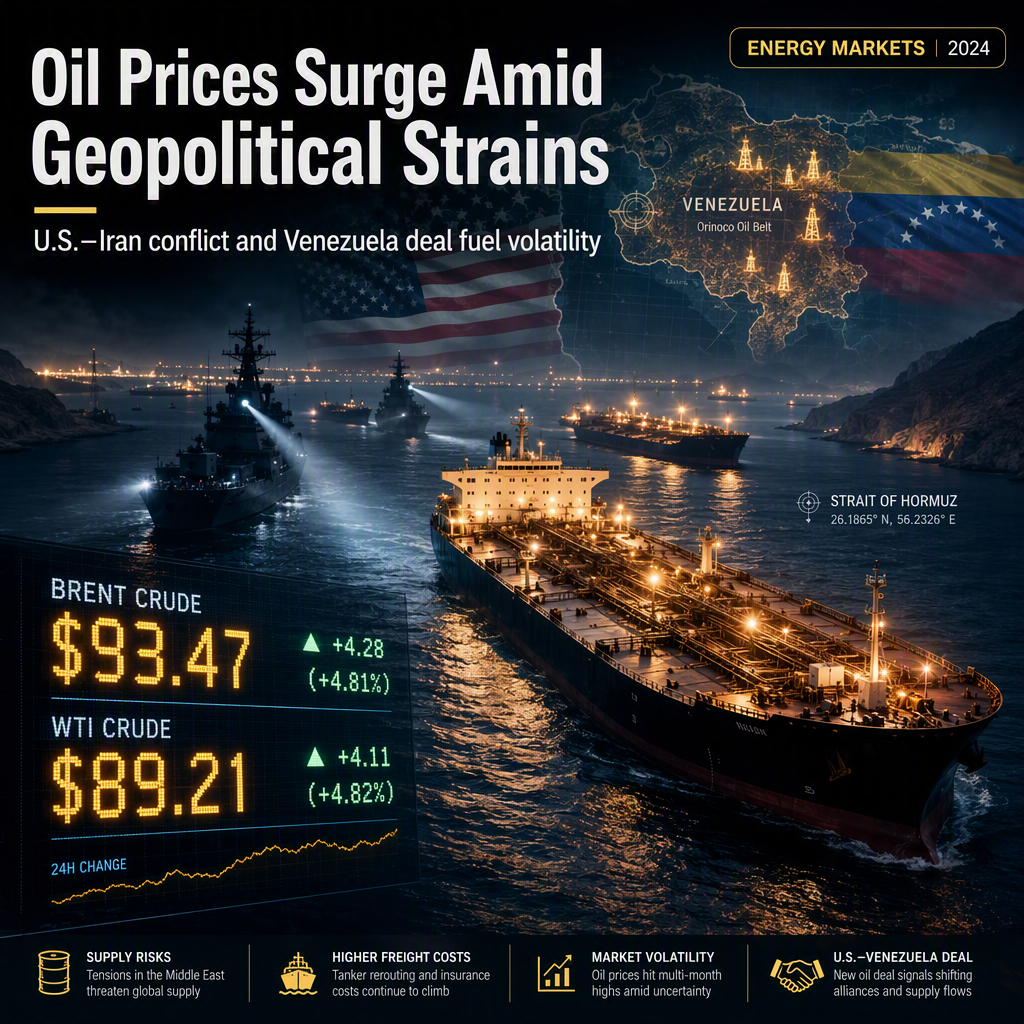
Oil prices are currently supported by escalating geopolitical tensions and a major announcement regarding Venezuelan oil reserves, according to BNY’s Wee Khoon Chong [1]. The U.S. has conducted military strikes against Iranian rocket launchers that were allegedly preparing to deploy mines in the Strait of Hormuz, marking the first such action in over a month. The U.S. Central Command has stated that it is closely monitoring the area and remains prepared to protect commercial shipping through this critical waterway, which is responsible for a significant portion of global oil and LNG flows [1].
Risk sentiment in the market has worsened following a hawkish message from Fed Chair Kevin Warsh at Jackson Hole, compounded by renewed U.S.–Iran exchanges near the Strait of Hormuz and weak Chinese PMI data, which present additional headwinds to global growth [1].
In a separate development, President Trump has announced that the U.S. has reached a deal with Venezuela to secure majority control over more than 65 billion barrels of oil reserves. Trump claimed that the agreement would come at 'no cost' to U.S. taxpayers, would strengthen bilateral ties, and help lower gasoline prices. However, the announcement lacked details regarding legal terms, timing, or implementation, and no official government documentation was provided [1].
These events occur against a backdrop of elevated energy costs and tighter global crude flows. U.S. gasoline prices are reported at approximately $4.09 per gallon, and WTI crude prices have risen sharply since the onset of the conflict with Iran [1].
CONCLUSION
Geopolitical risks in the Strait of Hormuz and the announcement of a U.S.–Venezuela oil deal are providing significant support to oil prices. However, uncertainty remains due to the lack of details on the Venezuela agreement and ongoing global growth concerns. Market participants are likely to remain cautious amid these elevated risks and volatile energy markets.