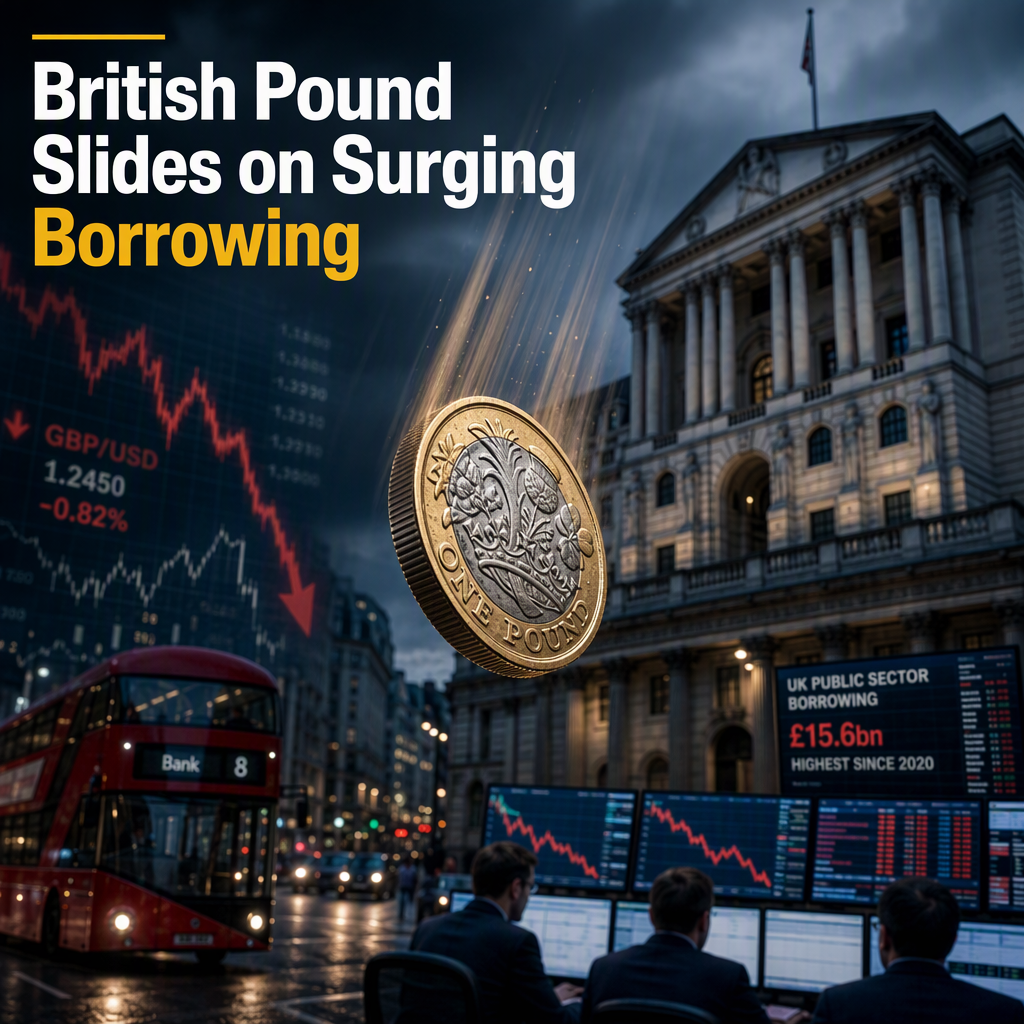
The British Pound (GBP) reversed earlier gains against the US Dollar (USD) on Tuesday after data from the UK National Statistics Office revealed that public sector net borrowing surged to GBP 18.26 billion in August, significantly exceeding the market consensus of GBP 15.70 billion and up from an upwardly revised GBP 2.04 billion in July [1]. This sharp increase in borrowing, which rose by about a fifth compared to August last year, has reignited market concerns about the UK's fiscal position, especially as government income from taxes and other receipts lagged, partly due to inflationary pressures linked to the Middle East war [1].
The GBP/USD pair retreated below 1.3370 from session highs near 1.3390, reflecting the market's negative reaction to the borrowing data, although the pair remained within its recent trading range [1]. The report also noted that government debt stayed below the GBP 3 trillion mark, and as a share of the economy, it was lower than a year earlier [1]. However, the UK public sector has already borrowed GBP 8.1 billion more than the Office for Budget Responsibility’s forecast for the fiscal year, presenting a significant challenge for Chancellor John Healey ahead of next month's budget [1]. With ongoing bond market turmoil, Healey faces limited options if he wishes to avoid raising taxes [1].
Looking forward, ING analyst Francesco Pesole commented that while the Pound has found some support from market expectations of further Bank of England (BoE) tightening, it seems unlikely the BoE will fully meet these expectations. Pesole warned that a 'large dovish repricing should still occur at some point,' suggesting further downside risk for the Pound if the BoE disappoints [1]. Meanwhile, the US Dollar remains supported by the Federal Reserve's recent hawkish stance, and upcoming US economic data could further strengthen the Dollar if it points to robust momentum [1].
Overall, the surge in UK public sector borrowing is viewed as bearish for the GBP, with fiscal concerns and central bank policy uncertainty weighing on the currency [1].
CONCLUSION
The unexpected surge in UK public sector net borrowing has put renewed pressure on the British Pound, highlighting fiscal challenges ahead of the upcoming budget. With market expectations for Bank of England tightening at risk of disappointment and ongoing support for the US Dollar, the outlook for GBP remains cautious.