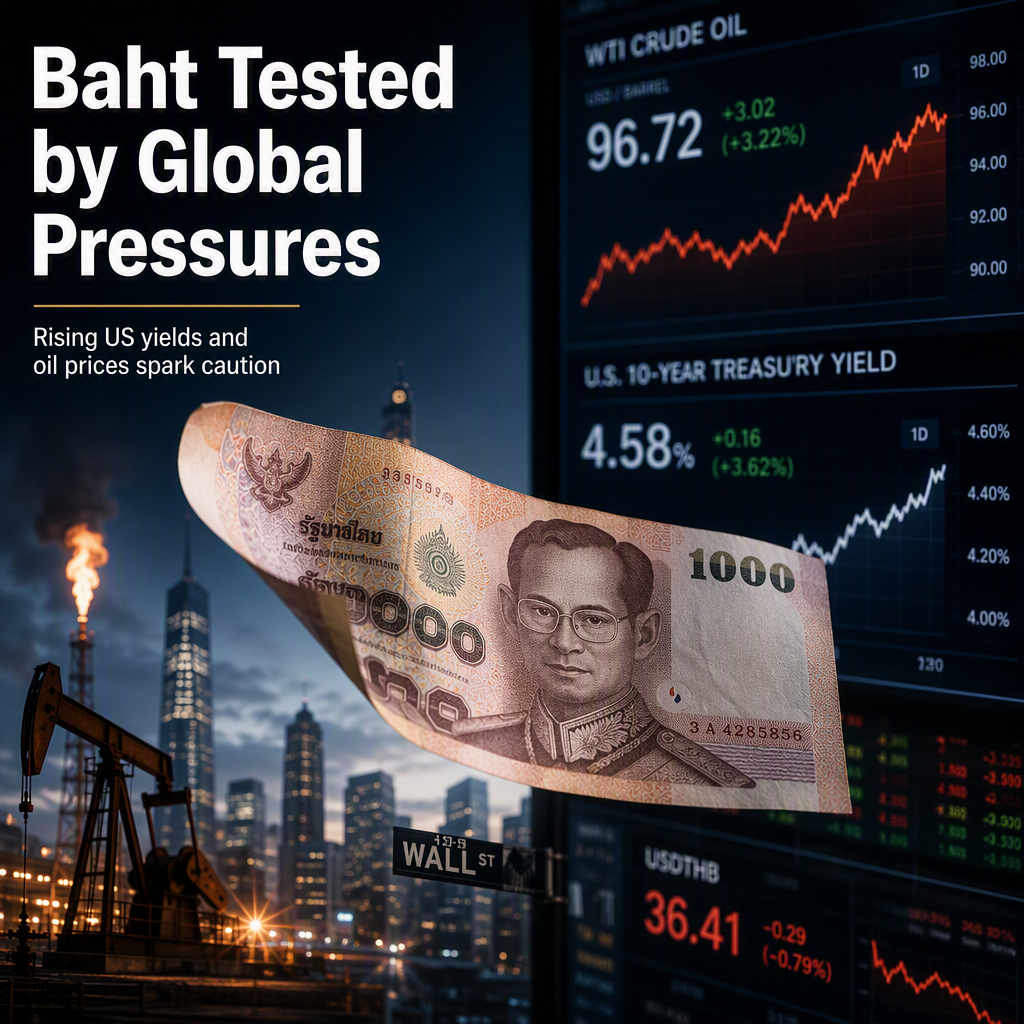
The Thai Baht (THB) has recently shown strength, but OCBC’s Christopher Wong notes that this outperformance may face consolidation as external conditions become less supportive [1]. Governor Vitai’s comments indicate that further rate cuts are unlikely unless another shock occurs, which has tempered market expectations for monetary easing [1].
Several external factors are now weighing on the Baht. Stronger US payroll data released on Friday led to higher US Treasury yields and a stronger US dollar, while also putting downward pressure on gold prices. This combination has removed some of the external and gold-related support that previously benefited the THB [1]. Additionally, elevated oil prices, exacerbated by renewed US–Iran tensions over the weekend, present further challenges. As Thailand is a net energy importer, the Baht remains particularly vulnerable if oil prices remain high [1].
Despite these headwinds, structural trends such as technology sector growth and Foreign Direct Investment (FDI) continue to offer longer-term support for the currency [1]. Technically, the USD/THB last closed at 32.94, with mild bullish momentum on the daily chart showing signs of fading and the Relative Strength Index (RSI) declining [1].
CONCLUSION
The Thai Baht’s recent gains are likely to face near-term challenges due to less supportive external factors, including higher US yields and elevated oil prices. While long-term structural trends remain positive, immediate market sentiment has turned more cautious as the Baht’s outperformance shows signs of fading.