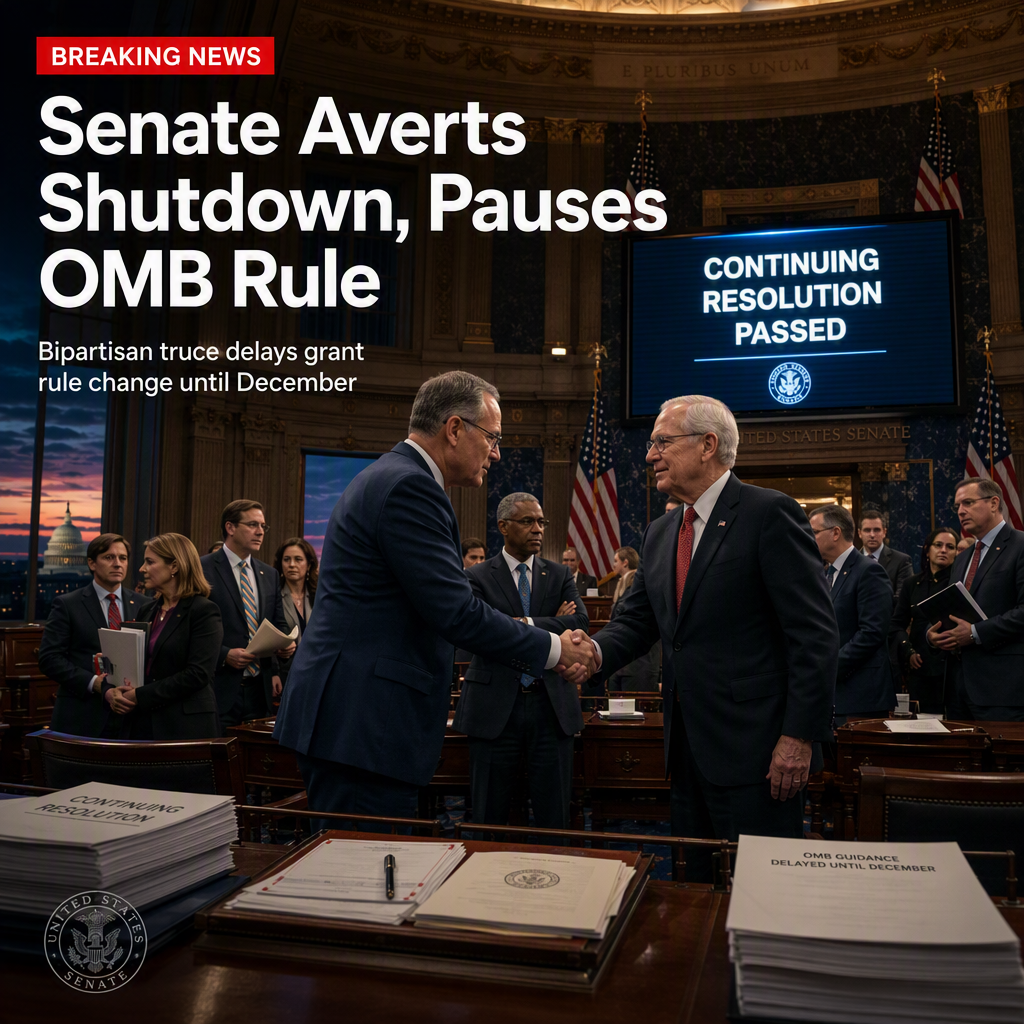
The U.S. Senate advanced a continuing resolution (CR) unanimously on Wednesday, moving a step closer to averting a government shutdown as the midterm elections approach [1]. This procedural move, while not the final vote, signals bipartisan intent to maintain government operations and avoid the uncertainty that has characterized shutdown politics in the past year [1]. The CR was negotiated between the top Republican and Democrat on the Senate Appropriations Committee, reflecting a tenuous but functioning truce between the parties [1].
Senate Minority Leader Chuck Schumer, D-N.Y., claimed the CR as a major victory for Democrats, emphasizing its role in pausing a Trump administration rule change that would give the Office of Management and Budget (OMB) more control over federal grants [1]. Schumer argued that the rule could be used to politically influence which states receive federal funding, citing concerns that identical projects in different states could be treated unequally based on political considerations [1]. If enacted, the CR would delay the OMB rule change until December 11, when the stopgap measure expires [1].
However, Republican Senator John Kennedy, R-La., disputed Schumer's characterization of the outcome, stating that the delay does not amount to a defeat for the White House's plans regarding grant-funded projects [1]. Kennedy noted that the OMB rule could still be implemented after December 11, suggesting that the current agreement merely postpones the administration's efforts rather than halting them entirely [1].
The market implications of the Senate's action are moderate, as the advancement of the CR reduces immediate uncertainty about a government shutdown, which can have broad economic and financial repercussions. However, the temporary nature of the resolution means that the issue could resurface in December, maintaining a degree of uncertainty for markets and stakeholders [1].
CONCLUSION
The Senate's unanimous advancement of the continuing resolution signals bipartisan intent to avoid a government shutdown and temporarily halts a contentious OMB rule change. While Democrats claim a victory in pausing the rule, Republicans emphasize that the administration's plans could proceed after December 11. The measure reduces short-term uncertainty but leaves the issue unresolved for the longer term.