
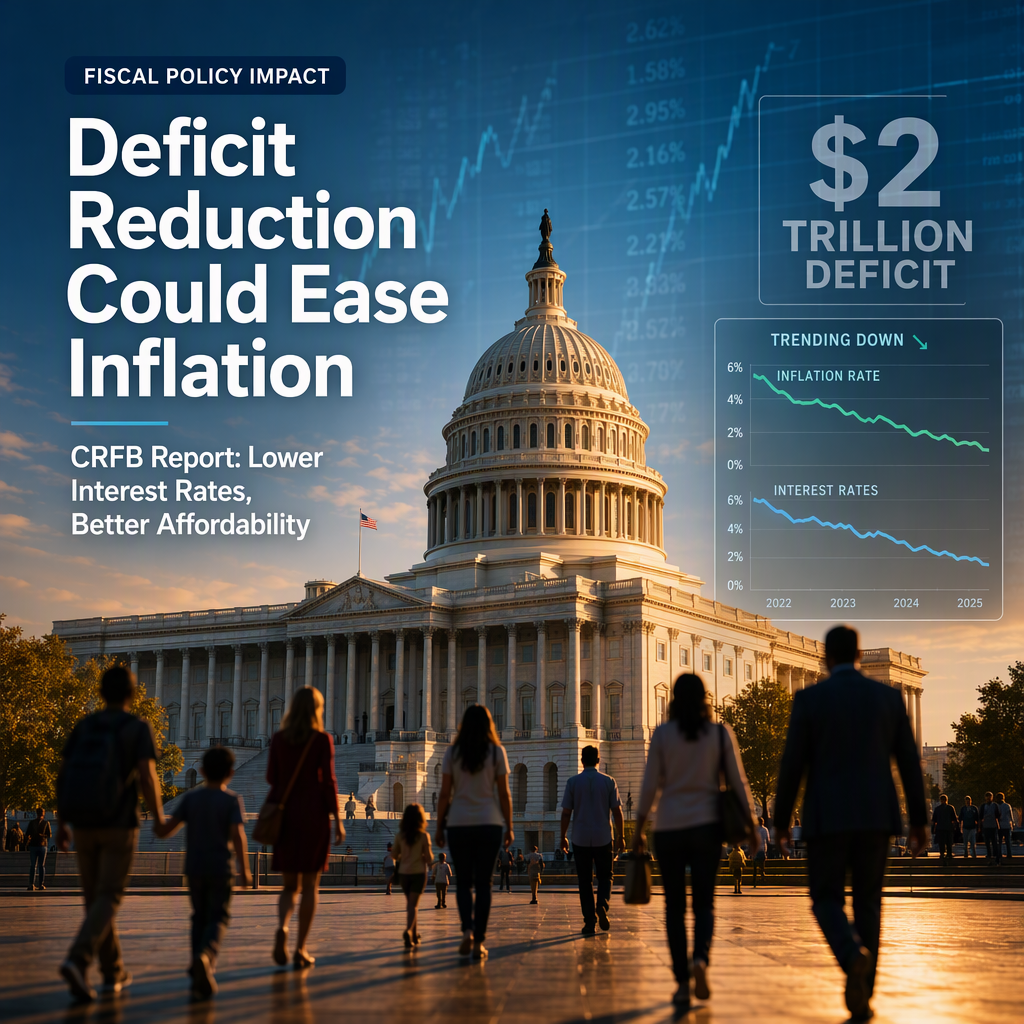
The Committee for a Responsible Federal Budget (CRFB) released a report on Wednesday analyzing the impact of reducing the federal government's approximately $2 trillion budget deficit on American households and the broader economy [1]. According to the CRFB, deficit reduction could improve affordability by tempering inflation, lowering interest rates, reducing cost pressures from government policies, boosting private investment, and preventing future affordability crises related to the insolvency of Social Security and Medicare [1]. The report emphasizes that while fiscal policy alone cannot solve all affordability challenges, responsible fiscal policy can play a significant role alongside monetary policy, regulation, and other policy areas [1].
The federal government is currently running a roughly $2 trillion budget deficit this fiscal year [1]. The CRFB warns that expansionary fiscal policy—such as subsidies, tax cuts, or spending measures financed by borrowed funds—may worsen affordability challenges over time by increasing inflation, interest rates, and the cost of subsidized goods and services [1]. In contrast, fiscal policies aimed at deficit reduction, including higher taxes or limited federal spending and transfers, can help reduce excessive consumer spending and inflationary pressures [1].
Inflation has remained above the Federal Reserve's 2% target for five-and-a-half years and is currently about 3.4% year over year [1]. Lowering inflation could give the central bank room to reduce short-term interest rates [1]. The CRFB report notes that deficit reduction lowers interest rates through two channels: first, by reducing inflationary pressure, making it easier for the Federal Reserve to cut short-term rates; and second, by lowering the stock of debt, which reduces the interest rates the Treasury must offer on long-term debt to attract buyers [1]. The Congressional Budget Office (CBO) estimates that every 1 percentage point reduction in the debt-to-GDP ratio lowers interest rates by about 2 basis points, and current interest rates are approximately 1.5 percentage points higher than they would be if the U.S. debt-to-GDP ratio had remained at 2001 levels [1].
Healthcare costs, particularly within programs like Medicare and Medicaid, are highlighted as a key area where government reforms could reduce costs for both the government and consumers [1].
CONCLUSION
The CRFB report underscores that reducing the federal deficit could help lower inflation and interest rates, improving affordability for American households. While fiscal policy is not the sole solution, responsible deficit reduction measures could have meaningful market and economic impacts. The current high deficit and elevated inflation suggest that policy changes may be necessary to ease cost pressures and support future economic stability.