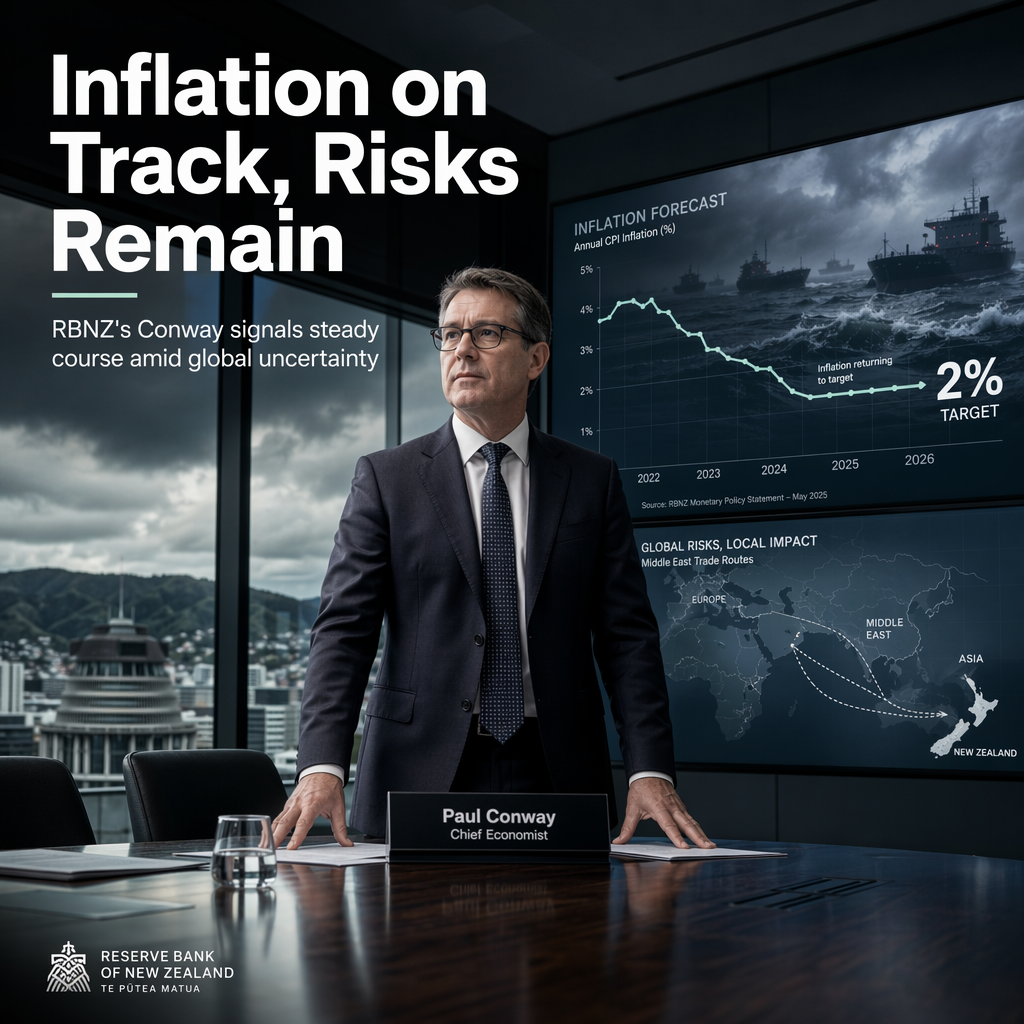
Reserve Bank of New Zealand (RBNZ) Chief Economist Paul Conway stated that the central bank is not currently discussing a shift to a tightened policy stance, emphasizing that inflation is expected to return to 2% over the medium term [1]. Conway highlighted that the ongoing Middle East conflict is complicating monetary policy, similar to other supply shocks, and noted that while oil prices have declined, the effects of these shocks are expected to linger in the economy [1]. He also mentioned that recent developments in the Middle East present upside risks to the September quarter forecast [1].
Conway stressed the importance of firm responses to cost shocks in maintaining low and stable inflation, and indicated that medium-term inflation expectations remain firmly anchored [1]. He suggested that extra capacity in the economy is likely to curb the pass-through of cost increases, and that additional easing of monetary stimulus may be needed [1]. The RBNZ's Monetary Policy Committee reached a consensus last week, and no vote was required on policy direction [1]. Conway reiterated that the central bank will act if inflation stemming from the Middle East conflict proves persistent [1].
On the economic data front, Conway noted that recent PMI data has been upbeat, which has led to an upward revision in the RBNZ's GDPNow projection [1]. In terms of market reaction, the NZD/USD currency pair was down 0.09% on the day, trading at 0.5756 at the time of reporting [1].
CONCLUSION
RBNZ Chief Economist Paul Conway reaffirmed the central bank's expectation for inflation to return to 2% over the medium term, despite ongoing supply shocks from the Middle East. The RBNZ is not considering a tighter policy stance at this time, and the market response has been modest, with the NZD/USD slightly lower.