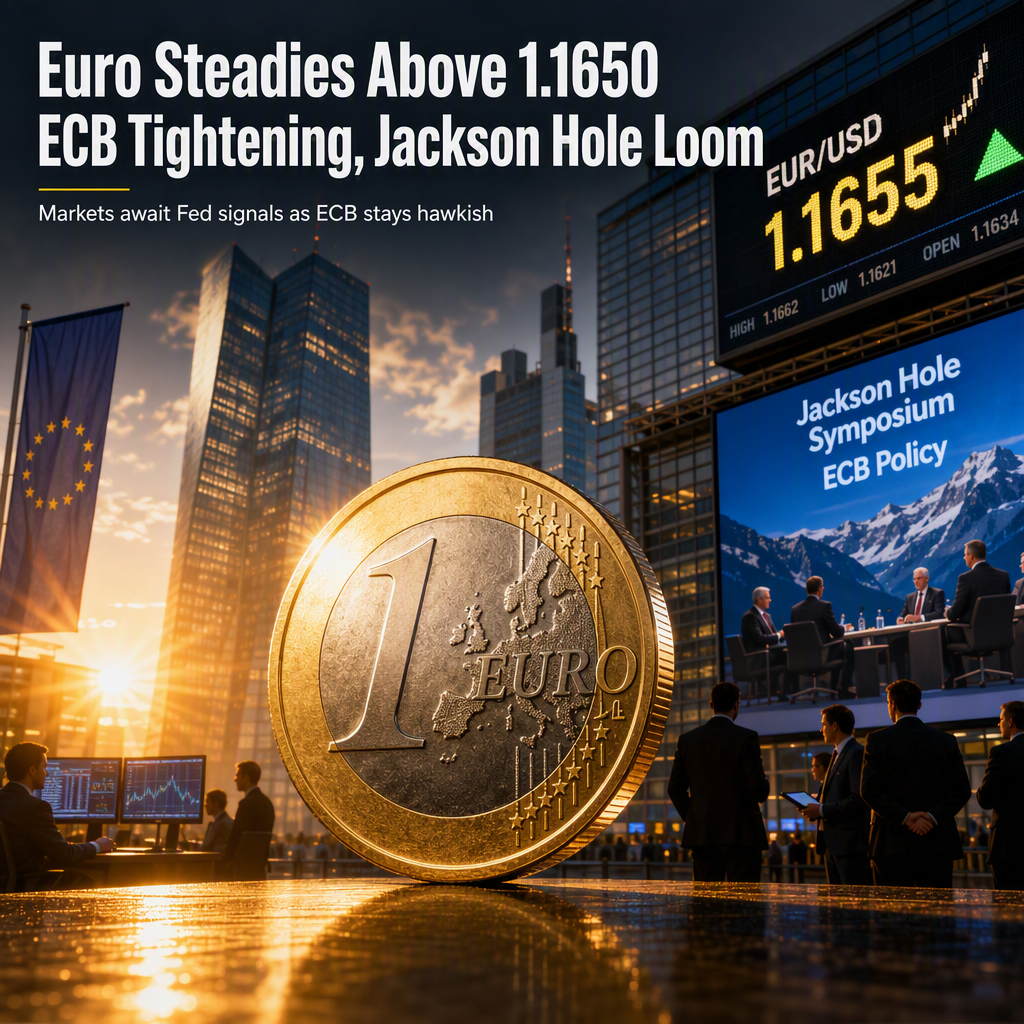
The EUR/USD pair posted modest gains near 1.1655 during the early Asian session on Friday, supported by a hawkish stance from the European Central Bank (ECB) and robust economic data from the Eurozone [1]. ECB Executive Board member Isabel Schnabel stated that borrowing costs will need to rise further, citing upside risks to inflation from the ongoing Middle East conflict and a surprisingly strong Eurozone economy [1]. Recent data showed Eurozone business activity growing at its fastest pace this year, reinforcing expectations for tighter ECB policy [1]. Markets are now pricing in nearly 96% odds that the ECB will increase the deposit rate to 2.50% at its September policy meeting, according to the ECB Watch tool [1].
Attention is also focused on the upcoming keynote address by Federal Reserve Chairman Kevin Warsh at the Jackson Hole Economic Policy Symposium. Market participants are looking for signals on the future path of US monetary policy. According to Mark Cabana, head of U.S. rates strategy at Bank of America, Warsh may indicate a willingness to raise rates again if inflation does not moderate, but a focus on broader structural themes could be interpreted as dovish by markets [1].
Strategists at Scotiabank observed that the Euro has lost some traction due to shifting yield dynamics, particularly the latest turn in German-US yield spreads. However, they maintain that policy divergence remains a constructive medium-term driver for the Euro, as the ECB is expected to tighten policy in September while markets reduce expectations for further Fed hikes [1].
From a technical perspective, EUR/USD retains a bullish near-term bias, holding above both the 100-day simple moving average (SMA) and the 20-day Bollinger middle band. The Relative Strength Index (14) around 65 suggests firm but not extreme upside momentum, indicating that buyers still control the short-term tone. Key support is seen in the 1.1585–1.1575 area, with stronger demand near 1.1465, while a break above the upper Bollinger band resistance at 1.1710 could open the door for further gains [1].
CONCLUSION
The Euro remains supported above 1.1650 on expectations of ECB tightening and resilient Eurozone data, while markets await potential policy signals from the Jackson Hole Symposium. The medium-term outlook for the Euro is constructive, though yield dynamics and upcoming Fed commentary could influence near-term direction.