
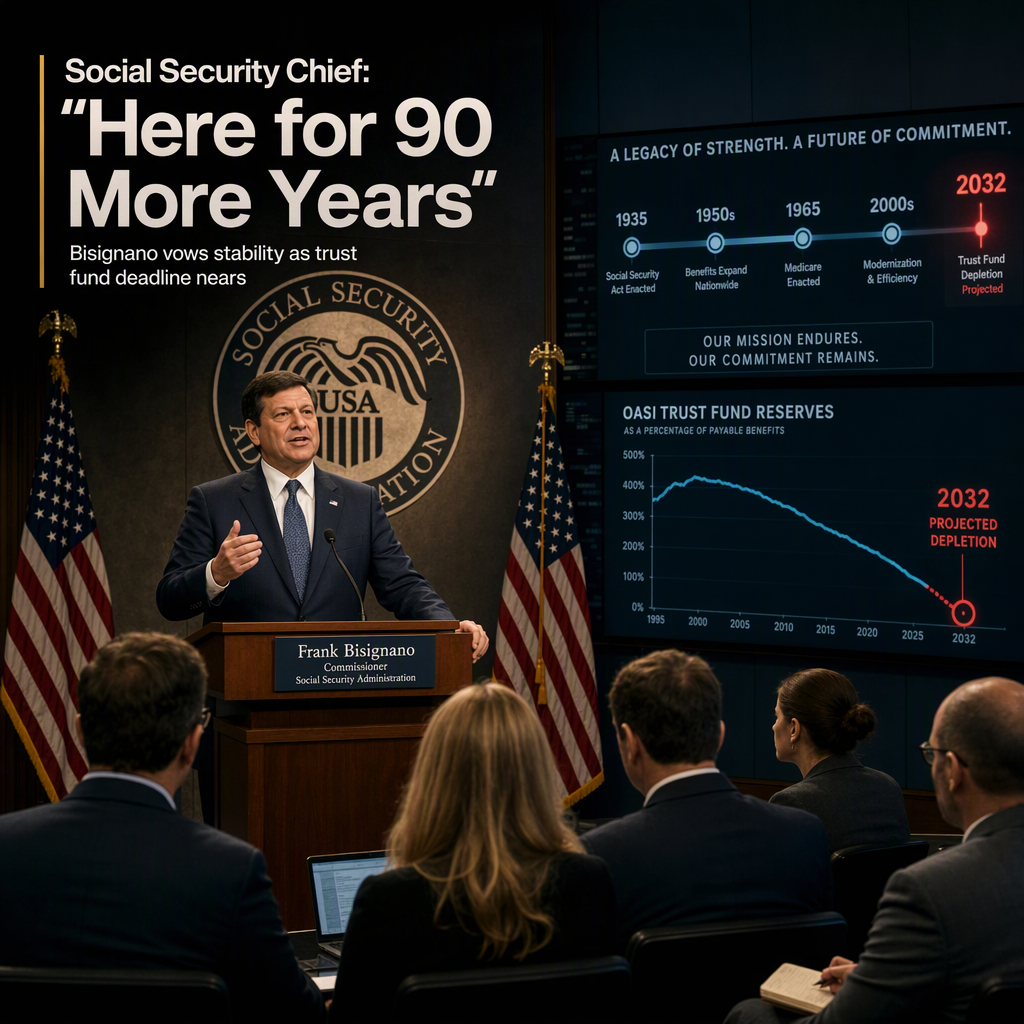
Social Security Administration Commissioner Frank Bisignano stated in a CNBC interview that the Social Security program will 'be around for another 90 years,' despite the main trust fund approaching insolvency [1]. Bisignano, who also serves as IRS CEO and is one of the trustees of Social Security's trust funds, emphasized the administration's commitment to protecting and preserving the program, citing President Biden's mandate to do so [1].
Bisignano acknowledged ongoing financial challenges, noting that Social Security's main trust fund is projected to reach insolvency in 2032, which would trigger automatic benefit cuts [1]. According to the latest trustees' report, once the trust fund is depleted, Social Security would only be able to pay 78% of scheduled benefits, resulting in an estimated 22% cut for beneficiaries starting in late 2032 [1]. The Congressional Budget Office (CBO) projects an even larger average benefit cut of 28% per year from 2033 to 2036, though it notes that the process for implementing these cuts is not outlined in federal law and could have varying economic and budgetary impacts [1].
Bisignano discussed efforts to improve the program's administration, including correcting erroneous records, with about 10% of the 30 million incorrect records already addressed [1]. When asked about potential reforms such as raising the retirement age, Bisignano declined to discuss specific changes to benefits or taxes, stating that such decisions would ultimately involve the White House, Congress, and the trustees [1].
The Social Security program, established in 1935 and operational since 1937, continues to face financial pressure due to changing U.S. demographics [1]. The upcoming announcement of the 2027 cost-of-living adjustment (COLA) for Social Security benefits is expected later this week, following the latest inflation data [1].
CONCLUSION
Commissioner Bisignano expressed confidence in the long-term viability of Social Security, despite projections of trust fund insolvency and potential benefit cuts beginning in 2032. The administration remains focused on program integrity and awaits further decisions from policymakers regarding reforms.