
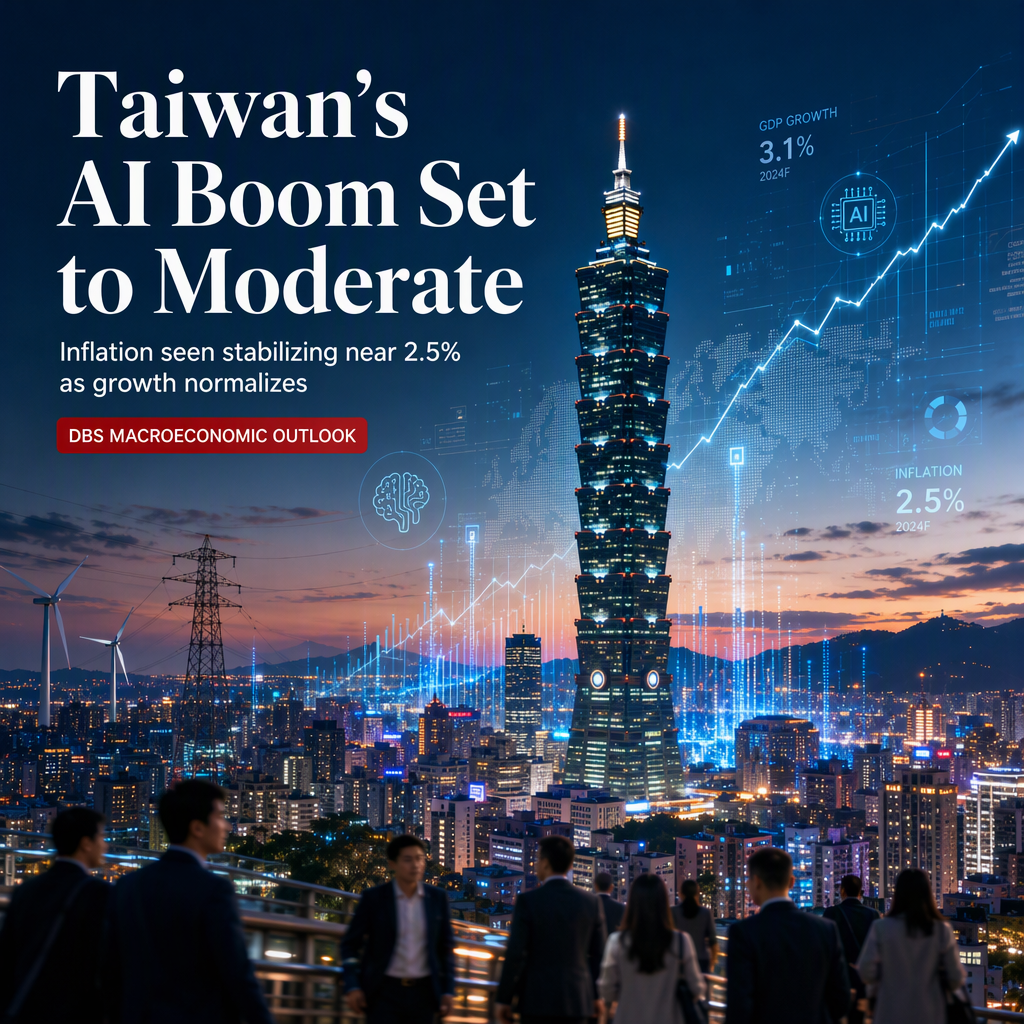
DBS Group Research economist Ma Tieying has provided an updated macroeconomic outlook for Taiwan, emphasizing the significant role of the AI cycle in driving recent economic growth. According to DBS, Taiwan's GDP growth is expected to remain robust at around 12% year-on-year in the third quarter, closely matching the 12.9% recorded in the second quarter but below the 15.4% peak seen in the first quarter of the year. However, growth is projected to moderate to a high-single-digit pace starting from the fourth quarter onward, with full-year GDP growth forecasts set at 11.6% for 2026 and 5.6% for 2027 [1].
On the inflation front, headline CPI inflation has remained elevated, reaching 2.4% year-on-year in the third quarter, up from 1.2% in the first quarter and 2.2% in the second quarter. DBS maintains its forecast for headline CPI to stay close to 2.5% in the fourth quarter, with full-year projections at 2.0% for 2026 and 2.1% for 2027 [1].
The report highlights that Taiwan has managed the complex global environment effectively this year, benefiting from strong AI exports and investment, diversified energy imports, and measures to absorb higher upstream energy costs. Looking ahead, DBS anticipates some normalization in 2026–2027 as the AI-driven growth boost moderates and domestic energy prices face increased pressure to adjust [1].
No specific market reactions or analyst opinions beyond the DBS forecast are mentioned in the article.
CONCLUSION
DBS forecasts indicate that while Taiwan's AI-driven economic growth will remain strong in the near term, a moderation is expected from late 2026 onward. Inflation is projected to stabilize near 2.5%, with energy prices and AI sector dynamics being key factors to watch. The overall outlook remains positive but signals a shift toward more normalized growth rates.