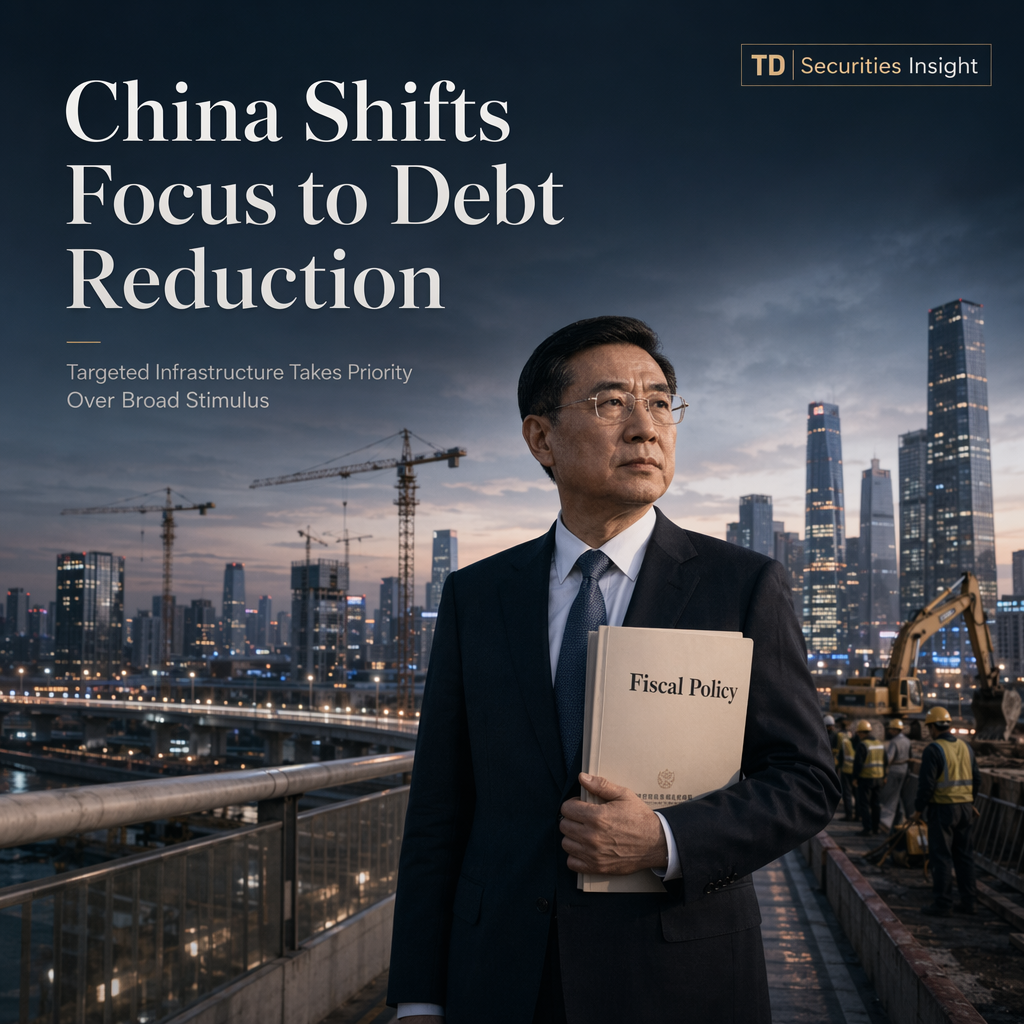
According to TD Securities’ Senior Asia Economist Alex Loo, China’s fiscal policy is becoming more austere as local governments shift their focus from stimulating economic growth to cleaning up debt. The report indicates that significant fiscal support in the second half of 2026 is unlikely unless GDP growth falls towards the 4.0–4.2% range, compared to TD Securities’ current forecast of 4.6% for 2026 [1].
The analysis highlights that policy support is expected to manifest through accelerated infrastructure execution rather than large-scale new stimulus measures. Specifically, the likely policy response includes quicker local bond issuance, faster project approvals, and some relaxation by the Ministry of Finance (MoF) on infrastructure project scrutiny. Additionally, a modest 10 basis point rate cut by the People’s Bank of China (PBoC) is possible in late Q3 [1].
TD Securities notes that a weak Q2 GDP print in the low-4% range, expected next week, could trigger speculation about new stimulus from authorities. However, the report suggests that the government will likely emphasize faster infrastructure build-out by local governments, as the sharp decline in investment was the main drag on first-half growth and contradicts the priority to 'boost domestic demand.' This approach is expected to involve quicker local fundraising and project deployment, rather than new fiscal funding [1].
Overall, the report underscores continued conservatism from the Ministry of Finance and limited fiscal support, with policy adjustments focused on infrastructure and modest monetary easing rather than broad-based stimulus [1].
CONCLUSION
China’s fiscal policy is expected to remain constrained, with authorities prioritizing debt reduction over major stimulus unless growth slows significantly. Market participants should anticipate targeted infrastructure measures and modest monetary easing, rather than large-scale fiscal intervention.