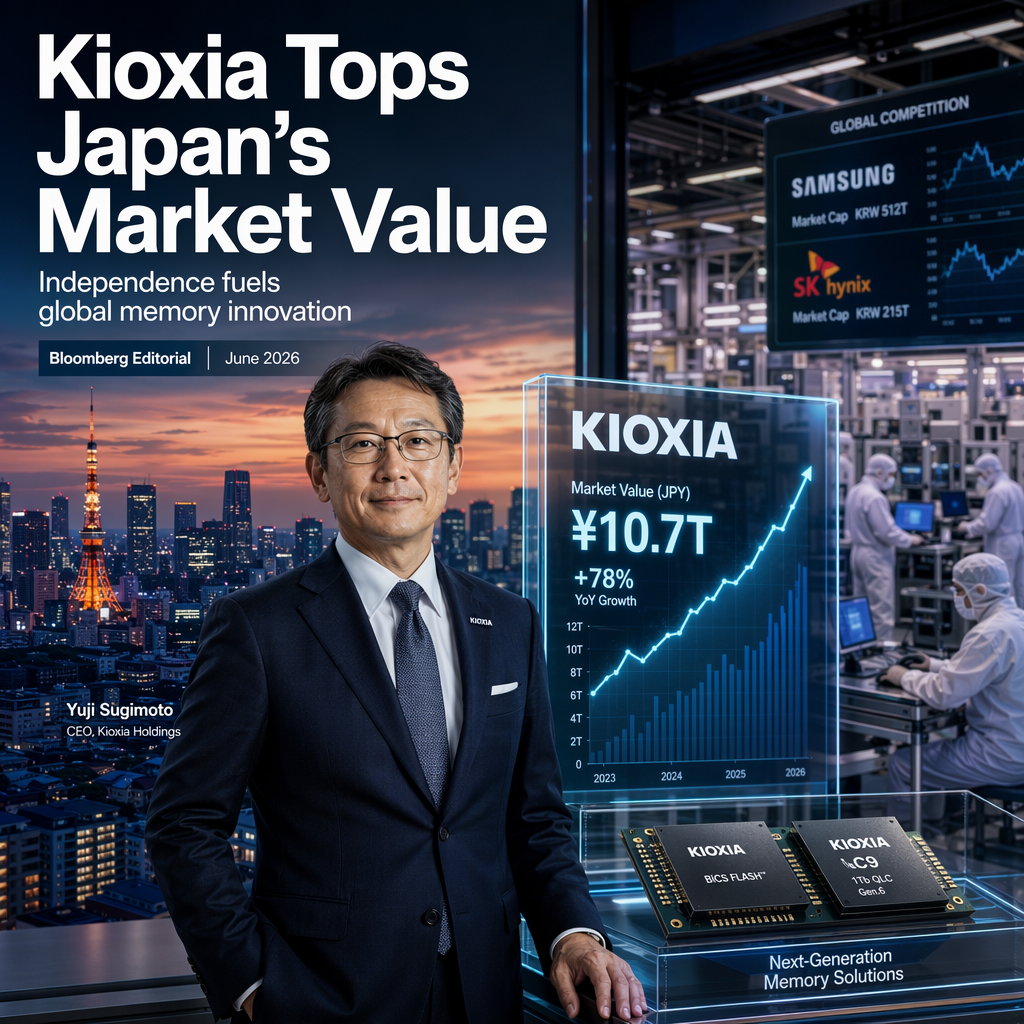
Kioxia Holdings, a memory maker formerly a unit of Toshiba, became the largest Japanese company by market capitalization in June 2026, marking a significant transformation since its acquisition by Bain Capital in 2018 [1]. Yuji Sugimoto, Bain Capital's representative in Japan and leader of the acquisition, emphasized that Kioxia's independence was crucial for its growth, stating, 'Kioxia of today wouldn't exist if it had remained under Toshiba' [1]. The company has pursued its own strategies, including major investments in advanced memory technologies and expanding its global footprint, enabling it to compete effectively with industry leaders such as Samsung and SK Hynix amid soaring demand for AI and data storage [1].
Sugimoto attributed Kioxia's market-leading status to its ability to make swift decisions and invest aggressively in research and development, actions that would have been difficult within Toshiba's broader corporate structure [1]. He highlighted the importance of agility in the memory industry, where rapid technological advances and shifting competitive dynamics are the norm [1]. Kioxia's focus on technological innovation, including the development and shipping of next-generation memory products, has kept it at the forefront of the market, even as the gap between competitors narrows [1].
Despite the current AI-driven memory boom, Sugimoto noted Kioxia's cautious approach to capital expenditure, balancing growth opportunities with prudent financial management to maintain profitability and avoid overextending in a volatile market [1]. The company's transformation is viewed as a case study in how independence and focused management can unlock potential in high-tech sectors [1]. Sugimoto concluded that Kioxia's journey demonstrates the possibilities when a company is given the freedom to pursue its vision [1].
CONCLUSION
Kioxia's rise to become Japan's most valuable company underscores the benefits of independence and agile management in the competitive memory industry. Investor confidence is reflected in its market capitalization, driven by strategic investments and prudent financial decisions. The company's approach positions it well for continued leadership amid technological shifts and growing demand for AI and data storage.